BOHOL, Philippines — Bohol is preparing an ambitious international tourism offensive for 2027, targeting travelers from South Korea, China, Japan, Taiwan, Europe, Australia and North America as the province seeks to strengthen its position among the Philippines’ leading island destinations.
The campaign, branded Visit Bohol 2027, aims to attract more foreign visitors, strengthen international air connections and generate greater economic opportunities for resorts, hotels, restaurants, transportation providers and local tourism businesses.
But the province’s ambitions face a critical challenge: turning overseas interest into actual tourist arrivals through stronger airline partnerships, competitive travel packages and sustainable destination development.
The Bohol provincial government, led by Governor Erico Aristotle “Aris” Aumentado, is working with the Department of Tourism (DOT), private tourism stakeholders and Aboitiz InfraCapital Bohol Airport Corporation, which operates Bohol-Panglao International Airport, to develop a coordinated tourism marketing strategy.
The initiative signals a push to transform Bohol from a destination relying heavily on established markets into one capable of attracting a broader international audience.
South Korea and China Lead Bohol’s Tourism Strategy
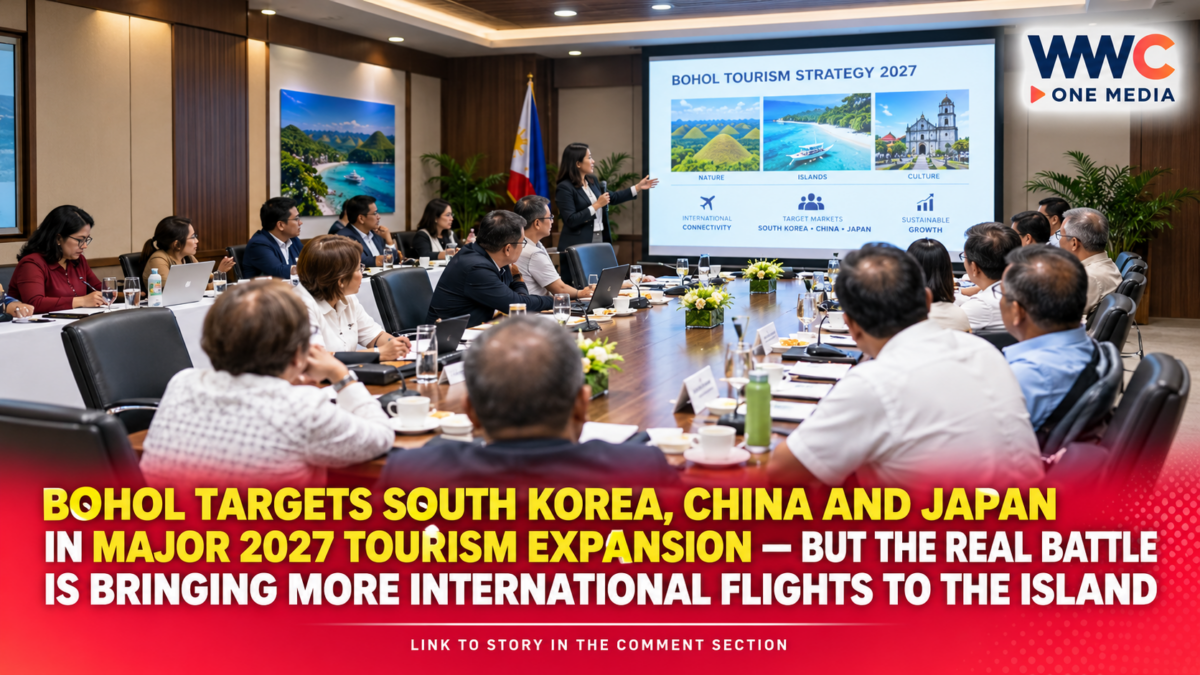
During the Bohol Tourism Marketing Workshop held on October 7, 2026, tourism officials and private stakeholders identified several international markets that could drive the province’s next stage of growth.
South Korea and China were designated as Bohol’s core tourism markets.
Japan and Taiwan were identified as growth markets, while Europe was recognized as an important source of travelers who may stay longer and explore multiple destinations within the province.
Australia and New Zealand were classified as emerging markets, while North America was identified as a source of balikbayan visitors, particularly Filipinos living overseas who return to the Philippines for vacations and family visits.
The market segmentation is intended to help tourism operators create more targeted travel packages rather than promote identical holiday experiences to every international audience.
For example, visitors from nearby Asian markets may be attracted by shorter beach holidays and convenient flight connections, while European travelers could be offered longer itineraries combining nature, diving, cultural attractions and community-based tourism.
These are marketing opportunities rather than guarantees of visitor growth.
Aboitiz InfraCapital and Bohol Government Join Forces
Aboitiz InfraCapital is playing an important role in the province’s tourism expansion efforts through its management of Bohol-Panglao International Airport.
The airport operator is collaborating with local officials, airlines, hotels, tour operators and government agencies to identify markets with the strongest potential for new travel demand.
Governor Aumentado has emphasized that tourism development requires cooperation across the entire industry, not simply government advertising campaigns.
The October 7 workshop brought together representatives from the DOT in Central Visayas, the Bohol Association of Hotels, Resorts and Restaurants, the Bohol Association of Tour Operators, airlines, transportation organizations and local tourism offices.
Tourism stakeholders examined visitor arrival information, market research and opportunities to strengthen Bohol’s competitiveness internationally.
The provincial government also committed to supporting promotional funding and exploring incentives for charter flights, subject to the necessary approvals.
However, no specific approved budget or finalized incentive package was disclosed in the October 12 report.
Visit Bohol 2027: A New Campaign to Attract Foreign Travelers
Visit Bohol 2027 will serve as the province’s central destination marketing campaign, supported by the complementary “Step Into Wonder” branding.
The strategy seeks to present Bohol as more than a traditional beach destination.
Tourism operators are being encouraged to develop market-ready accommodation rates, travel packages, visitor experiences and other promotional offerings that can be presented to international travel agencies and prospective visitors.
The province is also preparing a coordinated marketing calendar covering tourism promotions, travel industry partnerships and influencer-led campaigns.
Among the immediate priorities for October and November 2026 are finalizing campaign activities, securing funding arrangements and identifying promotional opportunities ahead of the 2027 tourism season.
The goal is to align airlines, airport operators, travel agencies, hotels and local tourism businesses behind a common international marketing strategy.
Japan Charter Flight Shows Bohol’s International Potential
Bohol’s campaign follows an important aviation milestone earlier this year.
On May 2, 2026, the province welcomed its first direct charter flight from Japan, arriving at Bohol-Panglao International Airport from Narita International Airport aboard Cebu Pacific flight 5J8811.
The Philippine Information Agency reported that the flight brought 163 Japanese visitors and was organized through JTB Asia Pacific Corporation with support from local tourism stakeholders.
The Bohol provincial government separately reported 164 arrivals. The small discrepancy between the two official accounts does not change the significance of the charter operation.
The flight demonstrated the potential for coordinated promotions and airline partnerships to bring visitors directly to Bohol without relying entirely on connecting flights through other Philippine gateways.
However, a successful charter operation does not automatically establish a permanent scheduled international route.
Airlines must still assess passenger demand, profitability, aircraft availability and operational requirements before committing to regular service.
Airport Connectivity Could Decide Bohol’s Tourism Future
Bohol-Panglao International Airport has become increasingly important to the province’s tourism strategy.
Aboitiz InfraCapital is pursuing a broader airport and tourism development program intended to improve connectivity and attract more travelers.
In October 2026, InsiderPH separately reported that Aboitiz InfraCapital and the Bohol provincial government had developed a tourism growth framework involving sales missions, trade exhibitions, destination marketing and new tourism products.
The initiative included a 90-day action plan and longer-term strategies to help build demand for the province.
Improved direct flight access could make Bohol more attractive to international travelers who would otherwise need additional domestic transfers.
It could also benefit resorts, restaurants, transportation businesses and tourist attractions by encouraging visitors to choose Bohol as their principal Philippine holiday destination.
But increased airline capacity must be matched by sufficient accommodations, reliable transportation and competitive visitor experiences.
₱500 and ₱1,000 Flight Discounts Aim to Stimulate Travel
As part of its efforts to encourage bookings, Bohol-Panglao International Airport partnered with online travel platform Trip.com to introduce promotional flight discount vouchers beginning October 1, 2026.
The promotional offers include:
- ₱500 discount vouchers for eligible domestic flights.
- ₱1,000 discount vouchers for eligible international flights.
The discounts are intended to encourage more travelers to consider Bohol for their vacations, including trips around the November 16–18 special nonworking days in Metro Manila associated with the 49th ASEAN Summit and related meetings.
The partnership provides an existing online travel booking platform to support the province’s marketing campaign.
Travelers should check Trip.com’s applicable booking conditions, availability and promotional restrictions before making reservations.
Bohol Tourism Generates ₱14.3 Million in Travel Mart Sales
Bohol has already recorded encouraging results from its participation in domestic tourism promotions.
According to the Bohol Provincial Tourism Office, the province generated approximately ₱14.3 million in sales during the 37th Philippine Travel Mart, held from September 4 to 6, 2026, at the SMX Convention Center in Pasay City.
The event brought together travel companies, accommodation providers, destination marketing organizations and tourism industry representatives.
Bohol promoted its natural attractions, cultural experiences and tourism packages as part of its preparations for Visit Bohol 2027.
The reported sales figure represents transactions or bookings attributed to the travel mart, not the province’s total annual tourism revenue.
Nevertheless, the result highlights continuing interest in Bohol’s tourism products and the potential value of coordinated promotions.
UNESCO Global Geopark Status Gives Bohol a Competitive Advantage
One of Bohol’s strongest international selling points is its designation as the Philippines’ first UNESCO Global Geopark.
The recognition highlights the province’s geological heritage, biodiversity, natural landscapes and opportunities for sustainable tourism.
Bohol’s attractions include the internationally known Chocolate Hills, Panglao’s beach resorts, diving destinations, countryside experiences and historic cultural sites.
The province’s tourism strategy increasingly emphasizes connecting these experiences into longer itineraries that allow visitors to explore destinations beyond the traditional beach tourism circuit.
Officials have also discussed developing tourism routes linking Bohol with other popular Philippine destinations, including Siargao and Boracay.
Such connections could make it easier for international travelers to combine several destinations within one Philippine vacation.
However, expanding visitor numbers brings responsibilities involving environmental protection, infrastructure capacity and the preservation of local communities.
Bohol’s ability to maintain its natural appeal will be central to its long-term tourism competitiveness.
Philippines Pushes Visa Reforms to Attract Asian Visitors
Bohol’s international expansion strategy also comes as the national government pursues policies intended to improve access for overseas travelers.
In a recent tourism policy update, the Department of Tourism said it was working with the Department of Foreign Affairs on visa reforms and expanded entry arrangements.
Among the proposals is extending visa-free access for eligible Chinese travelers to additional Philippine entry points, including Tagbilaran.
Taiwanese travelers already benefit from a 14-day visa-free entry arrangement under the policy cited by the DOT.
Separately, Governor Aumentado discussed the possibility of a visa-upon-arrival arrangement for Bohol with national tourism officials in May 2026.
However, the proposal should not be confused with an approved or implemented visa-on-arrival program.
Any changes to immigration entry requirements would depend on national government authorization and applicable regulations.
Improving entry convenience could strengthen Bohol’s appeal in international markets, particularly when combined with direct flights and competitive holiday packages.
More Tourists Could Mean More Jobs and Business Opportunities
A successful Visit Bohol 2027 campaign could provide benefits throughout the province’s tourism economy.
Hotels and resorts could benefit from increased occupancy, while local restaurants, tour operators, transport providers, souvenir businesses and tourist attractions could experience greater demand.
Longer visitor stays may also increase spending on accommodation, dining and recreational activities.
However, these benefits will depend on actual visitor arrivals, average tourist expenditure, seasonal demand and the ability of local businesses to participate in tourism growth.
The province’s challenge will be to ensure that smaller enterprises and communities benefit alongside major hospitality operators.
The Bigger Question: Can Bohol Compete With Asia’s Top Island Destinations?
Bohol’s international tourism campaign comes at a time when island destinations across Southeast Asia are competing aggressively for travelers.
Destinations in Thailand, Indonesia, Vietnam and other regional markets offer extensive airline connections, established tourism infrastructure and diverse holiday experiences.
For Bohol, natural beauty alone may not be enough to secure a larger share of international tourism.
The province must convince airlines to provide reliable access, encourage tour operators to sell attractive packages and deliver a visitor experience that encourages repeat visits.
The Visit Bohol 2027 campaign is an opportunity to bring these elements together.
But its success will ultimately be measured by sustained arrivals, greater tourism spending, improved connectivity and benefits for local communities — not simply by the number of countries targeted in marketing promotions.
Bohol’s next tourism breakthrough may depend on whether it can transform its international reputation into direct airline routes, longer visitor stays and lasting economic opportunities.
With South Korea, China, Japan, Taiwan and other overseas markets now in its sights, the province is making an ambitious bid for a larger share of Asia’s tourism economy.
The bigger test begins in 2027, when Bohol must prove that its global tourism ambitions can translate into actual arrivals, stronger businesses and sustainable growth.