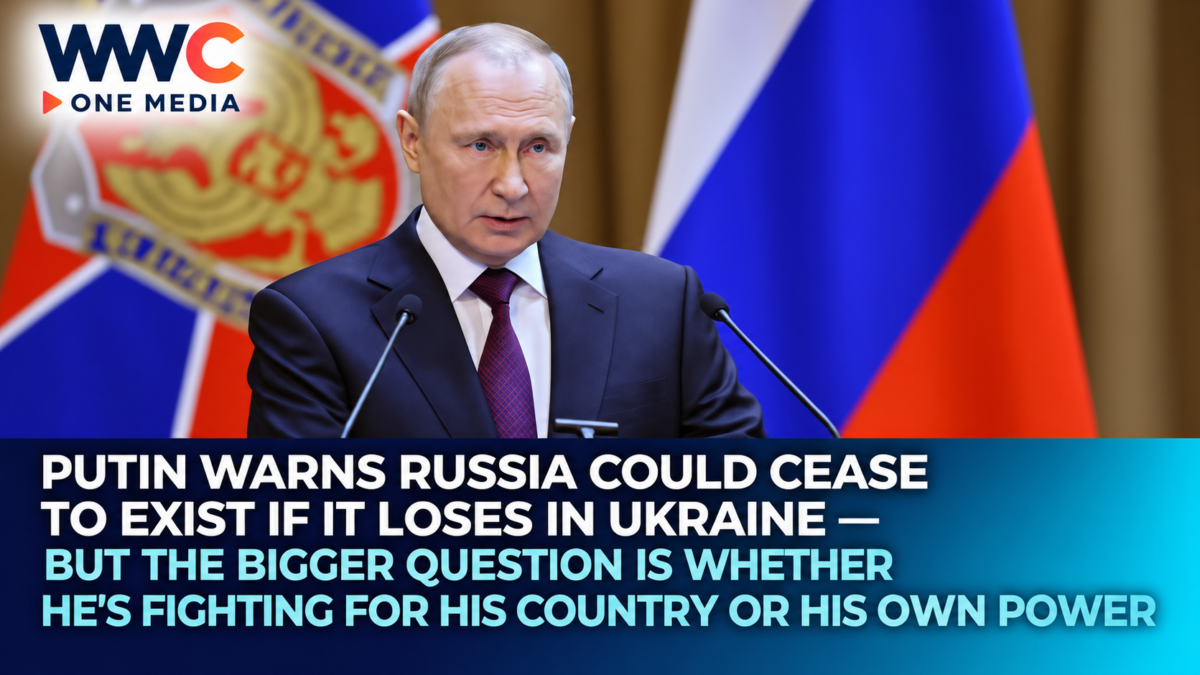
MOSCOW, Russia — October 12, 2026 — Russian President Vladimir Putin has repeatedly warned that a decisive defeat in Ukraine could threaten the survival of the Russian state, turning a war launched more than four years ago into what the Kremlin describes as a struggle for national existence.
But as Russia continues fighting in Ukraine, a fundamental question is becoming increasingly important: Would losing the war actually endanger Russia’s survival, or would it primarily threaten the political system and strategic ambitions built around Putin’s leadership?
The debate is at the center of a Bloomberg Opinion column published on October 12, examining why the Russian president has framed the conflict in existential terms.
Putin’s argument has been consistent for years. He portrays the conflict not simply as a territorial struggle with Ukraine, but as part of a wider confrontation with Western powers that he accuses of trying to weaken or dismantle Russia.
Yet Ukraine and its Western supporters reject that characterization.
They maintain that Ukraine is defending its sovereignty against Russia’s full-scale invasion, which began in February 2022, and that resisting Moscow’s aggression does not require destroying the Russian state.
The deeper question is whether Putin’s rhetoric reflects a genuine fear of national disintegration, a strategy to justify continued military sacrifice, or a concern that defeat could destabilize his own rule.
Why Putin Claims Defeat Could Mean the End of Russia
Putin’s warnings about the possible destruction of Russia did not begin in October 2026.
In February 2023, he argued that Western governments wanted to break the Russian Federation into smaller entities.
Speaking on Russian state television, he suggested that the Russian people might cease to survive as one nation if the country were divided.
In June 2024, during a news conference in Vietnam, Putin again connected battlefield defeat to the survival of Russian statehood.
He argued that a strategic defeat sought by Western governments could mark the end of Russia’s centuries-long history as a state.
These statements formed part of a broader Kremlin narrative portraying the war in Ukraine as a defensive struggle against hostile foreign powers.
However, Putin’s assertion that Western governments are seeking Russia’s destruction is disputed.
Western leaders have repeatedly framed their support for Ukraine as an effort to defend the country’s internationally recognized borders and deter further aggression.
There is no established evidence that a Ukrainian military victory would necessarily cause the Russian Federation to disintegrate.
How Russia’s Invasion Became an Existential Political Narrative
When Putin launched the full-scale invasion in February 2022, Moscow presented its operation as a response to security threats and Ukraine’s relationship with Western institutions.
Russia’s leadership claimed that NATO expansion and Ukraine’s growing ties with Europe threatened Moscow’s strategic interests.
Ukraine rejected those justifications, maintaining that it had the right to determine its own foreign policy and security arrangements.
As the conflict continued, the Kremlin increasingly emphasized the war’s alleged importance to Russia’s national survival.
The distinction is politically significant.
A limited military operation might be judged by whether it achieves defined battlefield or territorial objectives.
But a conflict portrayed as a struggle for national existence can be used to justify far greater sacrifices.
It can also make compromise more difficult because concessions may be presented domestically as threats to the country itself.
For Putin, linking the war to Russia’s historical identity and survival may help sustain political support despite the conflict’s mounting costs.
However, the degree to which individual Russians accept that argument is difficult to measure reliably in a heavily controlled political environment.
Military Defeat Is Not the Same as State Collapse
A central weakness in the existential argument is the assumption that losing a war necessarily destroys the country that fought it.
History offers numerous examples of governments surviving major military setbacks.
Countries can lose wars, withdraw from foreign territory or abandon strategic objectives without ceasing to exist.
Russia itself experienced substantial military and political turmoil following the collapse of the Soviet Union in 1991, but the Russian Federation continued as a sovereign state.
A defeat in Ukraine could have severe political, economic and strategic consequences for Moscow.
It might weaken Putin’s prestige, affect Russia’s military standing and intensify competition among political elites.
However, those outcomes are not equivalent to the automatic dissolution of the Russian Federation.
The exact consequences would depend on the nature of any defeat, the behavior of Russia’s political institutions, economic conditions and the response of its security establishment.
What Russia’s Political System Has at Stake
Putin’s long tenure in power has closely connected the Russian government’s legitimacy to themes of national strength, stability and geopolitical influence.
The Kremlin has presented Russia as a major global power capable of resisting Western pressure.
Ukraine’s continued independence and military resistance complicate that narrative.
A settlement that falls substantially short of Moscow’s declared objectives could force Russian leaders to explain years of military losses and economic sacrifice.
That could create political risks, especially if the outcome were widely perceived as a failure.
But the consequences for Putin personally remain uncertain.
Russia’s political system gives the presidency extensive powers, while organized political opposition faces significant restrictions.
Those characteristics may help the government manage public criticism and limit the immediate political impact of military setbacks.
A defeat would not automatically lead to Putin’s removal from office.
Nor would his departure necessarily mean the country would break apart.
Russia’s War Has Exposed Military and Economic Strains
More than four years of fighting have placed pressure on Russia’s military forces, state finances and economic relationships.
The war has required extensive spending on weapons, personnel, logistics and military production.
Russia has also faced sanctions and restrictions on access to certain technologies and international markets.
At the same time, Moscow has adapted parts of its economy to sustain military operations, increased domestic defense production and maintained important commercial relationships outside Western countries.
That combination makes simple predictions of imminent economic collapse unreliable.
The war has imposed substantial costs, but Russia retains significant industrial capacity, natural resources and state institutions.
Independent analysts disagree about how long Moscow can maintain its current military and economic strategy.
Some emphasize the cumulative effects of military losses, demographic pressures and technological restrictions.
Others argue that the Kremlin may be able to continue fighting for an extended period by prioritizing military needs over other economic activities.
Ukraine Has Demonstrated That Russia Cannot Dictate an Easy Victory
Putin initially launched the invasion with expectations of securing major strategic gains.
But Ukraine’s resistance and continuing support from international partners prevented Russia from achieving a quick victory.
Ukraine has retained an independent government and military, while its forces have continued fighting across multiple fronts.
The conflict has also prompted European countries to increase defense investment and reconsider long-term security arrangements.
Finland and Sweden joined NATO after Russia’s full-scale invasion, expanding the alliance’s northern membership.
This outcome contrasts with Moscow’s stated concerns about NATO’s proximity and influence.
Still, the war’s ultimate outcome remains unresolved.
Russia continues to occupy substantial Ukrainian territory, and both sides retain military capabilities.
The durability of Ukraine’s defenses also depends partly on external financial and military assistance.
Neither Russia’s defeat nor its victory should be treated as inevitable.
Putin’s Strategy Depends on Outlasting Ukraine and Its Allies
One interpretation of the Kremlin’s strategy is that Moscow believes time may work in its favor.
Rather than achieving a rapid victory, Russia may seek to exhaust Ukraine’s defenses and weaken the willingness of its international partners to maintain support.
A war of attrition can place pressure on manpower, ammunition supplies, infrastructure and government finances.
It can also create political disagreements among countries helping Ukraine.
Russia’s leadership has repeatedly argued that it is prepared to continue fighting until its objectives are achieved.
However, a prolonged war also carries costs for Moscow.
Ukrainian attacks on Russian military facilities, energy infrastructure and logistics networks have demonstrated that Russia remains vulnerable far from the front lines.
The sustainability of either side’s strategy depends on military production, international partnerships, public finances and political decisions.
Nuclear Weapons Make the Existential Narrative More Dangerous
Russia’s status as a nuclear power adds another dimension to the debate.
Putin and other Russian officials have repeatedly invoked the country’s nuclear capabilities while discussing the conflict and relations with NATO.
Moscow has also described scenarios in which threats to Russian sovereignty could justify extreme military responses.
Such rhetoric can increase the risks of misunderstanding and escalation.
But a military setback in Ukraine does not automatically imply that Russia would use nuclear weapons.
Nuclear escalation would involve political and military decisions carrying enormous consequences for Russia and the wider world.
Western governments have generally sought to support Ukraine while avoiding direct military confrontation between NATO and Russian forces.
The challenge is to deter aggression without allowing threats of escalation to make every Russian territorial demand effectively immune from resistance.
Trump’s Proposed Energy Ceasefire Adds New Uncertainty
The debate over Russia’s strategic objectives has become more urgent amid renewed diplomatic activity.
On October 11, US President Donald Trump announced what he described as an immediate energy ceasefire between Russia and Ukraine.
However, the announcement was not immediately confirmed by Moscow, and Ukrainian President Volodymyr Zelenskyy said Russian attacks on Ukrainian energy infrastructure were continuing.
Kyiv indicated that it would consider halting attacks on Russian energy facilities if Moscow reciprocated.
The development illustrates the difficulty of separating diplomatic announcements from agreements implemented on the ground.
A limited arrangement covering energy infrastructure would not necessarily establish a comprehensive ceasefire.
It would also leave important issues unresolved, including territorial control, security guarantees and Ukraine’s future relationship with European institutions.
For Russia, the question remains whether Putin would accept a settlement that could be presented domestically as a compromise rather than a victory.
For Ukraine, any durable agreement would need to address concerns about sovereignty and the risk of renewed attacks.
Could a Russian Defeat Trigger Political Instability?
Some analysts warn that a major Russian defeat could create domestic instability.
Possible consequences include disputes among political elites, increased economic pressure and questions about the performance of the country’s military leadership.
Russia’s size, ethnic diversity and federal structure have also prompted debate about the potential for regional political tensions.
However, these remain scenarios rather than established forecasts.
A military defeat could instead produce a more authoritarian political response, a negotiated leadership transition or a continuation of the existing system under modified policies.
The Center for European Policy Analysis has noted that the outcome of a Russian defeat would be difficult to predict.
The range of possibilities is precisely why claims that Russia must either win in Ukraine or cease to exist are too simplistic.
The future of the Russian state depends on many factors beyond the outcome of a single war.
Why Europe’s Security Depends on More Than Putin’s Survival
The conflict has reshaped Europe’s security debate.
European governments must consider how to protect Ukraine while managing a long-term relationship with Russia, regardless of who leads the country.
Some analysts argue that weakening Russia’s military capacity could reduce the danger of further aggression.
Others warn that a destabilized nuclear power could generate new security risks, including uncertainty over military command and control.
These concerns are not mutually exclusive.
European governments can oppose Russia’s invasion while recognizing that political instability in a nuclear-armed state would present serious challenges.
The central objective for Ukraine and its partners is a sustainable security arrangement that reduces the likelihood of renewed conflict.
That goal does not require assuming that Russia must cease to exist as a sovereign country.
The Bigger Question: Is Putin Defending Russia — or the Political Order He Built?
Putin’s repeated warnings about Russia’s survival reveal how closely he has connected the conflict in Ukraine to questions of national identity and state power.
By framing military defeat as a threat to the country’s existence, the Kremlin elevates the political stakes of the war and makes compromise more difficult to explain.
But the connection between a battlefield setback and national collapse remains unproven.
Russia could face serious consequences from defeat while continuing to exist as a state.
Putin could also survive politically despite failing to achieve all his objectives.
Conversely, continued fighting could deepen economic and military pressures without delivering the security benefits Moscow claims to seek.
The fundamental distinction is between protecting Russia as a sovereign state and preserving the political and strategic ambitions of its current leadership.
For Ukraine, the war is about defending its internationally recognized sovereignty against invasion.
For Russia, the Kremlin presents the conflict as a struggle against Western attempts to weaken the country.
For the rest of the world, the central challenge is preventing an already devastating war from escalating into a wider confrontation.
Putin says a defeat in Ukraine could threaten Russia’s existence — but the question increasingly confronting Moscow is whether continuing the war may pose greater long-term risks to Russia than accepting a settlement that falls short of the Kremlin’s original ambitions.