BAGHDAD, Iraq — October 12, 2026 — Some of the world’s biggest oil companies are returning to Iraq in pursuit of multibillion-dollar energy contracts, even as the continuing war involving Iran threatens shipping routes, strains regional economies and exposes the risks of relying on the Strait of Hormuz.
BP, Chevron, ExxonMobil, ConocoPhillips and TotalEnergies are among the international energy giants seeking new opportunities or expanding existing operations in one of the Middle East’s most resource-rich countries.
Their renewed interest comes despite Iraq suffering severe production and export disruptions during the regional conflict.
According to Reuters, Iraqi oil production fell from approximately 4.2 million barrels per day in February 2026 to just 1.48 million barrels per day in May as the war disrupted shipments.
Yet the crisis has not eliminated international investment interest.
Instead, some companies are betting that Iraq’s enormous oil reserves, potentially more attractive contractual arrangements and new export infrastructure could create profitable opportunities once security and logistical conditions improve.
A Bloomberg Opinion article published October 12, titled “Big Oil Goes Back to Iraq for Contracts Amid Iran War,” highlights the apparent contradiction of international producers pursuing long-term investments in a country exposed to regional instability.
The central question is whether Iraq’s oil wealth can attract enough investment to overcome the very security and infrastructure problems that have repeatedly prevented the country from reaching its production potential.
Why Big Oil Is Returning to Iraq
Iraq has some of the largest proven crude oil reserves in the world, making it a strategically important destination for international energy investment.
Much of its oil can be produced at relatively competitive costs, creating opportunities for companies willing to navigate difficult operating conditions.
But Iraq’s energy industry has faced persistent obstacles.
Political disputes, security concerns, infrastructure shortages, contractual disagreements and export bottlenecks have limited the country’s ability to expand production.
For years, some Western oil companies reduced their exposure or withdrew from major Iraqi projects after concluding that the commercial returns did not adequately compensate for the risks.
Now, the investment environment appears to be changing.
Iraqi officials are seeking new foreign partnerships to restore production, expand gas development and improve export capacity.
Major oil companies are also looking for opportunities to replenish their long-term production portfolios.
The result is renewed interest in Iraq, even as geopolitical uncertainty remains elevated.
Chevron Targets West Qurna-2 as Russian Oil Influence Weakens
One of the most significant potential transactions involves US energy giant Chevron and the West Qurna-2 oil field in southern Iraq.
The field is among the country’s major producing assets and has long been associated with Russia’s Lukoil.
Western sanctions against the Russian company created an opening for a possible change in operating arrangements.
In February 2026, Chevron reached preliminary agreements with Iraqi authorities covering negotiations over West Qurna-2 and other development opportunities.
The Iraqi government subsequently approved a framework agreement.
In September, Chevron signed a technical consultancy agreement to assist state-owned Basra Oil Company with the field’s development.
The arrangement represents an important step toward deeper involvement, but consultancy work and exclusive negotiations should not automatically be described as completed acquisition or full operational control.
The ultimate commercial terms and future operating structure remain crucial.
For Chevron, Iraq offers an opportunity to increase exposure to significant low-cost petroleum resources.
For Baghdad, the company’s involvement could bring technical expertise, capital and international partnerships.
However, the project must still contend with production infrastructure, security conditions and the financial terms of any long-term agreement.
BP’s $25-Billion Kirkuk Strategy Attracts ConocoPhillips
British energy company BP is another major participant in Iraq’s energy revival.
The company finalized an agreement in 2025 to help redevelop several oil fields in the Kirkuk region of northern Iraq.
The investment framework could involve up to $25 billion over approximately 25 years, depending on development plans and performance.
The project focuses on improving production from fields with a long history of oil extraction.
In July 2026, US producer ConocoPhillips agreed to acquire a 42% stake in BP Energy Company of Kirkuk Ltd, the company associated with the redevelopment project.
The transaction illustrates how international companies are forming partnerships to manage investment requirements and share exposure to operating risks.
Kirkuk also has strategic significance because northern Iraq offers potential access to export routes that do not rely entirely on the Strait of Hormuz.
However, increasing output will require sustained investment in existing facilities, field redevelopment and transportation systems.
The project is not simply a matter of reopening old wells.
Its success will depend on execution, field performance and the ability to move additional production to customers.
ExxonMobil Explores New Opportunities at Majnoon
ExxonMobil, which previously reduced its exposure to Iraq, has also been exploring possible new investments.
In October 2025, the company signed a preliminary agreement with Iraq’s Oil Ministry to evaluate opportunities involving exploration, field development and crude marketing.
One area of interest is the giant Majnoon oil field.
The discussions suggest that ExxonMobil is reconsidering the commercial potential of Iraqi assets as the government seeks new international partners.
However, an agreement to evaluate opportunities is not equivalent to a final investment decision.
Actual project development would require detailed commercial arrangements, technical assessments and clarity over the allocation of risk.
For Baghdad, attracting a producer with Exxon’s capabilities could support its ambitions to improve output.
For ExxonMobil, the decision will depend on whether Iraq offers sufficiently attractive financial terms and predictable operating conditions.
TotalEnergies Expands Beyond Oil Production
France’s TotalEnergies has continued pursuing a broader energy strategy in Iraq.
Its multibillion-dollar development program includes oil, gas, water infrastructure and electricity-related projects.
These investments are intended to address some of the country’s longstanding energy challenges.
One significant initiative involves using seawater to support oil production, reducing pressure on freshwater resources.
Other projects aim to capture gas that would otherwise be wasted through flaring.
Gas development could improve domestic electricity supplies and reduce the need for some fuel imports.
TotalEnergies has also been active in marketing and transporting Iraqi oil during the regional conflict.
The company’s diversified approach demonstrates that Iraq’s energy opportunities extend beyond simply increasing crude production.
Reliable water, gas and power infrastructure can also determine whether oil fields operate efficiently over the long term.
Iran War Exposes Iraq’s Greatest Weakness: Export Routes
The biggest obstacle facing Iraq’s oil expansion may be the ability to export additional production.
The country’s southern crude terminals depend heavily on maritime routes connected to the Persian Gulf and Strait of Hormuz.
The war involving Iran has made those routes more dangerous and expensive.
Threats to commercial vessels, higher insurance costs and uncertain transit conditions have disrupted normal energy trading.
As a result, Iraq has experienced difficulty moving some of its production to international markets.
In September, Bloomberg reported that Iraq’s state oil marketing company was offering last-minute cargoes as exceptionally high freight costs complicated sales.
The country has also explored new shipping arrangements to give it greater control over tanker movements.
The problem demonstrates a fundamental weakness in the economics of oil production.
A company may be able to extract crude profitably, but its investment becomes less attractive if the oil cannot be delivered consistently to customers.
For Iraq, expanding production capacity without strengthening export routes could leave the country exposed to another major disruption.
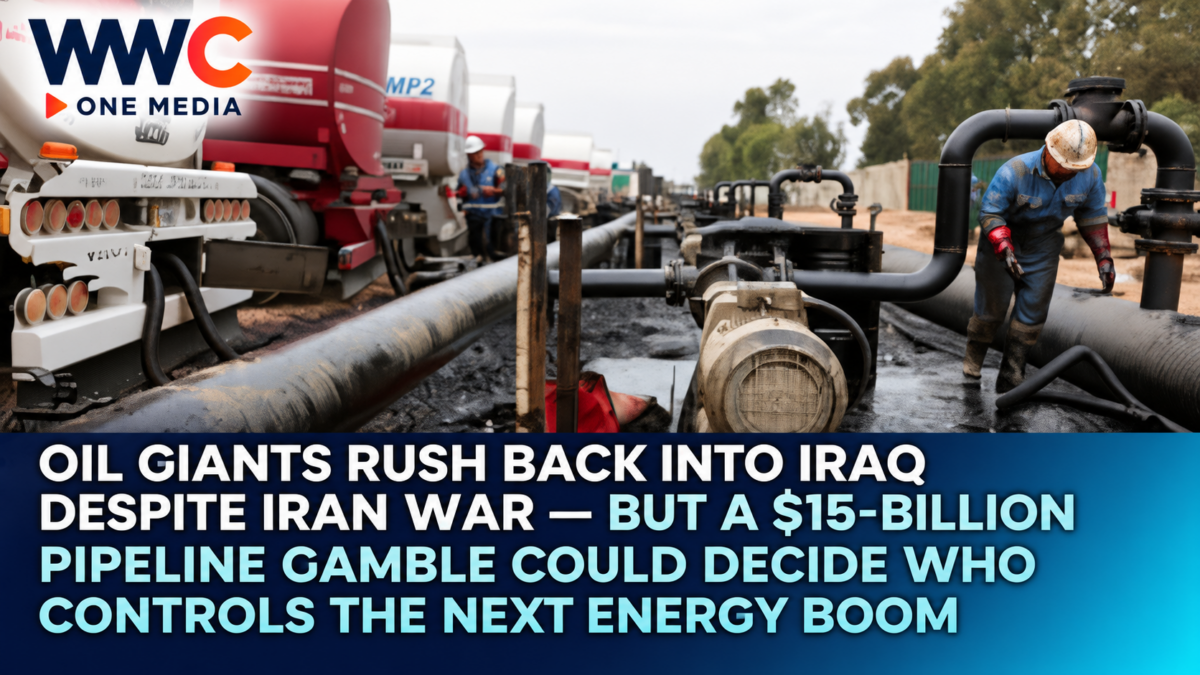
A $15-Billion Pipeline Could Transform Iraq’s Oil Trade
Iraq is pursuing a major pipeline project designed to reduce reliance on the Strait of Hormuz.
The proposed infrastructure would connect producing regions with export routes through Syria and potentially Turkey.
A central element involves a modern corridor toward Syria’s Mediterranean coast.
Reuters reported in August that a pipeline through Syria could require at least $15 billion and approximately four years to complete.
The proposed initial capacity could reach around 2 million barrels per day.
The project remains at a preliminary stage and faces significant technical and financial challenges.
A new pipeline would need to cross difficult terrain and areas affected by years of conflict.
Developers must also manage security, land access, financing, environmental requirements and agreements between governments.
Oil companies and investors are studying possible involvement, but the estimated investment is not equivalent to a fully financed construction program.
If eventually completed, the pipeline could give Iraq an alternative way to export substantial volumes of crude.
But it will not solve the country’s immediate shipping problems.
Oil Executives Warn the World Needs More Backup Routes
The war has changed how major energy companies think about logistics.
At an industry forum in October, executives emphasized that the global petroleum system needs greater redundancy.
Rather than relying exclusively on the cheapest normal shipping routes, producers and consumers are considering the value of backup infrastructure.
TotalEnergies CEO Patrick Pouyanne discussed the potential importance of alternative pipeline corridors.
Chevron and BP executives also acknowledged the need to improve regional transportation resilience.
The shift reflects an important lesson from the Iran war.
Highly efficient energy systems can become vulnerable when their most important shipping chokepoints are disrupted.
Alternative pipelines, ports, storage facilities and tanker arrangements may cost more to develop.
But they can reduce exposure to a single geographical point of failure.
For Iraq, this could strengthen the case for investments that previously appeared too expensive.
Iraq’s Oil Revenue Crisis Makes Foreign Investment Urgent
The Iranian conflict has created severe financial pressure for Baghdad.
Oil accounts for the overwhelming majority of Iraqi government revenue.
Reuters reported that petroleum provided approximately 88% of state income, leaving the country vulnerable to sudden reductions in crude exports.
When shipments are disrupted, the government receives less foreign currency even if international oil prices remain elevated.
That creates difficulties financing public services, government salaries and infrastructure.
In October, Iraq also moved to devalue its currency in response to economic pressures linked to the war.
According to the Associated Press, the official exchange rate was adjusted from around 1,300 Iraqi dinars per dollar to approximately 1,500.
A weaker currency can increase local-currency revenues generated from dollar-denominated oil receipts.
However, it also makes imported goods more expensive and can intensify inflationary pressure.
The combination of fiscal stress and currency weakness helps explain why Iraq is eager to attract major international energy investors.
China and Asian Refiners Have a Growing Stake
Iraq’s energy strategy also has important implications for Asia.
China has become a major buyer of Middle Eastern crude and an important participant in international energy investment.
Reuters reported in early October that Chinese independent refiners increased purchases of Iraqi and Qatari crude as Iranian supplies became more constrained.
The shift demonstrates how regional conflict can redirect trade rather than simply eliminate demand.
Asian refiners must balance crude prices, shipping risks and the availability of suitable grades.
Iraqi crude has become increasingly important because it offers an alternative to supplies affected by sanctions and maritime restrictions.
However, higher freight costs and physical crude premiums can weaken refiners’ profit margins.
For oil-importing economies across Asia, the reliability of Middle Eastern supply routes remains a major concern.
What Iraq’s Energy Investments Mean for the Philippines
The Philippines does not need to invest directly in Iraqi oil fields for developments in Iraq to affect its economy.
As a net importer of petroleum products, the country is exposed to international fuel prices and regional refining conditions.
Disruptions affecting Middle Eastern crude can contribute to higher costs for diesel, gasoline and other fuels.
Those costs can influence transportation, electricity generation, logistics and food distribution.
Additional Iraqi production could eventually support global supply, particularly if the country develops more reliable export infrastructure.
But the connection is not immediate.
New contracts may take years to translate into higher output, and increased production does not guarantee lower Philippine pump prices.
Refining capacity, shipping costs, exchange rates, taxation and domestic market conditions also affect retail fuel prices.
For Philippine businesses and consumers, the most important development is whether international energy supplies become more reliable and affordable.
Why Big Oil Is Willing to Accept the Risk
Energy companies make investment decisions over long periods.
A major oil field can produce for decades, meaning near-term conflict does not necessarily eliminate the potential value of its reserves.
Companies may conclude that today’s risks are manageable if contractual terms, resource quality and future returns are sufficiently attractive.
There is also a competitive dimension.
Firms that establish commercial relationships early may be better positioned when political and security conditions improve.
But investing during a conflict is not automatically a winning strategy.
Projects can suffer delays, cost overruns, damage to infrastructure or changes in government policy.
Contractual disputes can also reduce expected returns.
For major producers, the opportunity is real, but so is the possibility that years of committed capital will fail to generate the anticipated profits.
The Bigger Question: Can Iraq Become an Energy Powerhouse Without Becoming a Bigger War Casualty?
The return of international oil companies reflects Iraq’s enormous resource potential.
BP is pursuing a long-term redevelopment strategy in Kirkuk.
ConocoPhillips has joined the northern oil project.
Chevron is negotiating deeper involvement in southern fields.
ExxonMobil is studying potential new investments.
TotalEnergies continues developing projects spanning oil production and supporting infrastructure.
Together, the developments suggest that Iraq is attracting serious international attention despite the war.
But the contradiction is difficult to ignore.
The same conflict that has made energy supplies more valuable has also exposed Iraq’s inability to export its oil reliably.
New fields, improved drilling technology and higher production targets cannot fully resolve that weakness.
For Iraq, the defining challenge is no longer simply discovering or producing more oil. It is building an energy system capable of continuing to function when regional conflict disrupts the routes connecting its fields to international buyers.
The proposed multibillion-dollar pipeline network could help address that problem, but construction would require years and substantial cooperation.
Meanwhile, the country must manage fiscal pressure, competing foreign interests and political uncertainty.
For international oil giants, Iraq presents the possibility of decades of production from some of the world’s most significant petroleum resources.
For Baghdad, foreign investment offers a potential path toward rebuilding its economy and increasing energy revenue.
Big Oil is returning to Iraq despite the Iran war — but the bigger question is whether billions in new contracts can deliver a lasting energy boom before the next regional crisis traps the country’s oil underground again.