
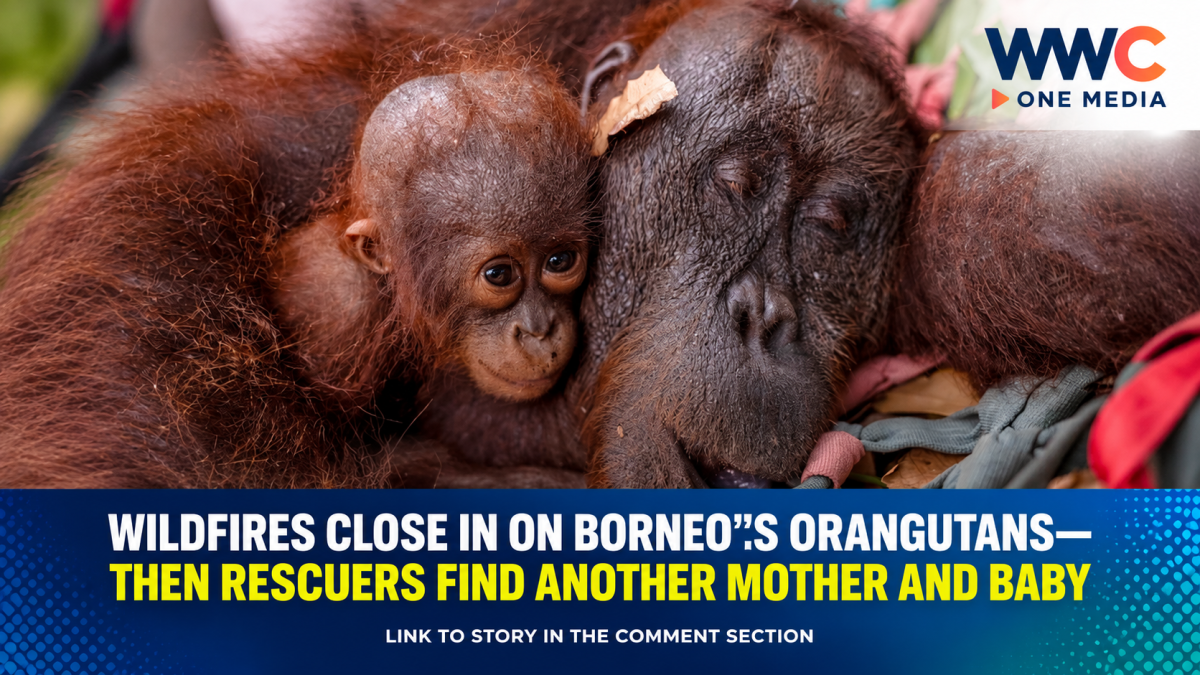
JAKARTA, Indonesia — Indonesian wildlife rescuers have evacuated another orangutan mother and her baby from a forest threatened by advancing wildfires, highlighting the growing danger facing one of the world’s most endangered great apes as fires continue to spread across Borneo.
The latest rescue took place in West Kalimantan’s Ketapang district, where a mother orangutan and her infant had been under observation since July after they were spotted in a plantation area near a forest.
Authorities moved the pair to a rescue and rehabilitation facility after wildfires began encroaching on their shrinking habitat.
The rescue was carried out by the West Kalimantan Natural Resources Conservation Agency (BKSDA) in coordination with wildlife conservation group Yayasan Inisiasi Alam Rehabilitasi Indonesia (YIARI). Initial veterinary examinations found no burn injuries, but the mother and baby remain under close observation because prolonged exposure to thick wildfire smoke can cause serious respiratory problems.
Ninth Orangutan Evacuated in Less Than a Month
The latest operation is the second recent rescue involving an orangutan mother and baby as fires threaten wildlife habitats across Indonesian Borneo.
According to reports from Al Jazeera, the evacuation brings the number of orangutans rescued from fire-affected areas in Ketapang district to nine in less than a month.
The growing number has raised fresh alarm among conservationists, who warn that the true impact of the fires may be far greater than the number of animals found by rescue teams.
Orangutans are highly vulnerable during forest fires because they cannot simply escape across open land. Adults and infants depend on remaining forest cover for food, shelter and movement, while thick smoke can cause respiratory distress even when flames do not directly reach them.
Smoke Is Becoming a Silent Threat
The latest rescue comes after another orangutan, later named Sampurna, was found weak and suffering respiratory problems near a fire zone in West Kalimantan.
That animal was rescued from a palm oil plantation near Ketapang after a local farmer spotted it in distress. Veterinarians provided emergency treatment, including oxygen and intravenous fluids, and said the orangutan was likely suffering from an acute respiratory infection linked to smoke exposure.
The case underscored a major problem for wildlife rescue teams: animals do not have to be burned by flames to become victims of wildfires.
Smoke and haze can linger for days or weeks, affecting animals deep inside remaining forest patches and making it difficult for rescuers to determine how many have been displaced, injured or killed.
Indonesia Battles Severe Fire Season
Indonesia has been battling widespread forest and land fires for weeks across Kalimantan and Sumatra, with smoke spreading beyond the country’s borders and contributing to air pollution in neighboring parts of Southeast Asia.
Reuters reported that Indonesia’s wildfire crisis has been intensified by an exceptionally severe dry season and a strong El Niño pattern that has created hotter and drier conditions.
Nearly 95,000 hectares of land burned in Indonesia in July alone, according to figures cited by Reuters, while authorities detected more than 9,000 hotspots in August.
Peatlands pose an especially difficult challenge. Fires can smolder beneath the ground for extended periods, making them difficult to detect and extinguish while producing enormous amounts of smoke and carbon emissions.
Wildfires Also Move Closer to Indonesia’s New Capital
The threat is no longer limited to traditional fire hotspots.
Reuters reported that wildfires have also spread near Nusantara, Indonesia’s under-construction new capital in eastern Borneo. Hundreds of hectares around the project area have been affected, prompting authorities to step up firefighting operations, cloud-seeding efforts and aerial water bombing.
The expanding fire zones demonstrate how rapidly the crisis is spreading across Borneo during one of Indonesia’s most challenging dry seasons in years.
A Race Against Time for Borneo’s Wildlife
For the rescued orangutan mother and her baby, evacuation may have prevented immediate disaster.
But conservationists now face a much larger challenge: what happens to wildlife when the forest they depend on is damaged, fragmented or destroyed?
The pair will remain under veterinary monitoring at the rescue and rehabilitation center as authorities assess their health and determine their next steps.
With fires continuing to threaten forests across Borneo, wildlife rescuers may soon face even more emergency calls.
The mother and baby were saved—but how many orangutans are still trapped beyond the smoke?
WWC ONE MEDIA J.M.S

Leave a Reply