
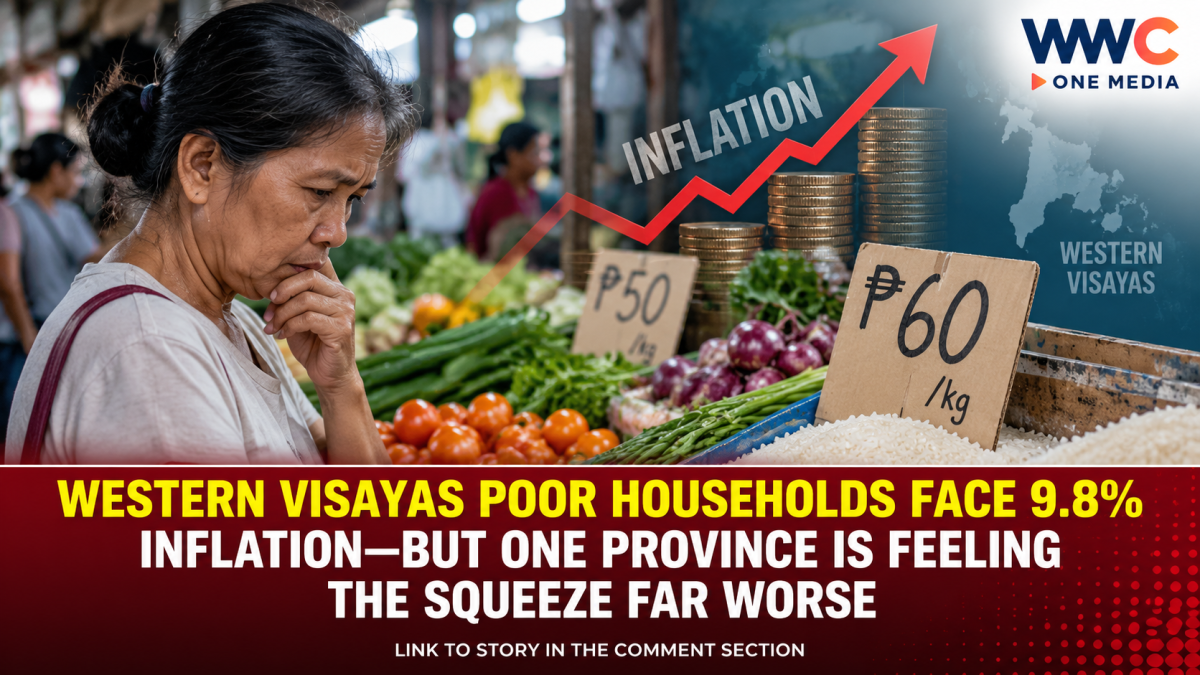
ILOILO CITY, Philippines — The cost-of-living squeeze is intensifying for low-income families in Western Visayas, with inflation among the region’s bottom 30 percent of income households jumping to 9.8 percent in July 2026, significantly higher than the 8.2-percent national rate for the same income group.
The latest figures from the Philippine Statistics Authority (PSA) show that the regional rate climbed from 8.1 percent in June, highlighting the growing pressure on families whose budgets are already heavily concentrated on food, transportation and other basic necessities.
The situation was particularly severe in Iloilo province, where inflation for the bottom 30 percent surged to 12.5 percent in July, up from 9.3 percent the previous month.
Aklan followed with 11.3 percent, while Antique posted 10.2 percent. Iloilo City recorded 9.3 percent, compared with 5.7 percent in Guimaras and 3.9 percent in Capiz.
Iloilo households bear the heaviest pressure
The sharp increase in Iloilo province stands out across Western Visayas.
From June to July, inflation among low-income households in Iloilo accelerated by 3.2 percentage points, moving from 9.3 percent to 12.5 percent. Aklan also saw a significant increase, from 9.6 percent to 11.3 percent, while Antique rose from 9.6 percent to 10.2 percent.
Guimaras was the exception, with its rate holding steady at 5.7 percent. Capiz remained the region’s lowest at 3.9 percent.
The wide gap between provinces underscores how uneven the inflation burden can be for low-income households, even within the same region.
Food remains at the heart of the problem
For poorer households, inflation can have a particularly painful impact because a larger portion of their income is typically spent on necessities such as food.
National PSA data for July showed that food and non-alcoholic beverages were the largest contributor to inflation among the bottom 30 percent of households, accounting for 54 percent of overall inflation, followed by housing, water, electricity, gas and other fuels at 18.5 percent and transport at 11.1 percent.
The pressure did not disappear in August.
The PSA’s latest national report, released on September 4, showed that inflation among the bottom 30 percent of income households remained at 8.2 percent in August, unchanged from July. The January-to-August average reached 6.2 percent.
Food inflation for this group eased slightly to 8.3 percent in August from 8.5 percent in July. But that improvement was overshadowed by continued increases in several essential food items.
Most notably, rice inflation accelerated to 22.5 percent in August from 19.3 percent in July.
Rice remains a major concern
The latest PSA data show why headline inflation alone does not tell the entire story for poorer families.
Although overall food inflation slowed nationally in August, rice prices continued to put pressure on household budgets. Cereals and cereal products accounted for 84.7 percent of food inflation among the bottom 30 percent, with fish and seafood another major contributor.
For families already spending a large share of their income on food, sustained increases in rice and other staples can quickly translate into difficult choices involving transportation, utilities, education and other household expenses.
Western Visayas already showed signs of mounting price pressure
The July figures came after inflation among Western Visayas’ bottom 30 percent households had already accelerated to 8.1 percent in June from 7.7 percent in May.
At the time, food and other basic spending categories were already exerting pressure on household budgets.
The broader Western Visayas inflation rate for all income households also rose to 7.8 percent in July from 6.8 percent in June. The PSA identified housing, water, electricity, gas and other fuels, along with food and non-alcoholic beverages, as important drivers of the increase.
That distinction matters: the 9.8 percent figure applies specifically to the bottom 30 percent of income households, not the entire Western Visayas population.
The bigger warning for families
The numbers point to a widening cost-of-living challenge for some of the region’s most financially vulnerable households.
While the national inflation rate for the bottom 30 percent remained at 8.2 percent in August, households outside Metro Manila recorded an even higher 8.4 percent, compared with 4.3 percent in the National Capital Region.
For Western Visayas, however, the latest detailed regional figure available for the bottom 30 percent remains the 9.8 percent recorded in July.
The PSA has not yet released detailed August provincial figures for this income group in Western Visayas, meaning it would be premature to claim that the region’s 9.8-percent rate either increased or declined in August.
What is clear is that the inflation burden remains heavily concentrated in the goods and services that poorer families cannot easily avoid—food, housing-related expenses and transportation.
And with rice inflation accelerating nationally in August, the question now facing households is not simply whether inflation will slow, but whether family incomes can keep pace with the rising cost of necessities.
WWC ONE MEDIA J.M.S

Leave a Reply