
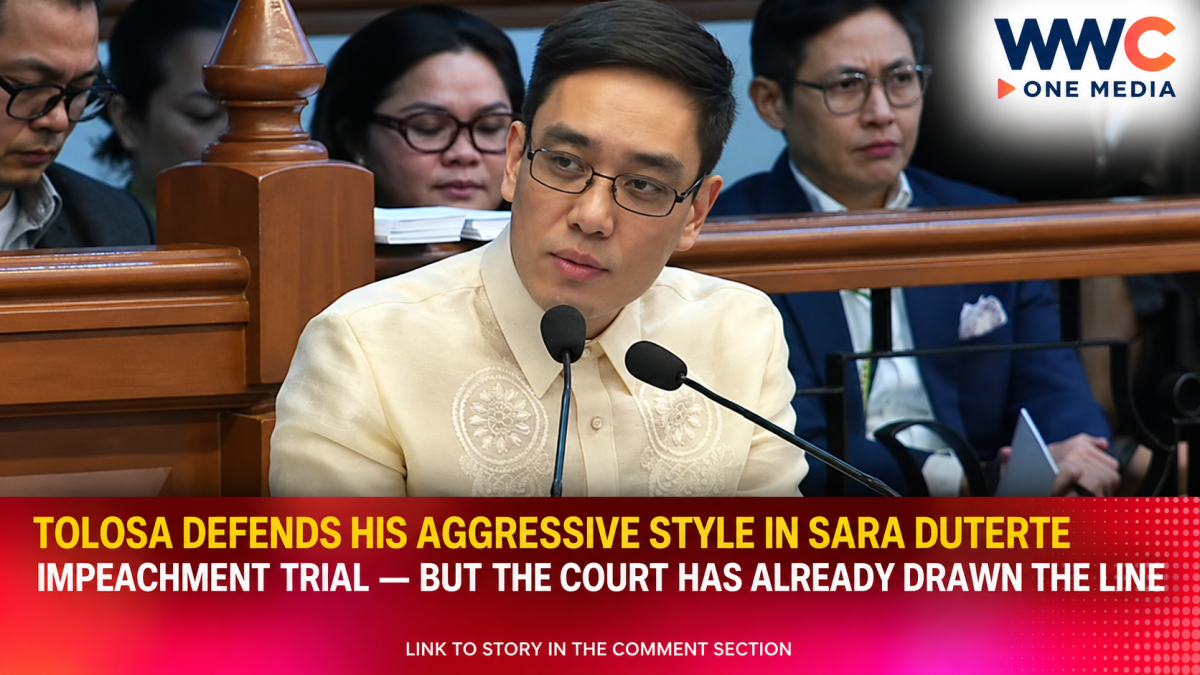
Private prosecutor Benjamin “Jay” Tolosa Jr. is defending his forceful courtroom style in Vice President Sara Duterte’s impeachment trial, saying his assertiveness is part of his responsibility to defend the public interest — not an attempt to intimidate witnesses.
Tolosa made the clarification after his questioning of former Education Undersecretary Michael Poa triggered one of the more heated exchanges of the impeachment proceedings.
The controversy has now turned the spotlight not only on what Tolosa says in court, but also on how aggressive questioning should be handled in a nationally watched impeachment proceeding.
Tolosa: “No intention” to intimidate
Speaking at a Saturday news forum in Quezon City, Tolosa said lawyers do not have to maintain the same demeanor throughout a trial.
He argued that courtroom strategy can change depending on the circumstances, including the behavior of opposing counsel and the nature of the witness being questioned.
Tolosa said there was no intention to intimidate Poa, stressing that sometimes a lawyer has to be assertive and “stand your ground” when defending an argument based on the rules and jurisprudence.
He also framed his approach in the impeachment case as different from representing an ordinary private client.
According to Tolosa, the prosecution is dealing with issues that affect the broader Filipino public, which he said explains why he has been particularly forceful during the proceedings.
The exchange that started the controversy
The debate over Tolosa’s courtroom manner intensified on September 2, when he questioned Poa, who was declared a hostile witness by the Senate Impeachment Court.
Poa is a former Department of Education chief of staff and is also part of Duterte’s defense team. Because the court declared him hostile, Presiding Officer Francis “Chiz” Escudero allowed Tolosa to use leading questions — while reminding the prosecutor not to ask misleading ones.
The hearing became particularly tense when Tolosa used the phrase “abogadong walang alam” (“lawyer who knows nothing”) in referring to Poa.
Duterte’s lead defense counsel Sheila Sison objected, arguing that the remark was inappropriate and amounted to rhetoric intended to add drama to the proceedings.
Escudero ultimately ordered the phrase removed from the official record, describing it as discourteous, particularly because it was directed at a fellow member of the legal profession.
The impeachment court later admonished Tolosa after exchanges with the defense consumed time, with the court warning against what was described as “intramurals” between the lawyers.
Prosecutors say Tolosa’s style is part of trial lawyering
Despite the criticism, members of the prosecution team defended the lawyer’s approach.
Manila Rep. Joel Chua said lawyers have different courtroom styles and noted that Tolosa is an experienced trial lawyer whose aggressive approach is part of his professional style.
Chua also observed that younger trial lawyers can sometimes be more aggressive and tend to become more restrained with experience.
Lanao del Sur Rep. Zia Alonto Adiong offered another explanation: Poa was not an ordinary witness.
He was a lawyer, a former education official and a member of Duterte’s defense team. Because Poa understood courtroom procedure and legal arguments, Adiong said a more intensive examination was to be expected.
Adiong even said he would not personally advise Tolosa to tone down his approach, arguing that the prosecutor remained respectful despite the intensity of his questioning.
Why Poa’s testimony matters
The confrontation was not merely about courtroom personality.
Poa was questioned in connection with the prosecution’s presentation of evidence concerning confidential funds associated with the Department of Education during Duterte’s tenure as education secretary.
According to reporting on the hearing, Poa maintained that he did not have personal knowledge of how the confidential funds were actually used on the ground. He said his involvement largely concerned the agency’s responses to Commission on Audit observations.
That testimony matters because Article I of the impeachment complaint concerns allegations involving confidential funds, making questions about documentation, utilization and accountability central to the prosecution’s case.
The allegations remain matters for the impeachment court to determine; they should not be treated as established wrongdoing simply because they have been raised during the trial.
The bigger issue: courtroom strategy versus courtroom discipline
The Tolosa controversy exposes a difficult balance in high-profile trials.
Aggressive cross-examination can be a legitimate courtroom strategy, particularly when a lawyer is dealing with a hostile witness. But lawyers must still operate within the rules imposed by the tribunal.
In this case, the Senate Impeachment Court did not prohibit Tolosa from using a forceful questioning style. Instead, it specifically removed language it considered discourteous and reminded him about the proper conduct of proceedings.
That distinction is important.
Being aggressive is not automatically misconduct. But being forceful does not give a lawyer unlimited freedom to use language the court considers inappropriate.
Tolosa has become a prominent face of the prosecution
Tolosa’s role in the impeachment trial goes beyond questioning witnesses.
The House prosecution panel formally designated him as its legal spokesperson and one of its private prosecutors in June. The House said he would help communicate developments in the proceedings while actively participating in the trial.
The House described him as a veteran trial lawyer and managing partner of Tolosa, Lim and Chua, with experience in complex and high-stakes litigation.
His increasingly visible role means his courtroom demeanor is likely to remain under close public scrutiny — particularly as the impeachment trial moves through evidence involving Duterte’s alleged use of confidential funds and other allegations.
The real battle may be bigger than Tolosa’s personality
For viewers following the impeachment trial, the dramatic exchanges between lawyers can easily become the headline.
But the more consequential question is what those exchanges actually establish about the evidence.
Tolosa says his aggressive style reflects the seriousness of the public interest involved.
The defense, meanwhile, has challenged some of his language and tactics.
And the impeachment court ultimately has the responsibility to separate courtroom drama from evidence.
The question now is not whether Tolosa can command attention in the courtroom — he clearly can. The bigger question is whether that aggressive strategy will strengthen the prosecution’s case when the senator-judges finally weigh the evidence.
WWC ONE MEDIA M.J.E
Leave a Reply