
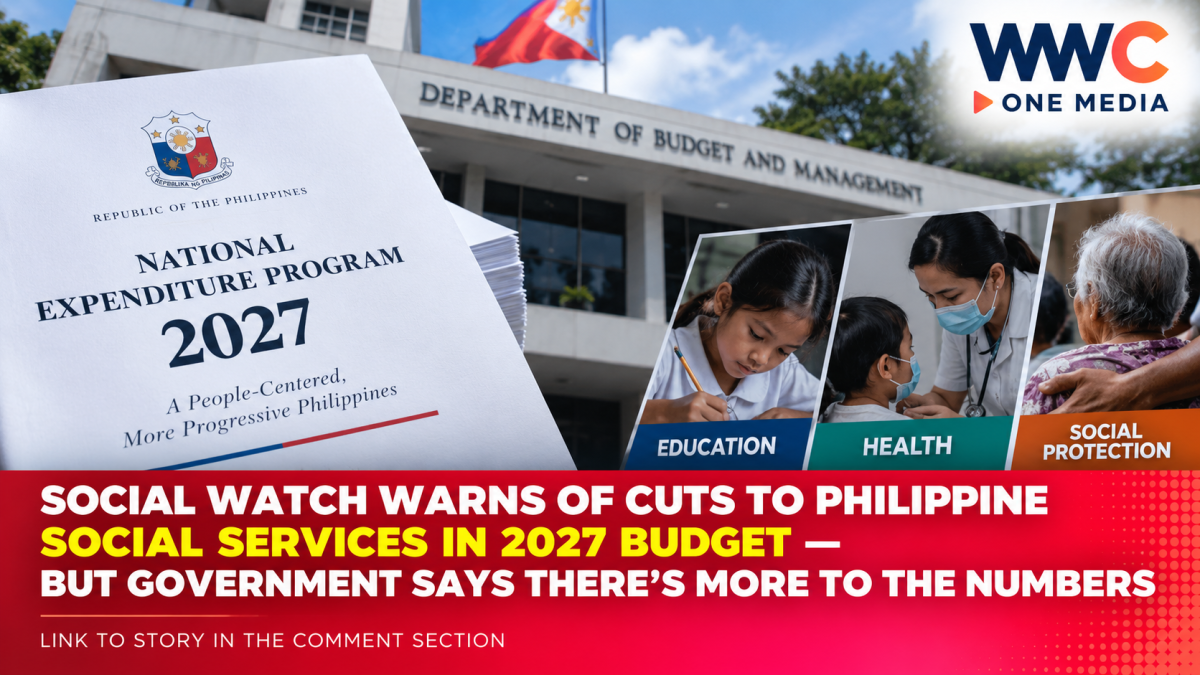
Social Watch Philippines Senior Budget Specialist Alce Quitalig said programs directly supporting poor and vulnerable Filipinos are among those facing significant reductions in the proposed 2027 spending plan.
According to Quitalig, the government is allocating more resources to mandatory expenditures, leaving less fiscal space for programs that directly deliver services to ordinary Filipinos.
Social Watch specifically raised concerns over education, health and social welfare, saying their share of the overall budget is declining even as the government faces growing demands for public services.
One of the most striking figures cited by the group is a roughly ₱45-billion reduction in the education sector compared with the current budget.
Education is already at the center of the budget fight
The Social Watch warning is not an isolated criticism.
House Assistant Minority Leader Chel Diokno earlier flagged proposed reductions affecting several education and health agencies.
Under the proposed 2027 budget, the Department of Education would receive about ₱916.7 billion, compared with ₱961.3 billion in 2026.
State universities and colleges would receive ₱134.5 billion, down from ₱137.9 billion, while the Commission on Higher Education’s proposed budget would fall to ₱34.6 billion from ₱47.5 billion.
TESDA’s proposed allocation would also decline from ₱26 billion to ₱20.8 billion.
The proposed cuts have also drawn attention from the National Union of Students of the Philippines, which said 49 of the country’s 113 state universities and colleges are facing lower allocations under the proposed 2027 National Expenditure Program.
Health and social protection are also under scrutiny
The budget debate extends beyond schools.
Diokno also pointed to a proposed ₱30-billion reduction in the Department of Health budget and a ₱50-billion reduction involving PhilHealth compared with their 2026 allocations.
Social Watch’s broader concern is that reductions across several social-sector programs could eventually affect the government’s capacity to deliver services to families that depend on public assistance.
But there is an important distinction: a reduction in an agency’s proposed budget does not automatically mean that services will disappear or that every beneficiary will receive less assistance.
The effect depends on which programs are being cut, how funds are allocated and whether Congress changes the proposed amounts before the budget becomes law.
Government pushes back: Social Services still get the biggest share
The Marcos administration has presented a different picture.
According to the Department of Budget and Management, Social Services remain the largest spending category in the proposed 2027 national budget.
The DBM says ₱2.456 trillion — equivalent to 34.1% of the proposed national budget — is earmarked for Social Services, covering education, health care, social protection, employment, housing and programs directly supporting Filipino families.
Economic Services would receive ₱1.833 trillion, or 25.5%, while General Public Services would receive ₱1.317 trillion.
Defense is allocated ₱452.4 billion.
Debt-related expenditures, meanwhile, account for ₱1.143 trillion, or 15.9% of the proposed budget.
That means the current debate is not simply about whether the government is spending money on social services.
It is about whether the increases in some areas are enough to offset reductions in others — and whether the overall allocation reflects the country’s most urgent needs.
Why debt payments are becoming a bigger issue
A Congressional Policy and Budget Research Department assessment offers important context.
Its analysis found that mandatory expenditures are projected to absorb 63.8% of the proposed 2027 national budget.
That significantly reduces the government’s fiscal space for new priorities and makes it harder for lawmakers to move money toward programs they consider more urgent.
The same assessment said Social Services retain the largest share of the proposed budget but noted a shift toward infrastructure and economic services, alongside reductions in key areas including health, education, agriculture and social welfare.
This supports part of Social Watch’s concern while also showing why the government argues that the issue is more complicated than simply “cutting social services.”
Assistance programs face particularly sharp reductions
Another civil-society analysis has highlighted specific social-protection programs that could receive significantly less funding in 2027.
The People’s Budget Coalition identified ₱140.07 billion in what it calls “soft pork,” including social assistance and other programs it believes could be vulnerable to political intervention.
It pointed to proposed reductions in programs such as:
- Assistance to Individuals in Crisis Situation: ₱33.28 billion, down from ₱63.9 billion in 2026
- TUPAD: ₱14.25 billion, down from ₱22.44 billion
- Medical Assistance to Indigent and Financially Incapacitated Patients: ₱24.24 billion, down from ₱51.65 billion
The coalition also said CHED’s Tulong Dunong program and the Presidential Assistance to Farmers and Fisherfolk program received no allocation in the proposed 2027 budget after receiving funds in 2026.
These figures provide concrete examples of why civil-society groups are questioning the government’s priorities.
But the 2027 budget is not final
This is one of the most important facts for readers to understand.
The figures being debated now are part of the proposed 2027 National Expenditure Program. They are not yet the final General Appropriations Act.
Congress can modify allocations during the budget deliberations.
The House Appropriations Committee, for example, is scheduled to conduct its briefing on the Department of Social Welfare and Development’s proposed 2027 budget on September 8.
That means the numbers being criticized today could still change before the final budget is enacted.
The bigger budget battle
The controversy comes at a particularly sensitive time.
The proposed national budget is about ₱7.2 trillion, while the government is simultaneously trying to manage debt, infrastructure requirements, health needs, education gaps and social-protection demands.
The government argues that infrastructure and economic investment can generate jobs, improve connectivity and strengthen long-term growth.
Critics counter that investment in people — particularly education, health and social protection — cannot be sacrificed while the country pursues infrastructure-led development.
And that is where the 2027 budget fight is likely to become even more intense.
The question Congress must answer
Social Watch Philippines wants lawmakers to take a closer look at the proposed reductions and ensure that vulnerable Filipinos do not bear the cost of tighter fiscal space.
The government, meanwhile, points to the ₱2.456 trillion Social Services allocation as evidence that the sector remains its biggest spending priority.
Both statements can be true at the same time: Social Services can remain the largest overall budget category while individual programs and agencies receive less funding than in 2026.
That distinction will be crucial as Congress reviews the spending plan.
The real battle now is not just over the size of the ₱7.2-trillion budget.
It is over which programs will gain, which will lose — and ultimately, which Filipinos will feel the difference.
WWC ONE MEDIA M.J.E



Leave a Reply