
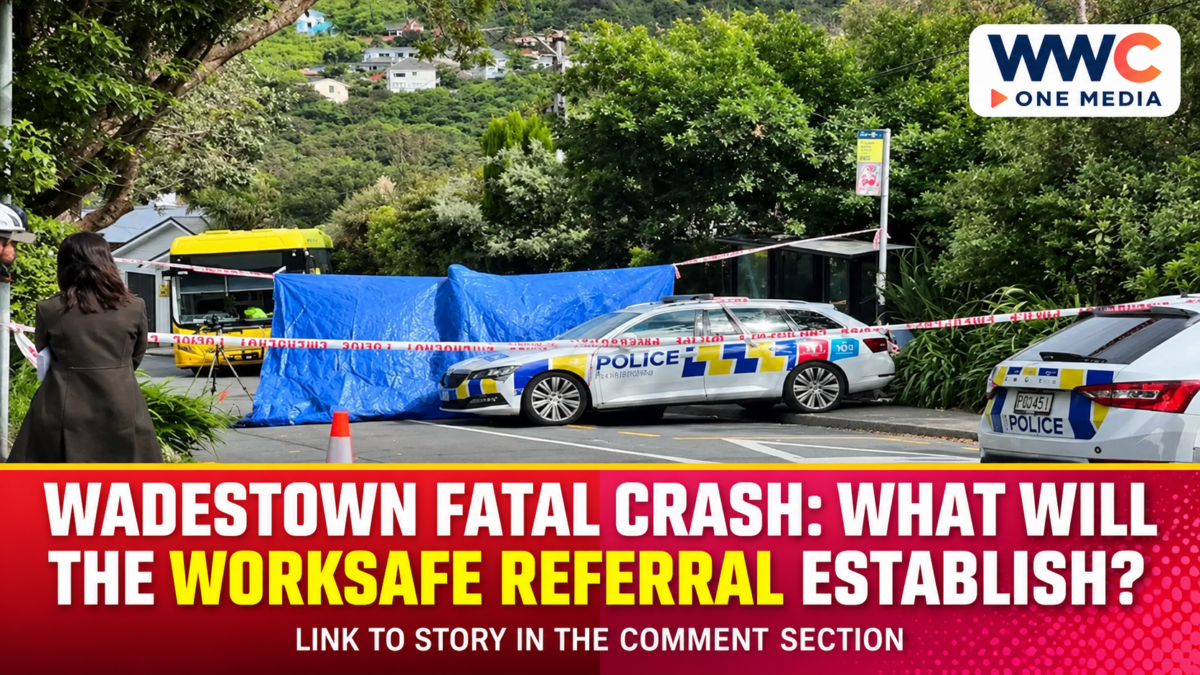
WELLINGTON, New Zealand — A person died following a single-vehicle crash on Norwich Street in Wadestown on Nov. 20, 2026, New Zealand Police confirmed. Officers were called at about 8:15 a.m., and police later referred the incident to WorkSafe after the Serious Crash Unit examined the scene.
The fatal Wadestown crash raises an immediate distinction between facts already established and questions still requiring investigation. A WorkSafe referral brings workplace health and safety into the regulatory picture, but it does not, by itself, establish why the crash occurred or whether anyone breached a legal duty.
Wadestown fatal crash: What police confirmed
The police timeline began with a traffic alert issued at 8:31 a.m. on Nov. 20. It identified Norwich Street, said emergency services were attending a single-vehicle crash reported at approximately 8:15 a.m., and warned motorists about a closure and delays.
Later the same day, at 1:46 p.m., police confirmed that one person had died at the scene. The later statement also said the Serious Crash Unit had carried out a scene examination and that Norwich Street had reopened. It recorded the referral to WorkSafe.
Those updates establish the location, the broad incident classification, the fatal outcome and two procedural developments. They do not describe the vehicle’s technical condition, its precise movements, road conditions, the victim’s identity or an established cause.
That boundary is important. An initial emergency alert is intended to inform the public during a developing response. A later fatal-crash notice can confirm an outcome without answering every question that a completed investigation might address.
Why the WorkSafe referral matters
WorkSafe New Zealand is responsible for regulatory functions concerning workplace health and safety. Its published guidance explains that certain work-related deaths, serious injuries and dangerous incidents must be notified to the appropriate regulator by a person conducting a business or undertaking.
A referral by police is a significant administrative step, but it should not be described as a finding that an employer or worker acted unlawfully. It also does not demonstrate that a formal WorkSafe investigation has already begun.
WorkSafe’s guidance says reported events are assessed to determine the most appropriate response. Possible actions include an investigation, an assisted review of health and safety systems or a decision that no further action is required.
Its published investigation policy describes an inquiry as a process for establishing facts and deciding what action, if any, should follow. That creates a route for considering workplace systems and risks, where they are relevant and supported by evidence.
Analysis: The public interest extends beyond identifying a final moment in the crash. If work-related issues arise, a useful review would distinguish an individual’s actions from the arrangements, equipment and safeguards that may have shaped the event. None of those potential factors can yet be treated as an established cause.
What a safety review could examine
The official crash statement does not identify a mechanical failure, weather event, road defect or medical episode as a contributing factor. Such possibilities should not be converted into explanations simply because they can arise in other road incidents.
A proportionate review could seek to establish the vehicle’s condition, available maintenance records, the sequence of events, relevant operating procedures and any work-related risks. These are potential lines of inquiry, not claims about what investigators have found.
WorkSafe’s general guidance encourages businesses to consider what happened, what could prevent a similar event and which changes could reduce risk. It is not proof that any particular safeguard was absent in Wadestown.
The same distinction appears in WWC’s coverage of a separate Christchurch pedestrian crash report, which examines why a reported incident and an independently established cause should not be confused.
Road reopening does not close the questions
The first police notice warned that Norwich Street was closed while emergency services attended. The afternoon statement confirmed the road had reopened following the Serious Crash Unit’s scene examination.
Reopening a road tells residents that the immediate traffic restriction ended by the time of that update. It does not mean every technical, evidential or regulatory question has been resolved.
WWC recently covered a separate crash and road restriction at Ōhaupō, where the distinction between a timestamped traffic notice and a continuing inquiry was similarly important. The events are unrelated and cannot be used to infer what happened in Wadestown.
Analysis: Public updates are most useful when they specify whether they concern immediate road access, the casualty record or progress in an investigation. Treating all three as one question risks suggesting a conclusion before a regulator has announced it.
Why restraint matters after a fatal crash
A death creates understandable demand for clear answers. But the official police release reviewed for this report does not identify the person who died, establish how the vehicle came to crash or assign responsibility to any individual or organisation.
Without a directly verifiable primary statement, this article does not assert the person’s occupation, name or personal circumstances. Nor does it repeat unverified accounts about passengers or the vehicle’s movements.
This approach is consistent with the distinction WWC drew in its Antipolo truck crash safety report: investigators must establish the evidence before the public can reasonably draw conclusions about responsibility. The Antipolo case has no demonstrated connection to the Wellington crash.
The appropriate questions are whether investigators can establish the event sequence, whether workplace duties require further scrutiny and whether any corrective action is justified. None should be answered by speculation.
What happens next
A further police announcement could clarify the collision circumstances or the status of the inquiry. WorkSafe could separately explain whether it will investigate, pursue another regulatory response or take no further action. Neither outcome was established in the official documents reviewed here as of Nov. 22.
The verified position remains narrow: a person died at the scene of a single-vehicle crash on Norwich Street; the Serious Crash Unit examined the scene; the road reopened; and police referred the matter to WorkSafe. Any account of the cause or legal responsibility must await additional official evidence.
Frequently asked questions
When did the Wadestown crash happen?
Police were called to a single-vehicle crash on Norwich Street, Wadestown, at about 8:15 a.m. on Nov. 20, 2026.
Did anyone die in the crash?
Yes. New Zealand Police confirmed one person died at the scene. Its published crash statement did not identify the deceased person.
Why was the crash referred to WorkSafe?
Police confirmed the referral but did not explain its case-specific grounds. WorkSafe handles matters involving work health and safety; referral alone does not establish wrongdoing.
Has WorkSafe confirmed an investigation?
The reviewed primary records confirm a referral, not a formal WorkSafe investigation or enforcement decision.
Was Norwich Street reopened?
Yes. Police stated at 1:46 p.m. on Nov. 20 that the road had reopened after the Serious Crash Unit’s scene examination.










