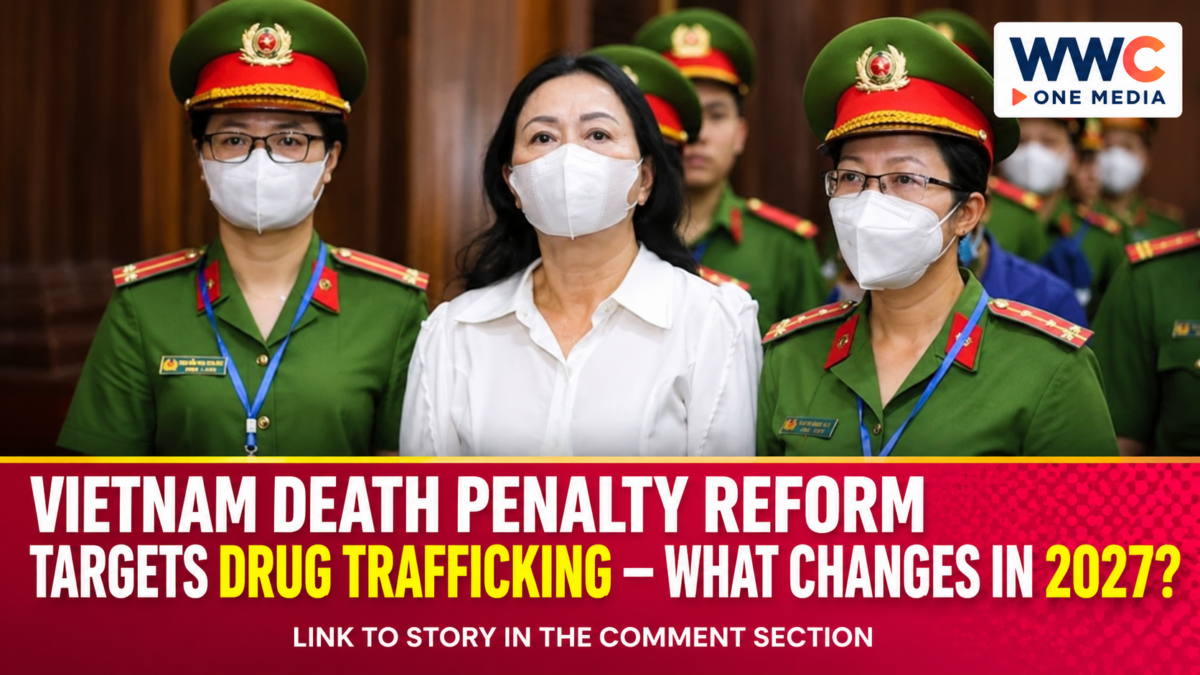
HANOI, Vietnam — Vietnam’s National Assembly approved a revised Penal Code on Nov. 20, 2026, paving the way for the removal of capital punishment for illegal drug trafficking and five other criminal offences. The legislation is scheduled to take effect on March 1, 2027, with life imprisonment replacing the death penalty as the maximum punishment for the affected offences.
The Vietnam death penalty reform represents another significant change in the country’s criminal justice policy, following an earlier reduction in capital offences in 2025.
However, the legislative decision does not amount to the legalisation of drug-related activities or the complete abolition of capital punishment. Authorities will continue to prosecute serious narcotics offences, while the distinction between trafficking and illegal drug production remains central to the reform.
Vietnam death penalty reform advances through parliament
The National Assembly approved the revised Penal Code with 463 of the 472 participating legislators voting in favour, representing 92.79% of the legislature’s total membership.
The revised code contains 417 articles organised into 25 chapters and three parts.
During the legislative proceedings, Minister of Public Security Lương Tam Quang presented the government’s position on the amendments, including its decision to support the removal of capital punishment for six additional offences.
The government maintained that serious criminal conduct must continue to attract substantial penalties despite the narrower application of death sentences.
WWC ONE MEDIA previously examined the proposed reforms in its coverage of a major Vietnamese drug-trafficking case. The latest parliamentary decision moves the issue beyond the proposal stage and towards implementation.
The immediate challenge for the justice system is preparing for the transition between the existing sentencing framework and the revised legislation.
Why trafficking and drug production are treated differently
Vietnam’s approach distinguishes between different criminal activities within illegal narcotics networks.
Under Law No. 86/2025/QH15, which took effect on July 1, 2025, Vietnam removed the death penalty for the separate offence of illegal drug transportation. Illegal drug trading and production, however, remained eligible for capital punishment under the amended framework.
The latest reform extends the reduction to illegal drug trading, commonly described in English as drug trafficking.
During parliamentary discussions on Oct. 27, 2026, the public security minister explained that some individuals involved in trafficking had been manipulated, deceived or pressured into criminal activity.
He argued that criminal justice policy should account for the possibility of rehabilitation while continuing to pursue those responsible for organising illegal networks.
The distinction is significant because people convicted of related narcotics offences may have played substantially different roles.
Removing capital punishment for one offence does not necessarily change the punishment available for another. The precise criminal charge, evidence and applicable statutory provisions remain important.
A change in punishment, not the end of prosecution
The decision to replace capital punishment with life imprisonment should not be interpreted as a relaxation of Vietnam’s prohibition against illegal drug trading.
Life imprisonment remains a severe criminal sanction. Investigators, prosecutors and courts will continue to have responsibilities in addressing organised narcotics activity.
The parliamentary debate also demonstrated that there were competing views about how Vietnam should respond to serious drug offences.
Some legislators supported reducing the use of capital punishment, while others expressed concern about whether removing it would weaken deterrence, particularly for organisers of extensive trafficking networks.
The government’s position ultimately favoured a narrower application of the death penalty.
WWC analysis: The effectiveness of the revised approach will depend on whether authorities can maintain credible enforcement while applying penalties proportionately.
The experience of other legal systems illustrates why sentencing distinctions matter. WWC’s earlier examination of Singapore’s life imprisonment and death penalty framework provides a separate regional example of how statutory provisions influence sentencing decisions.
What the reform could mean for existing criminal cases
One of the most consequential questions concerns individuals sentenced under Vietnam’s previous criminal laws.
Alongside the revised Penal Code, the National Assembly approved an implementation resolution addressing the transition to the new legal framework.
The resolution provides for favourable criminal-law provisions to apply to qualifying earlier offences, including certain cases still undergoing investigation, prosecution or judicial proceedings.
Vietnam has previously established procedures for converting eligible, unexecuted death sentences into life imprisonment.
Article 4 of the 2025 amendment provided a mechanism for the Supreme People’s Court’s chief justice to commute qualifying sentences.
However, the application of the 2026 reform to an individual case must be determined under the new legislation and its relevant implementation provisions.
Families and legal representatives should distinguish between the approval of the legislation, its effective date and formal judicial decisions concerning individual sentences.
Commutation also does not mean acquittal. It changes the punishment imposed without necessarily overturning the underlying conviction.
Why the decision matters across Southeast Asia
Vietnam’s legislative direction is relevant to the wider regional discussion about criminal justice, public safety and the treatment of serious offenders.
Capital punishment policies raise questions about deterrence, rehabilitation, proportionality and the responsibilities of governments towards victims and affected communities.
The decision also comes within the broader context of Vietnam’s regional engagement, including its efforts to strengthen ASEAN cooperation.
WWC analysis: A more differentiated sentencing framework could create opportunities for judicial cooperation with countries that maintain restrictions on involvement in cases carrying capital punishment.
Such opportunities should not be treated as guaranteed outcomes. International cooperation would still depend on applicable treaties, domestic laws and decisions by the relevant authorities.
Similarly, the reform alone cannot establish whether narcotics-related crime will increase or decline. That assessment would require reliable enforcement and criminal justice data collected after implementation.
What happens next
March 1, 2027, is the scheduled starting point for the revised Penal Code.
The next phase will involve applying the new legislation, interpreting transitional provisions and determining the consequences for eligible criminal cases.
Important developments to monitor include formal judicial guidance, decisions involving existing death sentences and official information about the implementation of revised sentencing rules.
Vietnam has made a legislative decision to narrow capital punishment further. The practical measure of that decision will be how consistently the new framework is applied while maintaining public safety and accountability.
Frequently Asked Questions
Has Vietnam abolished the death penalty for drug trafficking?
The National Assembly approved legislation removing capital punishment for illegal drug trading. The revised Penal Code is scheduled to take effect on March 1, 2027.
What will replace the death penalty for drug trafficking?
Life imprisonment is intended to become the maximum punishment for the affected offence.
Has Vietnam completely abolished capital punishment?
No. The reform reduces the number of offences eligible for the death penalty rather than eliminating capital punishment entirely.
Does the reform legalise illegal drugs?
No. Illegal narcotics activities remain criminal offences subject to prosecution and substantial penalties.
Will existing death sentences automatically result in release?
No. Commutation to life imprisonment does not constitute release or acquittal. Individual cases remain subject to applicable transitional provisions and judicial decisions.