
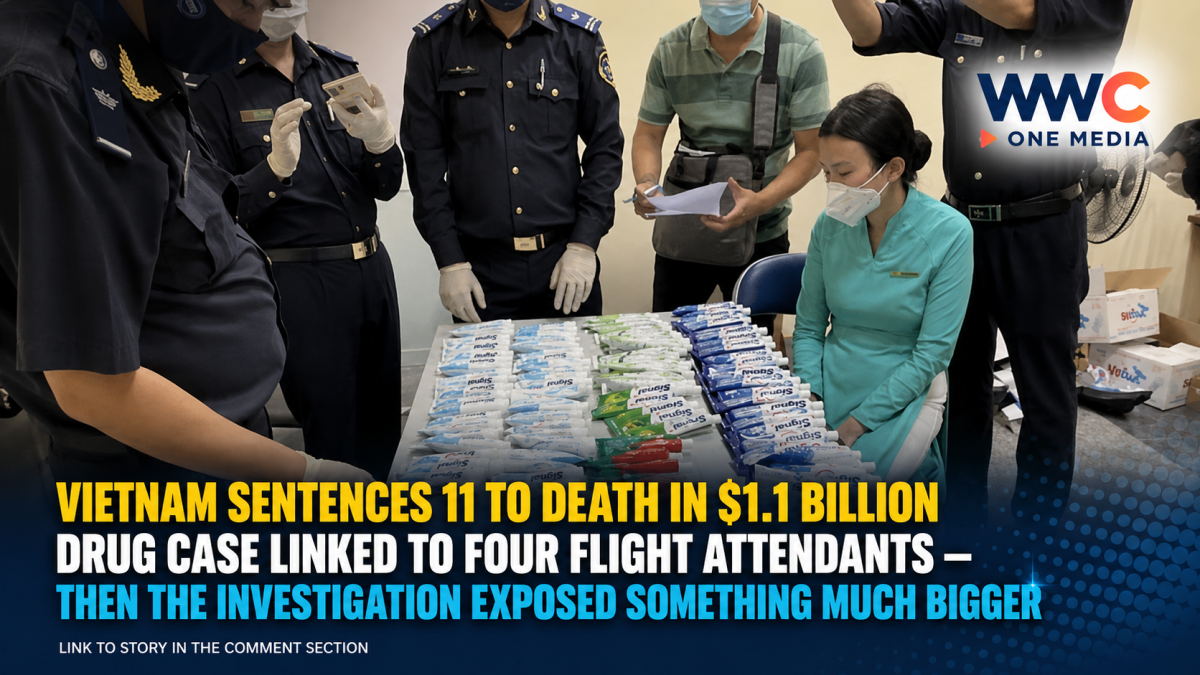
HANOI — A Vietnamese court has sentenced 11 people to death in one of the country’s largest drug trafficking cases, bringing a dramatic conclusion to an investigation that began after narcotics were discovered hidden inside toothpaste tubes carried by four flight attendants returning from France.
The Ho Chi Minh City People’s Court handed down the verdicts on September 3 in the sprawling VN10 case, which involved 227 defendants and a trafficking network prosecutors said was connected to transactions worth nearly VND29 trillion, or about US$1.1 billion. Reuters, VnExpress and Vietnam News all reported the death sentences.
Among those sentenced to death was 52-year-old Ha Danh Nam, whom investigators identified as a leading figure in the network. Authorities said he was responsible for arranging shipments of narcotics from France into Vietnam, including drugs concealed in consumer products.
The court also sentenced 19 other defendants to life imprisonment, while the remaining defendants received prison terms ranging from suspended sentences to lengthy imprisonment depending on their roles and the offences involved.
The case began with toothpaste tubes
The investigation dates back to March 16, 2023, when customs officers at Tan Son Nhat International Airport in Ho Chi Minh City inspected luggage carried by four female Vietnam Airlines flight attendants arriving from Paris on flight VN10.
Authorities discovered 157 toothpaste tubes containing more than 11kg of narcotics, including ketamine and MDMA, according to Vietnamese and international reports.
The discovery initially placed the spotlight on the four flight attendants. But investigators later concluded there was insufficient evidence that the women knowingly transported the drugs, and they were not prosecuted in connection with the trafficking network.
That decision opened the door to a much larger investigation.
Authorities began tracing where the drugs came from, who organized the shipments and how the narcotics were distributed after reaching Vietnam.
Investigators uncovered a multilayered trafficking network
According to court findings reported by Vietnamese media, Nam allegedly arranged multiple shipments from France, concealing narcotics inside products such as toothpaste and other consumer goods.
The network allegedly used cargo-consolidation and express-delivery services, secure messaging applications and bank accounts registered under other people’s names to conceal its operations.
Investigators said the operation was divided into multiple layers, with different individuals responsible for receiving, storing, transporting and distributing the drugs.
The investigation ultimately expanded far beyond the original airport seizure. Vietnamese authorities said more than 2,700 suspects were prosecuted in 477 related cases, while 227 defendants were brought before the court in the VN10 proceedings.
The court identified Nam as a key organizer and said he was connected to the trafficking of nearly 18kg of drugs.
High-profile defendants also sentenced
The massive case also included several Vietnamese public figures whose prosecutions attracted considerable attention.
Singer Nguyen Trung Hieu, better known as Chi Dan, was sentenced to seven years in prison for organizing the illegal use of narcotics.
Charity figure Nguyen Do Truc Phuong received six years for the same offence, while model Andrea Aybar Carmona, known professionally as An Tay, was sentenced to eight years — seven years for organizing illegal drug use and one year for illegal drug possession.
Their sentences were separate from the 11 death sentences imposed on defendants convicted of serious drug-trafficking offences.
The verdict comes as Vietnam considers changing its death-penalty laws
The timing of the verdict is particularly significant.
Just weeks before the VN10 verdict, Vietnam’s government proposed eliminating the death penalty for six offences, including illegal drug trafficking, as part of a broader revision of the country’s Penal Code.
Under the proposal, capital punishment would be retained for only four offences: treason, murder, terrorism and illegal narcotics production. The proposed changes have not yet taken effect.
That means the VN10 defendants were sentenced under the laws currently in force, rather than under the proposed reforms.
Reuters reported that Vietnam’s National Assembly is expected to consider the proposed criminal-code changes in its October 2026 session, with the revised law potentially taking effect in March 2027 if approved.
A case that started with four passengers became a nationwide investigation
What initially appeared to be a drug seizure involving four airline crew members ultimately exposed a far larger alleged trafficking operation spanning France and Vietnam.
The court proceedings demonstrated how investigators followed the trail from narcotics hidden in everyday consumer products to a network involving organizers, storage operators, couriers and distributors.
With 11 death sentences, 19 life sentences and hundreds of other convictions, the VN10 prosecution ranks among Vietnam’s most extensive recent drug-trafficking cases.
The case also arrives at a potentially pivotal moment for Vietnam’s criminal justice system, as the country considers whether drug trafficking should remain punishable by death.
For now, however, the proposed reform has not changed the law under which the VN10 defendants were sentenced.
WWC ONE MEDIA MJE



Leave a Reply