
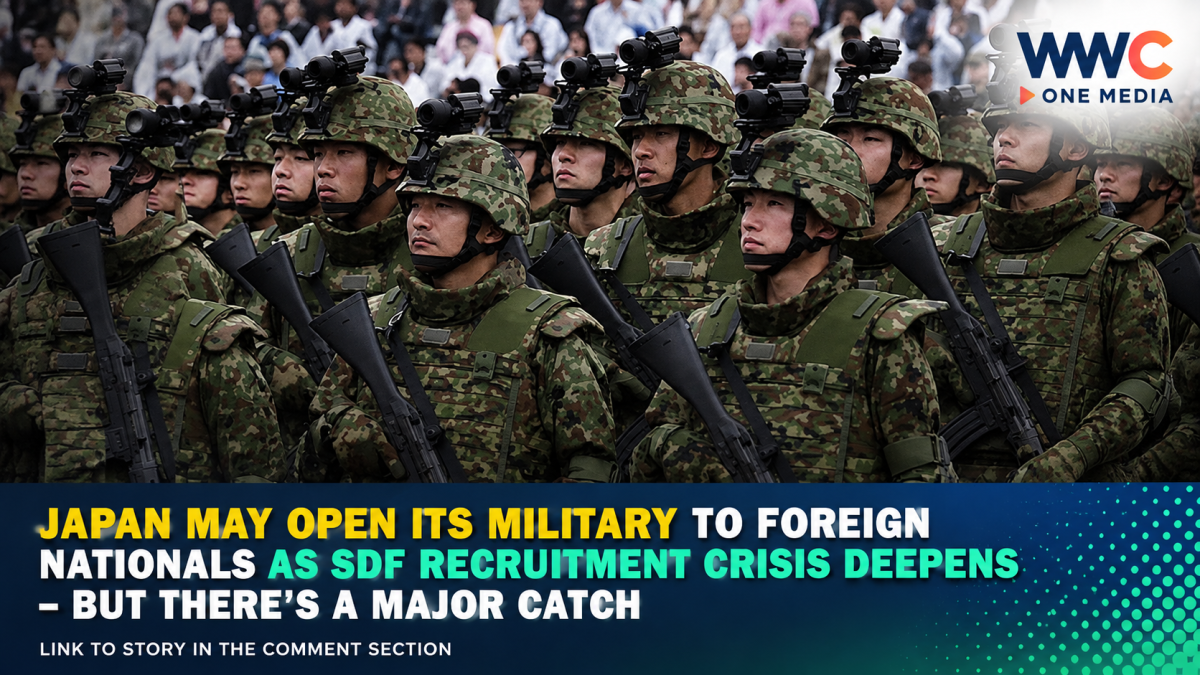
Japan is facing a manpower problem inside its Self-Defense Forces that is becoming increasingly difficult to ignore — and an expert panel has now proposed a once-unthinkable solution: allowing some foreign nationals to serve in the SDF.
The recommendation was presented to Defense Minister Shinjiro Koizumi on September 2 by a panel associated with the Sasakawa Peace Foundation as part of broader proposals aimed at strengthening Japan’s defense capabilities. The proposal comes as the country confronts a shrinking working-age population and persistent difficulty recruiting military personnel.
But this is not a decision by the Japanese government to open SDF recruitment to foreigners.
Instead, the panel is urging Tokyo to seriously examine whether foreign nationals could be recruited for carefully defined positions, rather than being automatically excluded solely because they are not Japanese citizens.
Foreign recruits would face strict limits
The proposal does not envision foreign nationals serving in every role within Japan’s military.
According to Japanese reporting on the recommendations, foreign personnel could potentially be restricted to duties that do not involve the exercise of public authority or the formation of national policy.
The panel also suggested considering restrictions on which nationalities would qualify, potentially limiting recruitment to citizens of allied or friendly countries. Controls over access to classified information would also have to be examined.
That means the proposal is closer to a tightly controlled manpower program than an unrestricted opening of Japan’s armed forces to foreign citizens.
Why is Japan considering such a dramatic step?
Japan’s demographic decline is putting increasing pressure on the SDF’s ability to maintain its authorized personnel levels.
Japan’s Defense Ministry reported that, as of March 31, 2026, the SDF had 217,701 personnel against an authorized strength of 247,154 — an overall staffing rate of just 88.1 percent. The Ground Self-Defense Force was particularly stretched, with a staffing rate of 86.5 percent.
The problem is not simply a temporary recruiting slump.
Defense Ministry data show that between fiscal 2014 and fiscal 2024, the number of SDF applicants fell by about 40 percent, while the number actually recruited declined by roughly 30 percent.
Japan’s government has already been trying to reverse the trend through better compensation, improved living and working conditions and new career-development measures.
Those efforts have produced some improvement. Defense Minister Koizumi said in June that the SDF hired 11,177 personnel during fiscal 2025, an increase of 1,453 from the previous year, or 14.9 percent.
Yet the broader manpower gap remains.
The proposal comes as Japan expands its defense capabilities
The manpower debate is taking place while Japan is simultaneously increasing investment in its military capabilities.
The country is seeking a record ¥8.9 trillion defense budget for fiscal 2027, with plans involving drones, artificial intelligence, missiles, interceptors and other advanced systems. The push reflects growing security concerns involving China, North Korea and Russia, while Japan’s aging population makes it increasingly difficult to expand the force through traditional recruitment alone.
This creates a strategic dilemma for Tokyo: Japan wants a more capable military, but its demographic trends are reducing the pool of people available to staff it.
Australia offers a possible model
The Sasakawa Peace Foundation panel pointed to Australia’s military recruitment system as an example worth studying.
Japanese reports said the panel examined Australia’s rules under which certain foreign nationals — including eligible citizens from countries such as New Zealand, the United Kingdom and the United States — can qualify for military service if they meet conditions including residency requirements.
The panel’s argument is essentially that nationality should not automatically eliminate every possible source of manpower, particularly for jobs that do not require the same level of access to sensitive information or governmental authority.
Koizumi signals interest, but the proposal is far from becoming policy
The recommendation was also notable because it arrived ahead of Japan’s planned review of its three major national security documents.
According to Jiji Press reporting, Koizumi described the recommendations as timely ahead of that review and indicated that the government would seek to realize necessary measures.
However, that should not be interpreted as approval for foreign nationals to enlist.
The proposal still faces major legal, political and national-security questions — including citizenship requirements for public servants, security clearances, classified information, loyalty concerns and determining which military duties could safely be performed by non-Japanese citizens.
For now, Japan’s SDF remains a force recruited under existing Japanese rules. The new development is that a prominent expert panel has formally pushed the government to consider changing those rules because the country’s demographic decline is making military recruitment increasingly difficult.
And that could become one of the most controversial questions facing Japan as it prepares to reshape its national-security strategy: Can Tokyo strengthen its military without enough Japanese citizens to fill the ranks?
WWC ONE MEDIA MJE



Leave a Reply