
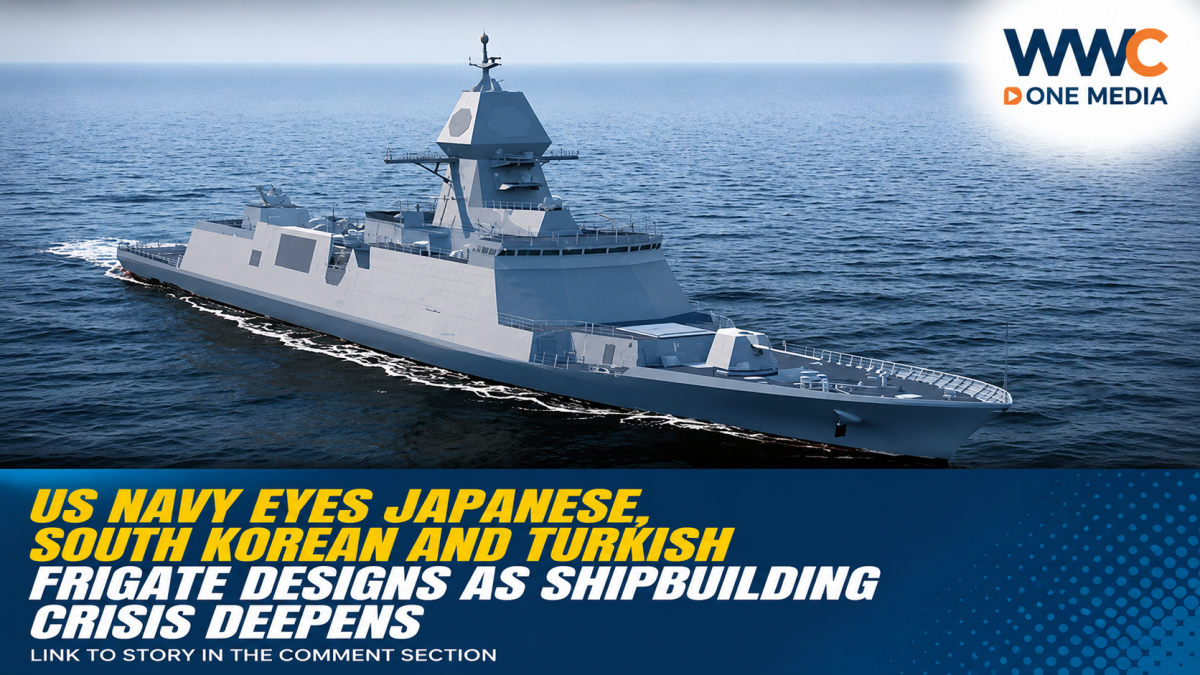
The United States is considering an unusual solution to a growing naval shipbuilding problem: using warship designs developed by key allies — and potentially building the first ships overseas.
The White House and U.S. Navy are reportedly evaluating frigate designs from Japan, South Korea and Türkiye as Washington looks for a faster way to expand its fleet and rebuild an American shipbuilding industry struggling with delays, rising costs and limited capacity.
The three designs reportedly under consideration are Japan’s Mogami-class, South Korea’s Chungnam-class and Türkiye’s Istanbul-class guided-missile frigates. The information was first reported by USNI News, citing three industry sources familiar with the deliberations.
But this is not yet a decision to purchase any particular foreign warship. The Navy is still assessing its options, and significant legal and political hurdles remain.
Why is Washington looking overseas?
The move follows a National Security Presidential Memorandum signed by President Donald Trump on August 13, 2026, which directed the administration to address what it described as serious problems in the U.S. shipbuilding industrial base.
The White House said overly complex designs, repeated design changes, limited shipyard capacity and weak supporting supply chains have contributed to cost increases, delays and cancellations across major naval programs.
The administration is therefore looking at whether established shipbuilding expertise among U.S. allies could help accelerate production while also transferring technology, investment and manufacturing know-how back to American yards.
The Navy says the objective is not simply to buy ships from abroad, but to increase U.S. shipbuilding capacity and train an American workforce using the expertise of allied shipbuilders.
Japan, South Korea and Türkiye enter the race
The reported competition puts three very different frigate designs in the spotlight.
Japan’s Mogami-class
Japan’s Mogami-class has become one of the country’s most prominent modern surface-combatant designs.
The U.S. is reportedly examining the export version developed by Mitsubishi Heavy Industries. The design is already being marketed internationally, giving Washington the possibility of leveraging an established platform rather than starting from a completely new design.
South Korea’s Chungnam-class
South Korea’s Chungnam-class is another candidate.
The Korean program involves multiple shipbuilders, with HD Hyundai Heavy Industries building the lead ship, while SK Oceanplant and Hanwha Ocean are also involved in subsequent vessels. Yonhap reported that South Korea is building six ships in the class.
That distributed industrial base is particularly relevant as Washington examines how to increase production speed.
Türkiye’s Istanbul-class
Türkiye’s Istanbul-class frigate has also entered the discussion, reportedly following talks involving Turkish and U.S. leadership around the July NATO summit.
However, there is an important caveat.
Türkiye has denied that it is engaged in joint shipbuilding work with the United States, according to a report citing the Turkish Ministry of National Defense. The ministry said that while cooperation exists between the two NATO allies, there is currently no joint shipbuilding work.
That means Türkiye’s inclusion should be treated as a reported U.S. consideration, not a finalized Turkish-American shipbuilding deal.
The controversial “Finland model”
One of the most striking elements of the proposal is the possibility of building the first up to two ships in foreign shipyards before moving production to the United States.
The approach has been described as the “Finland model.”
The idea is that an experienced foreign shipbuilder could initially construct the vessels while simultaneously helping establish American production capacity, train workers, transfer manufacturing knowledge and develop the necessary supply chain.
Production would then transition to U.S. shipyards.
The concept resembles an arrangement being pursued for U.S. Coast Guard icebreakers, where foreign shipbuilding expertise is being used while American production capacity is developed.
For Washington, the attraction is obvious: get proven ships moving sooner while the American industrial base catches up.
But Congress could stop it
This is where the proposal gets complicated.
U.S. law generally requires American warships for the U.S. armed forces to be built domestically. The August memorandum invoked a national-security exception that could potentially allow foreign construction.
Congress, however, is already pushing back.
Draft provisions in the Fiscal Year 2027 defense legislation from both chambers have sought to restrict the administration’s ability to use the waiver for foreign-built U.S. warships. The final legislation has not yet been settled.
So even if the Navy chooses a foreign design, Washington’s political battle over where those ships can actually be built is far from over.
The Navy has a frigate problem
The urgency comes from a capability gap.
U.S. Navy officials have argued that the fleet needs a smaller and less expensive surface combatant that can handle missions that do not necessarily require an Arleigh Burke-class destroyer.
Frigates could perform missions such as escort duties, patrols and operations in less contested environments, potentially freeing more capable destroyers for high-end combat missions.
The Navy previously planned to fill this role with the Constellation-class frigate, but that program was cancelled late last year amid concerns over cost, schedule and design problems.
The Navy subsequently moved toward an FF(X) patrol-frigate concept based on the Coast Guard’s National Security Cutter. HII’s Ingalls Shipbuilding has begun pre-production work, but the first construction contract has not yet been awarded.
That leaves Washington searching for ways to get additional hulls into the water faster.
$1.85 billion is already in the picture
The proposed Fiscal Year 2027 budget included approximately $1.85 billion for a foreign warship design study, according to USNI News.
The initial focus was on Japanese and South Korean designs, with the Turkish option subsequently entering the discussion.
The Navy’s international assessment is expected to cover not only combatants but also other types of vessels, including roll-on/roll-off ships and replenishment tankers.
The assessment is due November 12, 2026.
South Korea’s shipbuilding industry could be a major factor
The discussion comes as Washington and Seoul deepen cooperation on shipbuilding.
Yonhap reported that South Korea has committed US$150 billion in investment in the U.S. shipbuilding sector as part of a broader US$350 billion investment pledge under the countries’ bilateral trade and investment arrangement.
U.S. officials have also been visiting South Korean shipyards as Washington evaluates whether Korean industrial capacity could help address American production bottlenecks.
That makes South Korea particularly important in the debate over how quickly the United States can rebuild its naval industrial base.
This isn’t simply about buying foreign ships
The bigger story is industrial capacity.
America’s challenge isn’t only designing warships. It is being able to build them repeatedly, quickly and affordably.
The White House has acknowledged that years of complex designs, changing requirements and limited shipyard capacity have created major delays across the Navy’s shipbuilding programs.
Using an existing foreign design could potentially reduce some of the risks associated with developing a completely new ship.
But there is another danger: modifying a proven foreign design so extensively for American requirements that the U.S. ends up recreating the very delays it is trying to escape.
That lesson is particularly relevant after the troubled Constellation program.
What happens next?
For now, there is no winner.
The Navy is evaluating options, Congress could impose restrictions, and Türkiye has publicly disputed reports of joint shipbuilding activity.
The November 12 assessment will therefore be an important milestone.
If Washington ultimately chooses one of the three designs, the decision could represent one of the most significant changes to U.S. naval shipbuilding policy in generations — potentially combining foreign expertise with American production.
And the stakes extend beyond the U.S. Navy.
As China continues to expand its naval fleet and American shipyards struggle with capacity constraints, Washington faces a difficult question:
Can the United States rebuild its shipbuilding power fast enough — or will it need its allies to help build the fleet first?
WWC ONE MEDIA J.M.D




Leave a Reply