
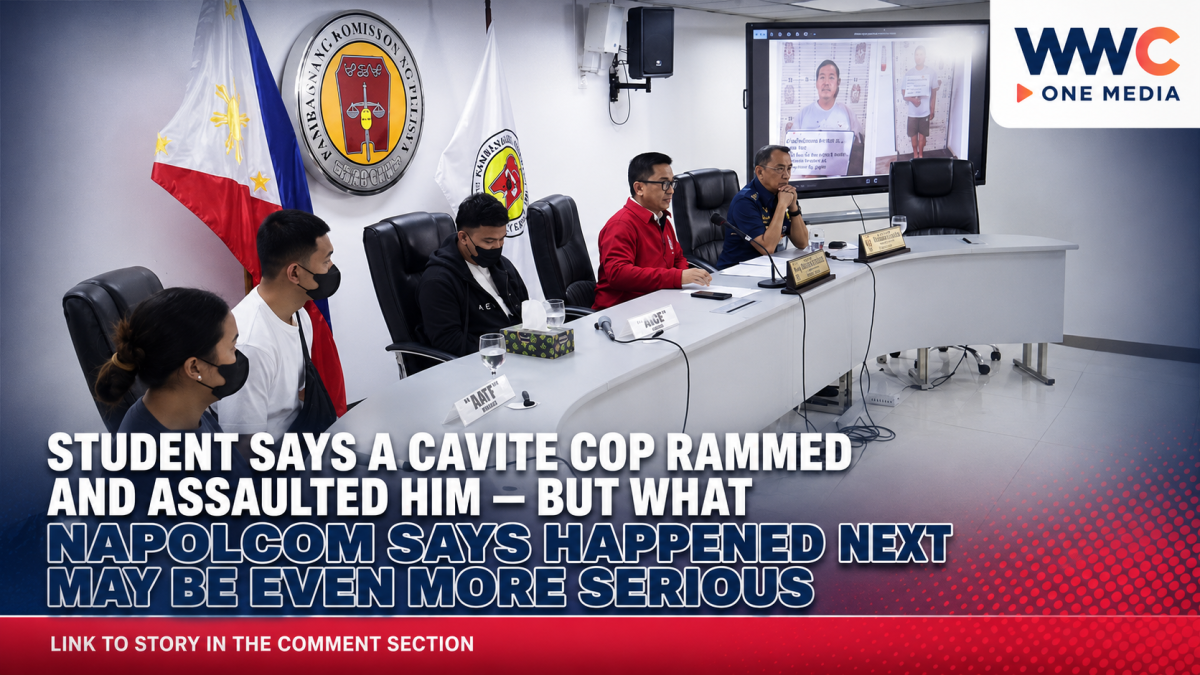
MANILA, Philippines — What began as an alleged late-night road confrontation between a college student and a police officer in Cavite has widened into a far more serious investigation, with the National Police Commission now examining not only accusations of assault and death threats but also claims that another police officer tried to influence how the case was handled.
A 20-year-old college student identified by authorities only as “Ace” filed a complaint with NAPOLCOM against Police Senior Master Sergeant Don Carlos Almonidovar of the General Trias Component City Police Station, alleging that the officer rammed the motorcycle he was riding, physically assaulted him, struck him with a firearm, cursed at him and threatened to kill him.
The alleged confrontation happened at around 11:30 p.m. on August 27 along Governor’s Drive in Barangay San Agustin, Trece Martires City, after Ace made a U-turn ahead of Almonidovar’s vehicle, according to NAPOLCOM and multiple news reports.
But developments disclosed on September 3 suggest that investigators are now looking beyond what allegedly happened on the road.
From traffic dispute to assault allegations
According to Ace’s account, Almonidovar allegedly followed and rammed the motorcycle carrying the student and his 19-year-old companion after the U-turn.
Ace further accused the officer of hitting him, including allegedly striking him with a firearm, and threatening his life.
The two students were subsequently brought to a police station, where there was allegedly an attempt to settle the incident.
NAPOLCOM said a breathalyzer test reportedly indicated that Almonidovar had consumed alcohol. The commission has not said that the test by itself establishes criminal liability, and the accusations against the officer remain subject to investigation.
NAPOLCOM Commissioner Rafael Vicente Calinisan said the allegations, if established, could expose the officer to administrative cases including grave misconduct and conduct unbecoming of a police officer. Dismissal from the police service is among the possible penalties should administrative liability ultimately be proven.
GMA News reported that it sought Almonidovar’s side through the General Trias Component City Police Station but had not received a response as of its September 2 publication.
Officer had already been transferred
The controversy had already triggered action within the police organization before Ace brought the matter directly to NAPOLCOM.
The Philippine Star reported on August 30 that Almonidovar had been transferred to the Cavite police administration and records management unit by Calabarzon police director Brig. Gen. Dominic Baccay.
The Star also reported that Almonidovar had submitted a robbery report involving the two students, but that the investigator on duty did not support that version of events. NAPOLCOM-Calabarzon subsequently assigned a special investigator to examine the case.
That part of the case is significant because what initially appeared to be a dispute over an alleged assault soon raised questions about how the incident itself was being documented.
And on September 3, those questions became even more serious.
NAPOLCOM: Investigator says he was pressured
In a major development reported by the Philippine Daily Inquirer, NAPOLCOM said it is now investigating allegations that Police Captain Gerald Nikko Carlos Almonidovar, the brother of Don Carlos Almonidovar, attempted to influence the investigation.
During a September 3 NAPOLCOM proceeding, case investigator Patrolman Rolyn Pagayon said he had initially considered filing an attempted homicide complaint because of what he viewed as an alleged intent to kill when the motorcycle was rammed.
Instead, the complaints eventually filed were for grave threats and physical injuries.
Asked by Calinisan why those were the cases pursued, Pagayon alleged that the police captain contacted him and made suggestions that affected the investigation. When Calinisan specifically asked whether he had been pressured, the investigator answered in the affirmative, according to the Inquirer report.
NAPOLCOM also presented screenshots it said showed messages between the police captain and the investigator.
According to the Inquirer, the messages allegedly included instructions to state that the students had been drinking while excluding information that the accused officer had consumed alcohol. The police captain was also accused of trying to prevent video connected with the incident from being released.
These remain allegations under investigation. They should not be interpreted as a final determination that either officer committed a crime or administrative offense.
Calinisan subsequently ordered a motu proprio investigation involving the police captain.
Why the investigation is now bigger than the original encounter
The original allegation is already serious: a police officer accused by a civilian of using his vehicle, firearm and authority during a road confrontation.
But the emerging question is no longer confined to what happened on Governor’s Drive.
Investigators now have to determine whether the police process that followed the incident was itself compromised.
If an investigator was actually pressured because of the rank or connections of another officer, the case could raise broader questions about whether existing safeguards are strong enough when police officers investigate accusations involving fellow officers.
Calinisan said NAPOLCOM would study whether cases involving police personnel should be assigned to more senior and experienced investigators, specifically to reduce the risk of intimidation or interference.
He also ordered Trece Martires police to pursue the appropriate charges arising from the incident.
That means the case now has several separate tracks: the student’s original accusations, possible administrative liability within the police service, questions surrounding the initial criminal complaints, and a new investigation into alleged interference by another police officer.
What happens next
NAPOLCOM’s investigation will ultimately have to determine which allegations are supported by evidence, including police records, witness accounts, any available video, the breathalyzer result and the communications allegedly involving the case investigator.
Until those processes are completed, all accusations against Don Carlos Almonidovar and Gerald Nikko Carlos Almonidovar remain allegations, and both are entitled to due process and the presumption of innocence in any criminal proceedings.
But the case has already evolved considerably.
What began as a dispute over a U-turn is now testing something much larger: whether the institutions responsible for policing police officers can establish not only what happened that night in Cavite—but whether the investigation that followed was allowed to proceed without interference.
And that may ultimately become the most consequential part of the case.
WWC ONE MEDIA MJE



Leave a Reply