
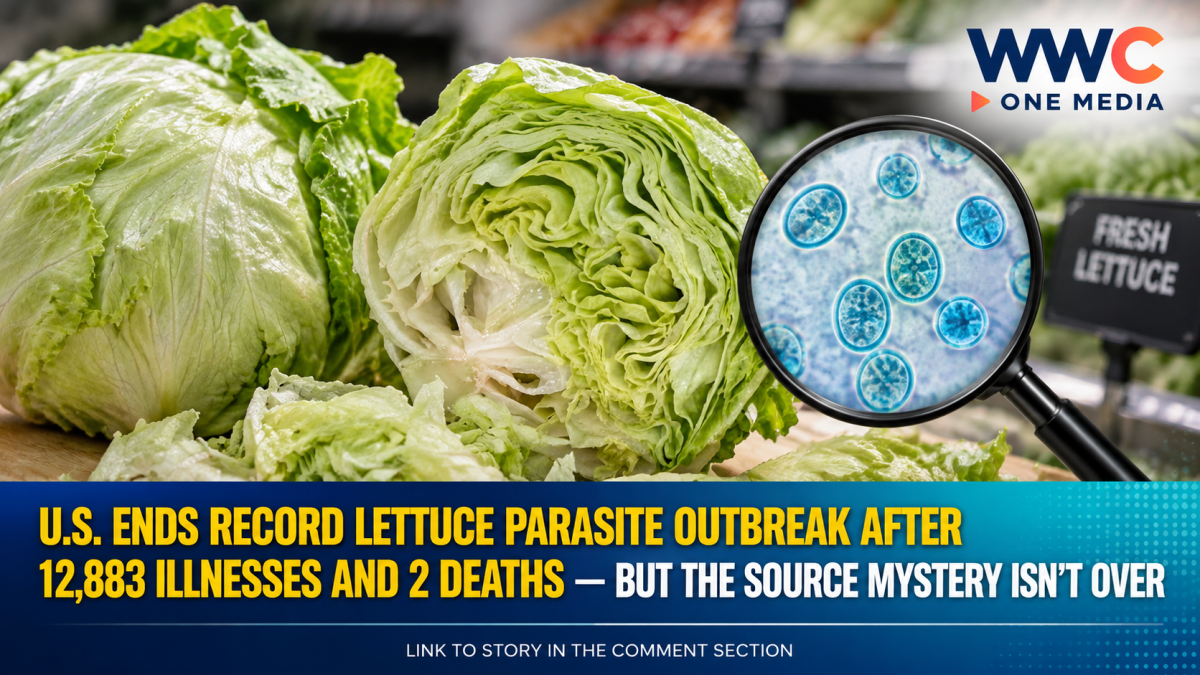
WASHINGTON — U.S. health officials have officially declared the country’s largest recorded multistate Cyclospora outbreak over after contaminated iceberg lettuce was linked to 12,883 illnesses, 570 hospitalizations and two deaths across 21 states.
But while the immediate threat from the recalled lettuce has ended, the investigation into how the parasite contaminated the food supply remains ongoing.
The Centers for Disease Control and Prevention (CDC) said Friday that infections associated with the outbreak have fallen sharply and that the implicated lettuce is no longer available in stores or restaurants. The agency said there is currently no risk of contracting cyclosporiasis from that specific source.
The Food and Drug Administration (FDA), however, is continuing its investigation into the contamination linked to Taylor Farms de Mexico, the supplier associated with the recalled iceberg lettuce.
A record-breaking outbreak
The outbreak became one of the most significant foodborne illness events in the United States this year.
According to the final CDC outbreak figures, 12,883 people in 21 states were linked to the lettuce-associated outbreak. At least 570 people were hospitalized, while two people in Michigan died. Both deaths involved people with significant underlying health conditions.
The outbreak was traced through epidemiological and traceback investigations to iceberg lettuce supplied by Taylor Farms de Mexico. The company initiated a voluntary recall in July covering iceberg lettuce sourced from central Mexico.
The recalled products had best-by dates that have now passed, and federal officials say the affected lettuce should no longer be in commerce.
From more than 1,000 infections a day to almost none
The scale of the outbreak was particularly striking at its peak.
Before the recall, more than 1,000 infections were occurring in a single day, according to the CDC’s final update. By August, the number of infections associated with the outbreak had fallen to fewer than two per day on average.
The last reported illness onset associated with the outbreak occurred in August, and health authorities now consider the specific lettuce-linked outbreak closed.
But that does not mean Cyclospora has disappeared from the United States.
Nearly 20,000 cases reported nationwide
The lettuce outbreak accounted for a large portion of a much broader surge in cyclosporiasis infections this year.
CDC data showed 19,595 laboratory-confirmed domestically acquired cases reported since May 1, with cases recorded in 49 states and Washington, D.C. The lettuce-associated outbreak therefore represented more than half of the country’s confirmed infections during that period.
That distinction is important.
The CDC has ended the specific lettuce outbreak — not the nationwide investigation into every Cyclospora infection reported this year.
Federal officials are continuing to investigate other clusters for which a food source has not yet been identified.
The contamination mystery remains
Cyclospora is a microscopic parasite that causes an intestinal illness known as cyclosporiasis.
The parasite is generally transmitted when food or water becomes contaminated with human fecal matter. Unlike some other foodborne pathogens, direct person-to-person transmission is considered unlikely because the parasite needs time outside the body before it becomes infectious.
That makes the central question in the investigation particularly important:
How did Cyclospora get onto the lettuce in the first place?
The FDA has completed on-site inspections and sample collection at lettuce-growing operations and the processing facility in Mexico, but laboratory analysis and the agency’s root-cause investigation are continuing.
Officials have not publicly established exactly where or when the contamination occurred.
Why the outbreak raised wider food-safety concerns
The outbreak has also triggered renewed scrutiny of the U.S. food-safety system and the inspection of imported produce.
An Associated Press investigation reported that FDA inspections of foreign food facilities have declined substantially since 2019, raising questions about how effectively imported produce is being monitored before reaching American consumers.
The issue is significant because fresh produce moves rapidly through international supply chains, making it difficult to identify the exact point at which contamination occurs.
Food-safety experts have also pointed to the challenges of tracking Cyclospora because the parasite can have a delayed incubation period and many infected people may never be tested.
What consumers should know now
For consumers, federal officials say there is no current risk from the specific recalled lettuce associated with this outbreak because the implicated products are no longer on the market.
However, cyclosporiasis can occur from other contaminated food or water sources.
Typical symptoms include:
- Frequent watery diarrhea
- Stomach cramps or abdominal pain
- Bloating and increased gas
- Nausea
- Loss of appetite
- Weight loss
- Fatigue
Symptoms can persist or return if the infection is not properly treated. People experiencing persistent diarrhea or other concerning symptoms should contact a healthcare professional, particularly if they recently consumed recalled or potentially contaminated produce.
The outbreak is over. The investigation isn’t.
The CDC’s declaration marks an important turning point: the contaminated lettuce connected to the record outbreak is no longer considered a source of ongoing infections.
But the FDA is still trying to determine how Cyclospora entered the lettuce supply chain and what can be done to prevent another outbreak of similar scale.
That leaves U.S. consumers with an uncomfortable reality:
The immediate lettuce threat is over — but the mystery behind America’s record Cyclospora outbreak remains unsolved.



Leave a Reply