
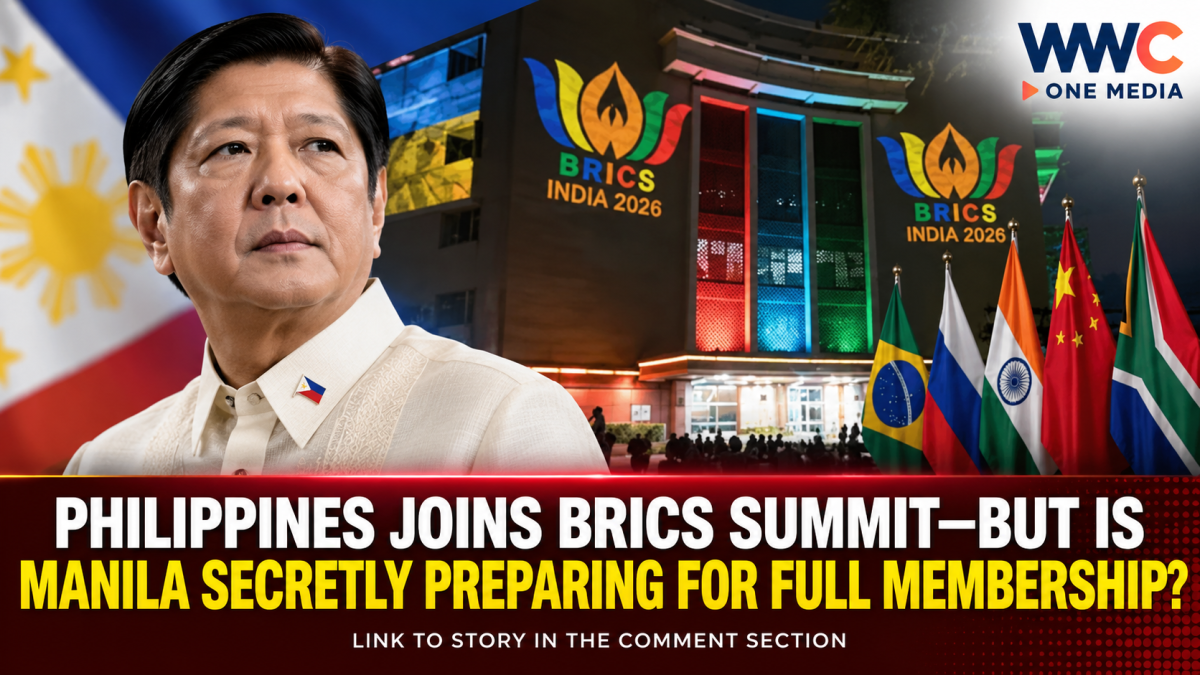
NEW DELHI, India — President Ferdinand Marcos Jr. is attending the 18th BRICS Summit in India, but Philippine officials have moved to clarify one major question: the Philippines is not yet discussing full membership in the powerful emerging economies bloc.
The clarification comes as speculation grows over whether Manila could eventually join BRICS, an increasingly influential group that brings together some of the world’s largest emerging economies.
Philippine Ambassador to Japan Mylene J. Garcia-Albano said there have been no discussions so far on the Philippines joining BRICS, according to ABS-CBN News.
The issue has gained fresh attention after President Marcos was invited to attend the September 12-13 BRICS Summit in New Delhi. But Philippine officials stressed that his participation should not be mistaken for a formal application for membership.
Marcos Attends BRICS as ASEAN Chair
The Department of Foreign Affairs said President Marcos was invited to the summit primarily in his capacity as ASEAN Chair for 2026, giving the Philippines an opportunity to represent broader Southeast Asian interests before leaders of major emerging economies.
DFA spokesperson Analyn Ratonel said earlier this week that any possible Philippine move toward BRICS membership would require further study and close monitoring, including an assessment of the experiences of fellow ASEAN countries that are already part of the bloc.
The Philippine government has described Marcos’ participation as a strategic opportunity to engage major emerging economies while advancing ASEAN priorities in peace and security, prosperity, people empowerment, trade and climate resilience.
The President is also expected to use the trip to strengthen the Philippines’ strategic partnership with India and review progress under the two countries’ five-year plan of action for 2025 to 2029.
So, Is the Philippines Joining BRICS?
Not at this point, based on the government’s latest statements.
While President Marcos is attending the summit, Philippine officials have made clear that there is currently no announced decision, application or formal discussion committing the country to full BRICS membership.
That distinction is important.
Manila’s current approach appears to be focused on engagement rather than membership—allowing the Philippines and ASEAN to explore cooperation and better understand emerging economic and geopolitical frameworks without immediately making a commitment.
President Marcos has repeatedly emphasized that the Philippines remains open to economic partnerships with different countries, saying the government’s priority is attracting investments, creating jobs and strengthening local capabilities.
Why BRICS Matters to the Philippines
BRICS has grown far beyond its original five members—Brazil, Russia, India, China and South Africa.
The expanded grouping now includes major emerging economies such as Egypt, Ethiopia, Indonesia, Iran, Saudi Arabia and the United Arab Emirates, giving the bloc greater economic and geopolitical influence.
The group represents a significant share of the world’s population and has increasingly pushed for reforms in global financial institutions, stronger cooperation among developing economies and alternative systems for cross-border payments.
Reuters reported that one of the major discussions surrounding the 2026 summit involves efforts to improve financial connectivity, including possible links between central bank digital currencies for faster cross-border transactions.
However, BRICS itself faces major challenges.
Despite its growing size and influence, the bloc includes countries with very different geopolitical interests, security concerns and economic priorities. Recent global conflicts and tensions among members have also raised questions about how effectively BRICS can maintain a unified position on major international issues.
A Delicate Balancing Act for Manila
For the Philippines, closer engagement with BRICS could potentially open doors for expanded trade, investment and cooperation with major emerging economies.
But Manila must also carefully balance those opportunities with its existing relationships.
The Philippines maintains deep economic and security ties with traditional partners such as the United States and Japan, while also pursuing economic engagement with China and other countries despite continuing tensions in the West Philippine Sea.
That balancing act could become even more important as BRICS expands its role in global trade, finance and diplomacy.
Philippine officials have stressed that the country’s engagement with BRICS is anchored in its commitment to ASEAN centrality. Rather than choosing one global camp over another, Manila appears to be positioning itself to work with multiple partners where Philippine interests can benefit.
What Happens After the BRICS Summit?
The biggest question now is whether President Marcos’ participation in New Delhi will eventually lead to deeper engagement between the Philippines and BRICS.
For now, the government’s position remains cautious.
There is no official indication that the Philippines is applying for membership, and officials say the matter would require further study.
But the President’s attendance at the summit places Manila directly in conversations involving some of the world’s most influential emerging economies—and that alone could have long-term implications.
As global power continues to shift and new economic alliances gain influence, the Philippines may increasingly face a critical question:
Should Manila simply engage with BRICS—or could the country eventually decide that joining the bloc is in its national interest?
For now, Philippine officials are keeping that door under review.
But with Marcos now sitting at the table in New Delhi, the conversation over the Philippines’ future relationship with BRICS may only be getting started.


Leave a Reply