
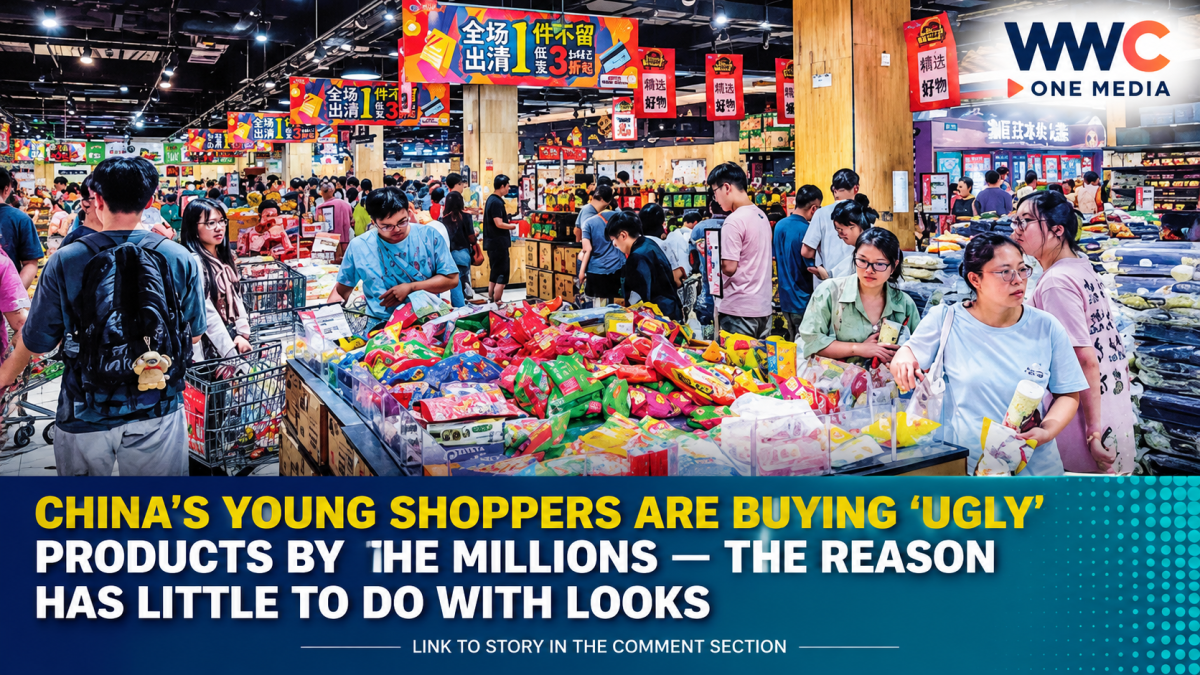
What was once dismissed as strange, useless or simply “ugly” is becoming a surprisingly lucrative corner of China’s consumer market.
Across Taobao, products that deliberately reject conventional ideas of beauty are attracting millions of young shoppers who are increasingly willing to pay for humor, individuality, novelty and emotional value rather than polished aesthetics.
According to figures cited by the South China Morning Post, sales connected to Taobao’s “ugly” goods industry have surpassed 230 million yuan (about US$34.3 million) since the platform launched its annual Uglies Award in 2020. The trend has now evolved beyond an online curiosity into a recognizable consumer and creative-business phenomenon.
When “ugly” becomes the selling point
The products are not necessarily defective or poorly designed. In many cases, their appeal comes precisely from being unusual.
Think bizarre-looking plush toys, deliberately awkward accessories, strange household products and unconventional characters that would struggle to fit into traditional definitions of attractive design.
For younger consumers, that difference can be the entire point.
Instead of buying something because everyone else considers it beautiful, shoppers can use an unusual product to communicate a sense of humor, personality or individuality.
That shift reflects a broader change in Chinese youth consumption, where emotional value and personal identity are increasingly influencing purchasing decisions.
Previous research and reporting by the South China Morning Post has documented the rise of “emotional consumption” among China’s younger generation, including spending on toys and other products that may have limited practical value but provide enjoyment, comfort or social connection.
Taobao turns an internet joke into a business
Taobao’s Uglies Award, launched in 2020, helped give this unusual category a platform.
What initially looked like a playful annual competition has increasingly become a discovery mechanism for designers and small businesses whose products fall outside mainstream aesthetics.
The trend has now moved offline as well.
In September 2026, Taobao and the China Academy of Art’s School of Intermedia Art jointly presented the second Taobao Ugly Things Art Exhibition in Hangzhou.
The exhibition features more than 500 products across more than 30 installations, covering more than 1,200 square meters—roughly twice the scale of the previous exhibition. It is scheduled to open to the public from September 12 to September 27.
That expansion is significant.
It suggests that what began as an internet trend is increasingly being treated as a legitimate source of creativity, intellectual property and commercial opportunity.
From one viral character to an entire brand
One of the biggest changes is that creators are no longer necessarily stopping after a single product goes viral.
A quirky character can become a series.
A strange illustration can become a plush toy.
A humorous object can evolve into an entire brand.
Chinese media reports that some products connected to the trend have already achieved substantial sales. For example, the “Longtou Laoda” hanging character reportedly sold more than 70,000 units in three months, while the “Langlangshan Little Monsters” series sold more than 30,000 pieces in just 10 days.
As of 2026, Chinese reports citing Taobao data put cumulative sales related to the “ugly things” industry at approximately 230 million yuan, with the products reaching tens of millions of young consumers.
Why young consumers are embracing the bizarre
The trend is part of a larger battle against sameness.
Mass production has made many consumer products increasingly standardized. Young shoppers, however, can find standardized design boring when every product begins to look interchangeable.
The appeal of an unconventional item is therefore partly its imperfection.
A weird-looking toy can be memorable.
An awkward accessory can become a conversation starter.
A deliberately strange object can provide something increasingly valuable in the digital age: a sense of personal identity.
China’s broader “emotional consumption” trend provides an important backdrop. Young consumers have shown willingness to spend on relatively inexpensive products that deliver amusement, companionship or a feeling of personal connection—even when the practical usefulness of the item is limited.
The business opportunity—and the danger
But “ugly” is not automatically profitable.
Earlier reporting on Taobao’s ugly-product phenomenon found that successful products generally require more than simply making something unattractive. The strongest products combine humor, character, storytelling and a recognizable creative concept.
That makes the trend more difficult to copy than it first appears.
A product that is merely ugly may attract attention once.
A product with a distinctive character can potentially create repeat customers and an entire intellectual-property ecosystem.
There is also the risk of imitation.
Once a quirky product becomes viral, competitors can quickly reproduce similar designs, potentially diluting the original creator’s identity. Chinese reports say Taobao has been emphasizing intellectual-property protections and says it seeks to avoid directing traffic toward mass-produced copies.
“Ugly” may actually be the new kind of beautiful
The deeper story is not really about ugly products.
It is about changing definitions of value.
For decades, consumer marketing largely relied on making products more beautiful, sophisticated and aspirational.
Now a growing group of consumers is showing that the opposite can also work.
The more unusual the product, the more memorable it can become.
And the more personal the story behind it, the stronger its emotional connection with the buyer.
China’s “ugly goods” phenomenon therefore offers a fascinating lesson for brands: in a marketplace crowded with products designed to look perfect, imperfection itself can become a competitive advantage.
What started as a collection of bizarre objects on Taobao may now be turning into something much bigger—a new business model built around humor, individuality, emotional value and the freedom to like something precisely because everyone else thinks it looks ridiculous.




Leave a Reply