
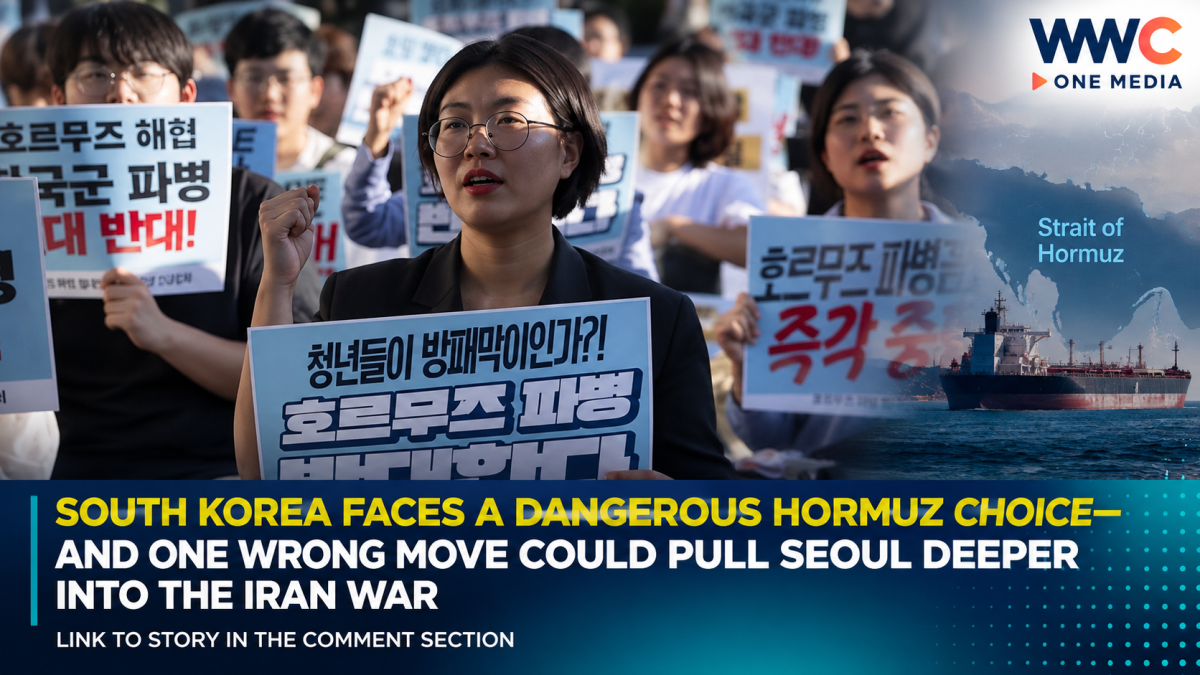
SEOUL — South Korea is facing a high-stakes decision over the Strait of Hormuz, with growing pressure to contribute to maritime security while avoiding a military commitment that could pull the country deeper into the escalating conflict involving Iran.
The dilemma has become increasingly urgent because the Strait of Hormuz is not simply a strategic waterway for Seoul—it is a critical lifeline for South Korea’s energy-dependent economy.
About 70 percent of South Korea’s crude oil imports pass through the strait, according to a recent Korea Herald editorial carried by Yonhap. That makes freedom of navigation in the waterway directly tied to the country’s economic and energy security.
But helping secure the waterway comes with a potentially dangerous price.
Seoul under pressure—but no final deployment decision
South Korean officials have repeatedly emphasized that no final decision has been made on sending military assets to the region.
Seoul has been reviewing different ways it could contribute to international efforts to protect maritime navigation, while stressing that any action must comply with South Korean law and preserve the country’s defense readiness on the Korean Peninsula.
Reuters reported earlier this month that President Lee Jae Myung and French President Emmanuel Macron discussed freedom of navigation and maritime security during Lee’s visit to France. South Korea’s national security adviser said discussions were focused on possible contributions to maritime security—not a decision to deploy troops.
The South Korean Defense Ministry has also sent an inspection team to the United Arab Emirates to assess regional security conditions. Officials stressed that the mission was for assessment and did not itself constitute a decision to deploy military forces.
Any overseas military deployment would require approval from South Korea’s National Assembly.
That legal requirement could become one of the biggest obstacles to any rapid decision.
Why the Strait of Hormuz is becoming an even bigger concern
The risks are no longer theoretical.
The Strait of Hormuz has become an increasingly dangerous environment for commercial shipping amid the wider Iran conflict. Ships traveling through the area face the possibility of attack, disruption and prolonged delays.
The danger has already been felt by Filipino seafarers.
On Aug. 31, the Saudi-flagged oil tanker MT SIDR, carrying 16 Filipino crew members, was attacked while operating near the Strait of Hormuz. Two Filipino seafarers were killed and the remaining 14 survived. The Department of Migrant Workers said a fire broke out aboard the tanker but was contained by the crew.
The 14 surviving Filipino crew members were later repatriated to the Philippines and arrived in Manila on Sept. 8.
The remains of the two deceased Filipino seafarers arrived back in the Philippines on Sept. 11. One was to be brought to the family in Laguna and the other to Cebu.
The Philippine government has also been investigating the circumstances surrounding the deployment of Filipino seafarers to vessels operating in high-risk areas.
The DMW has warned shipping companies and manning agencies to conduct appropriate risk assessments and recognize Filipino seafarers’ right to refuse sailing into dangerous areas.
The danger South Korea cannot ignore
For Seoul, the experience of commercial crews operating in the region highlights a fundamental problem.
Even if a South Korean mission were officially described as defensive, humanitarian or noncombat, its personnel could still operate in an active conflict environment.
The Korea Herald editorial warned that maritime patrol aircraft, support vessels and other supposedly defensive assets could become targets simply because they are part of the broader military infrastructure operating in the region.
That creates the possibility of an escalation scenario:
A Korean asset enters the region to protect shipping.
An incident occurs.
Korean personnel are attacked.
Seoul is then forced to decide whether to retaliate, reinforce the mission or withdraw.
What begins as a limited maritime-security operation could therefore evolve into a much larger military and diplomatic crisis.
Washington adds another layer of pressure
South Korea’s decision is also complicated by its alliance with the United States.
U.S. President Donald Trump has repeatedly pushed Seoul to make a greater contribution to efforts surrounding Iran. At the same time, Washington and Seoul are managing sensitive issues involving security commitments, trade, investment and broader alliance responsibilities.
The Korea Herald editorial cautioned against treating Hormuz participation as a bargaining chip in unrelated negotiations.
The argument is that decisions involving Korean military personnel should be based on South Korea’s own national-security interests rather than being exchanged for concessions on tariffs, semiconductors or other bilateral disputes.
That distinction could become crucial if pressure from Washington intensifies.
Iran is watching Seoul’s next move
There is another major complication: Iran.
South Korea has maintained diplomatic and economic relations with Iran, and Seoul must balance its relationship with Tehran against its alliance with Washington.
Reuters reported that Iranian officials had sought explanations through diplomatic channels after reports emerged about possible South Korean participation in Hormuz security efforts. Iran has also warned that Korean military involvement could be interpreted as support for U.S. actions.
That means a decision intended to protect South Korea’s energy supplies could potentially expose Korean ships, personnel and commercial interests to greater danger.
The economic stakes are enormous
The Strait of Hormuz carries a substantial share of the world’s energy shipments, making any prolonged disruption a potential threat to global oil and commodity markets.
For South Korea, the stakes are particularly high because the country depends heavily on imported energy.
This creates an uncomfortable paradox for Seoul:
The country has a powerful economic interest in keeping Hormuz open—but sending military assets there could expose those same economic interests to additional security risks.
The challenge is therefore not simply whether South Korea should help.
It is how far Seoul should go—and where it should draw the line.
A possible middle ground
South Korea could explore alternatives that strengthen maritime security without immediately placing Korean troops in the middle of the conflict.
These could include cooperation with international partners, intelligence-sharing, humanitarian assistance, mine-clearance operations or other narrowly defined defensive activities, depending on the security environment and South Korean law.
The Korea Herald editorial pointed to Japan as an example of how an ally can contribute to maritime security while maintaining legal and operational limits.
But whatever option Seoul chooses, officials will have to answer several difficult questions before moving forward:
What exactly would Korean forces be authorized to do?
Who would command them?
What would their rules of engagement be?
How long would they remain in the region?
And, perhaps most importantly, what circumstances would trigger a withdrawal?
Those questions matter because a mission that enters an active war zone can become much harder to control once the first shot is fired.
The bigger question for Seoul
South Korea now finds itself caught between two powerful realities.
On one side is its alliance with Washington and its enormous dependence on the uninterrupted flow of energy through the Strait of Hormuz.
On the other is the risk that participating militarily could expose South Korean personnel and commercial interests to retaliation and potentially draw Seoul into a conflict it has no interest in widening.
The deaths of two Filipino seafarers aboard the MT SIDR have provided a stark reminder that the danger in the region is already reaching civilian crews—not merely military forces.
For Seoul, the question is no longer simply whether it can afford to help protect the Strait of Hormuz.
It is whether the price of helping could ultimately be far higher than the security benefit it is meant to provide.
For now, South Korean officials say no final deployment decision has been made.
But as pressure mounts and the risks around the waterway continue to grow, Seoul’s window for making that decision safely may be getting smaller.


Leave a Reply