
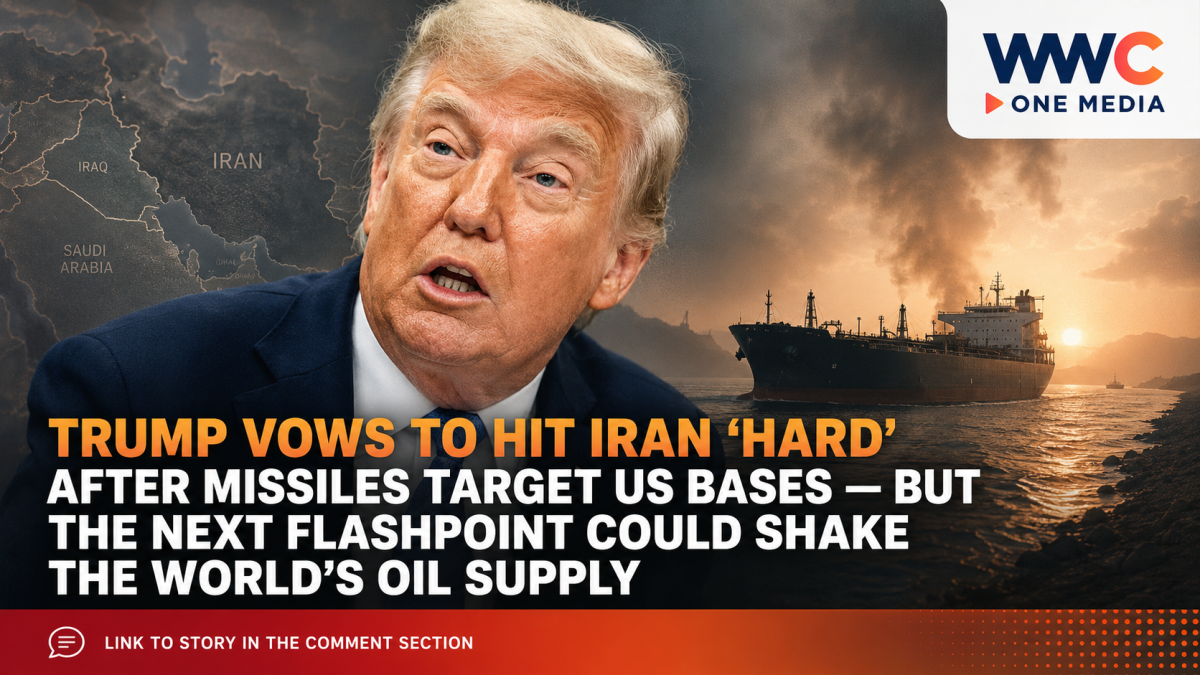
WASHINGTON/TEHRAN — The US-Iran conflict is threatening to explode back into open military confrontation after the first major exchange of direct fire in roughly a month, with President Donald Trump promising a forceful response and new attacks putting the strategically vital Strait of Hormuz back at the center of the crisis.
The latest escalation began after US forces struck Iranian military positions on Larak Island, an Iranian island sitting inside the Strait of Hormuz.
Washington said the operation targeted two launchers after forces belonging to Iran’s Islamic Revolutionary Guard Corps were observed preparing rockets that could deploy sea mines into the waterway.
US Central Command characterized the operation as a limited and precise strike against forces posing what it described as an imminent threat to navigation through the strait.
Iran responded by firing missiles toward American military positions in Jordan.
Iran’s Revolutionary Guards said its retaliatory operation targeted the King Hussein and Al Azraq bases, according to Al Jazeera. Jordanian authorities said Iranian missiles were intercepted, while regional reporting said eight missiles were brought down.
The retaliation immediately drew a warning from Trump.
“We’re going to hit them hard,” Trump told Fox News, according to Reuters, adding that there would be a US response.
But Trump simultaneously suggested Washington was not deliberately trying to restart the conflict at its previous intensity.
Speaking separately to reporters, he described Iran as militarily weakened and said the renewed strikes did not necessarily mean a return to full-scale warfare. Asked about nuclear weapons, Trump said he saw no reason to use them, arguing that Iran had already been severely weakened militarily.
The confrontation is already spreading beyond Iran and Jordan
The danger is no longer limited to the missiles exchanged between Washington and Tehran.
The United Arab Emirates said it intercepted an Iranian drone over its territorial waters on Monday and called the incident a dangerous escalation.
Iran had separately claimed that it attacked Al Minhad Air Base in the UAE. Emirati officials rejected that claim, saying the base had not been hit.
That distinction is important: Tehran is projecting an ability to threaten American-linked military infrastructure across the Gulf, while neighboring governments are increasingly being pulled into a confrontation they have strong economic and security reasons to contain.
Iranian officials, meanwhile, have tried to characterize the latest military exchange as controlled.
A senior Iranian source told Reuters that the confrontation was limited and contained but warned Tehran would respond more severely if Iran were attacked again.
Those two messages—restraint and retaliation—are now being delivered simultaneously by both sides.
And that is what makes the next move unusually dangerous.
Why Larak Island matters far beyond the battlefield
The location of the US strike may ultimately matter more than its size.
Larak sits beside the Strait of Hormuz, one of the most strategically important waterways on Earth.
Before the conflict severely disrupted shipping, roughly one-fifth of global oil and gas shipments normally passed through the narrow channel connecting the Persian Gulf with international markets.
Sea mines make that waterway particularly difficult to secure.
The United States does not merely need to destroy Iranian launchers to convince commercial shipping companies that Hormuz is safe. It must persuade tanker operators, insurers and energy traders that mines or other attacks will not threaten vessels entering the strait.
That is a much harder standard.
Experts cited by The Wall Street Journal have noted that mine warfare gives Iran an asymmetric advantage: even the possibility of mines can discourage commercial vessels from entering the waterway, while clearing and guaranteeing the safety of the entire shipping route is far more complicated.
Markets are already reacting.
Brent crude moved above $90 a barrel following the renewed US-Iran attacks, while West Texas Intermediate also climbed as traders added a larger geopolitical risk premium to Gulf oil supplies.
That means the next confrontation does not necessarily have to destroy an oil field to hurt consumers.
Fear alone can raise transportation costs, insurance premiums and energy prices.
Trump’s Kharg Island post added another layer of uncertainty
Hours after the renewed confrontation, Trump posted videos on social media appearing to show explosions engulfing Kharg Island, Iran’s main oil export terminal.
He wrote that the island was being “blown to smithereens.”
But the footage was AI-generated.
Reuters reported that no such attack had occurred.
Vice President JD Vance later portrayed the post as a message to Tehran rather than evidence of an actual military strike.
The episode matters because Kharg Island is not just another military target.
It is central to Iran’s oil-export infrastructure. Any real attack on the facility could dramatically widen the conflict and potentially trigger Iranian retaliation against energy infrastructure elsewhere in the Gulf.
Washington has so far largely avoided attacking Iran’s biggest oil and gas assets, while Tehran has repeatedly warned that strikes on its energy infrastructure could lead to attacks elsewhere in the region.
Washington is also trying to win the war economically
Military strikes are only one part of the US strategy.
Washington has been intensifying secondary sanctions aimed not only at Iran but also at banks, companies and countries that continue helping Tehran sell oil or move money internationally.
US Treasury Secretary Scott Bessent said new secondary sanctions could be announced on a weekly basis, with banks among the first targets.
Bessent has argued that Iran’s renewed military actions reflect mounting economic pressure from the sanctions campaign. Tehran disputes Washington’s broader portrayal of the conflict and maintains that it will defend itself against American attacks.
The approach creates another potential escalation path.
If military pressure remains limited but Washington succeeds in tightening Iran’s access to international banking and oil markets, Tehran could increasingly turn to the Strait of Hormuz as economic leverage.
Iran still says it wants negotiations
Despite the renewed attacks, Iranian President Masoud Pezeshkian has continued publicly advocating a negotiated solution.
Speaking during a meeting with Indian Prime Minister Narendra Modi, Pezeshkian said continued warfare was not in the interests of Iran, the region or the wider world.
Regional powers have also been searching for a diplomatic off-ramp after months of conflict and stalled negotiations.
But the central disagreements remain unresolved.
Washington still wants limits on Iran’s nuclear capabilities, reduced Iranian military pressure on neighboring states and greater security around the Strait of Hormuz. Iran wants an end to US attacks and economic pressure while insisting on its right to defend itself and maintain influence over access to the strategic waterway.
For now, neither side appears eager to return immediately to the heaviest fighting seen earlier in the conflict.
Yet neither is willing to absorb an attack without answering it.
That leaves the US and Iran in perhaps the most unstable position of all: a confrontation in which both sides say they want to avoid a wider war, while each new strike creates political and military pressure for another one.
And the biggest question may no longer be simply whether Trump orders another attack.
It is where that attack lands—and whether the Strait of Hormuz can survive the next round without turning a regional military confrontation into another global energy shock.



Leave a Reply