
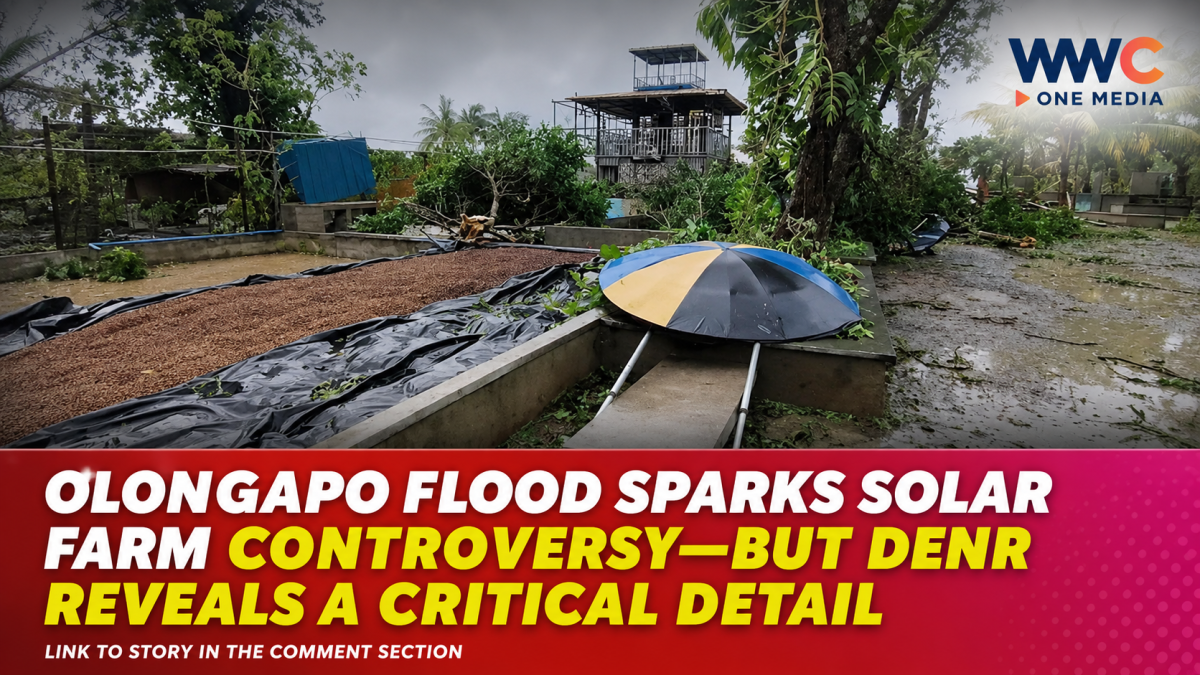
OLONGAPO CITY, Philippines — Severe flooding in Olongapo has reignited a contentious debate over a solar farm project on a nearby mountain, with residents questioning whether changes to the landscape may have contributed to the unusually high floodwaters.
But while residents have pointed to the solar project as a possible factor, authorities and the project’s developer have stressed that the actual cause of the flooding has yet to be established.
The controversy intensified after heavy rains brought by the Southwest Monsoon, or Habagat, caused a river near a bridge in Barangay Sta. Rita to overflow.
Residents told GMA News that they had experienced major flooding in the past, including during the devastating floods of 2013 and 2018. However, some said the latest flooding reached a level they had not previously seen and questioned whether development on the mountain had altered how rainwater moves toward communities below.
The project at the center of the controversy is Phase 1 of the Olongapo Solar Farm Project, developed by AP Renewable Corporation, a subsidiary of Aboitiz Renewables.
According to GMA News, Phase 1 covers about 284 hectares. The Department of Environment and Natural Resources (DENR) approved the project in 2022, and construction was completed in 2025.
Residents question changes to the mountain
Some residents and environmental advocates have raised concerns about vegetation loss and changes to the mountain’s surface.
The advocacy group Pro-People Engineers and Leaders (PROPEL) told GMA News that satellite imagery appeared to show substantial changes in vegetation in portions of the project area.
The group argued that reducing vegetation could potentially affect the ground’s ability to absorb rainfall, increasing surface runoff during periods of intense rain.
However, this remains a point of contention and has not been established as the cause of the recent flooding.
The DENR offered a different assessment.
DENR Region 3 Regional Director Martin Despi said the majority of the mountain area consisted of grassland and that the project’s natural land contour had not been flattened. He said open spaces remain between the solar panels, allowing rainwater to reach the ground.
Importantly, however, the DENR acknowledged that the project’s environmental assessment had identified the possibility of increased water volume coming from the mountain.
Because of that potential impact, the agency said conditions were imposed on the project, including measures involving drainage and tree planting.
Aboitiz: Project follows DENR requirements
Aboitiz Renewables has rejected the suggestion that the solar project was built without safeguards.
The company said its development and operations comply with applicable DENR standards and that the project was designed with measures intended to prevent it from contributing to flooding.
The company also pointed to Olongapo’s geographical location within the Kalaklan River basin, saying the city is naturally vulnerable to flooding because portions of it are situated on a low-lying coastal plain.
That explanation, however, has not ended the debate.
DENR said it would investigate the flooding incident and determine whether the solar project had any role in increasing runoff.
Heavy rainfall also a major factor
Authorities are also looking at the extraordinary amount of rainfall during the incident.
According to DENR, rainfall recorded in Olongapo was around 150% higher than normal on the Saturday of the flooding, providing another possible explanation for the severity of the event.
Olongapo Mayor Rolen Paulino Jr. likewise said an analysis of rainfall behavior on the mountain showed water moving down the area at a speed and volume comparable to runoff from an adjacent mountain without solar panels.
That comparison could become important as authorities examine whether the solar farm materially changed runoff patterns.
Meanwhile, Public Works and Highways Secretary Vince Dizon said he would coordinate with the DENR and Department of Energy to determine what happened and whether the solar project had any connection to the flooding.
The controversy did not start with this flood
The latest dispute is part of a much longer controversy surrounding the Olongapo solar project.
In December 2025, residents of Barangay Sta. Rita had already raised objections to the proposed Phase 2 expansion, citing concerns over flooding, landslides, tree cutting, erosion and possible effects on livelihoods.
More than 900 residents reportedly signed a petition opposing the expansion, according to earlier GMA reporting.
The proposed Phase 2 project has also faced opposition from the barangay government and local officials.
Philstar.com reported in January 2026 that the proposed expansion would add roughly 179 megawatts of capacity and that the Olongapo City Council urged the developer to secure stronger community acceptance and conduct further consultations.
Aboitiz, for its part, has said that Phase 2 had not yet undergone actual development or tree-cutting at the time of those reports and that it was still in the regulatory and consultation process.
DENR previously called for review
The environmental concerns surrounding the project are not entirely new.
In December 2025, the DENR said an investigation was needed to determine whether trees had been cut and whether land had been improperly leveled during construction.
The agency acknowledged that improper land leveling could increase water runoff and potentially contribute to flooding and landslides.
This history makes the latest flooding particularly significant: residents are now asking whether concerns they raised months earlier deserve a closer technical examination.
Indigenous communities raise separate concerns
The controversy also involves the livelihoods of members of the local Aeta community.
GMA News reported that some members of the community said they had lost access to areas used for growing or gathering mangoes and cashews and for raising livestock.
Their concerns therefore extend beyond flooding to questions involving livelihood, land use and ancestral areas.
Environmental groups have also continued to challenge the project’s potential effects on biodiversity, water systems and indigenous communities.
What remains unanswered?
At this point, it would be premature to declare that the solar farm caused the Olongapo flooding.
What is established is that:
- Olongapo experienced severe flooding following intense Habagat rains.
- Residents have blamed the nearby solar project for worsening runoff.
- The DENR previously recognized potential changes in water volume as an environmental concern.
- The project was approved subject to environmental conditions.
- Aboitiz Renewables maintains that it complied with DENR requirements.
- DENR has said it will investigate the incident.
- Authorities also cited exceptionally heavy rainfall as a significant factor.
- The controversy over the project’s environmental impact predates the latest flood.
The key question now is not simply whether Olongapo flooded, but whether changes associated with the solar project measurably altered the amount, speed or direction of water flowing toward communities downstream.
That answer will require technical investigation rather than speculation.
Until the DENR and other relevant agencies complete their assessment, claims that the solar farm directly caused the flooding should be treated as allegations—not established fact.




Leave a Reply