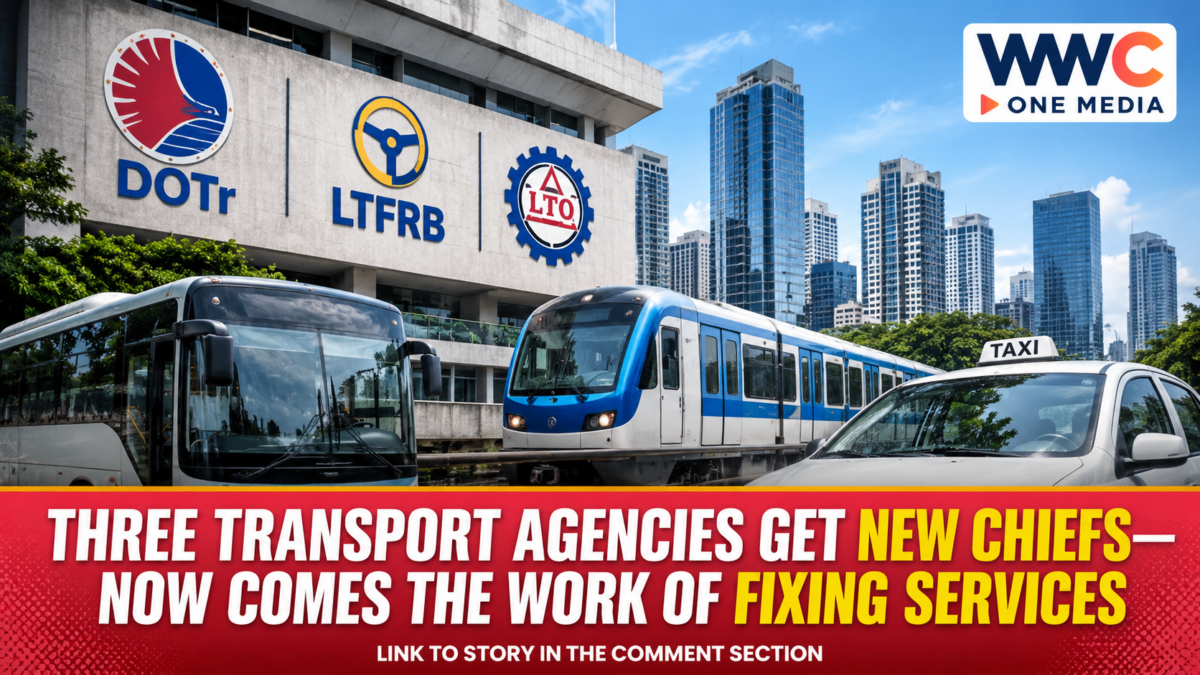
Three major Philippine transport agencies have new leaders following appointments announced by President Ferdinand Marcos Jr. on November 24, 2026. The changes involve the Maritime Industry Authority (MARINA), Land Transportation Office (LTO), and Philippine National Railways (PNR), with the newly appointed officials taking their oaths the following day.
The appointments place Markus Lacanilao at MARINA, Noreen Bernadette San Luis-Lutey at the LTO, and Jorjette Aquino at the PNR. Beyond the personnel changes, the transition raises a more practical question: how will the new leadership translate its responsibilities into safer travel, more dependable services, and better public accountability?
Transport agency chiefs take on different responsibilities
The three appointments cover separate parts of the country’s transportation system.
Lacanilao, previously identified as the LTO chief, was appointed administrator of MARINA. San Luis-Lutey was named to succeed him at the LTO, while Aquino was appointed general manager of the PNR.
The three officials took their oaths on November 25, with Transportation Secretary Vince Dizon administering the oath-taking ceremony. Their appointments therefore moved beyond the initial Palace announcement and into the formal transition of agency leadership.
The positions carry different operational responsibilities. MARINA is concerned with the regulation and development of the country’s maritime industry. The LTO handles land-transport administration, including driver licensing and motor-vehicle registration. The PNR is responsible for the government’s national railway operations and related railway development responsibilities.
That division matters because the agencies serve different groups of commuters, motorists, passengers, operators, and businesses. A change in leadership at one agency does not automatically resolve the operational problems facing the others.
MARINA faces the challenge of maritime safety and reliability
Lacanilao’s move to MARINA places him in an agency with responsibilities extending beyond administrative supervision. Maritime regulation affects passenger safety, vessel operations, shipping services, and the movement of goods.
For passengers, the most visible measure of performance is whether vessels operate safely and services remain dependable. For businesses, reliable maritime transport is part of the movement of products between islands and the wider logistics network.
The new administrator will therefore face expectations that go beyond a change in organizational leadership. The public interest lies in how the agency applies safety requirements, monitors compliance, and responds when operators fail to meet regulatory standards.
Those responsibilities are particularly important in an archipelagic country where sea travel is an essential connection between communities. Strong enforcement and clear public communication are necessary parts of that work.
WWC has previously examined a maritime regulatory issue in its report on MARINA’s suspension of a vessel’s safety certificate following a passenger incident. That coverage illustrates the type of public-facing regulatory responsibility that remains relevant regardless of who occupies the administrator’s office.
LTO leadership change puts licensing and enforcement in focus
San Luis-Lutey’s appointment places a new official at the head of an agency whose decisions affect millions of motorists and vehicle owners.
The LTO’s responsibilities include licensing drivers, registering motor vehicles, implementing land-transport regulations, and enforcing applicable administrative rules. Its services are encountered directly by the public, making processing efficiency, consistent enforcement, and accessible transactions important measures of performance.
The leadership transition also comes as motorists continue to rely on the agency for routine services and regulatory decisions. Delays, unclear procedures, and inconsistent implementation can create practical difficulties for people who depend on valid licenses and vehicle documents.
A new chief does not automatically mean that existing policies or systems will change. Any assessment of the transition should be based on official directives, published service standards, and measurable agency performance rather than assumptions about what the incoming official intends to do.
WWC has reported on the agency’s enforcement responsibilities in its coverage of an LTO administrative action involving a driver’s license suspension. The broader issue for the agency is the consistent application of rules, regardless of the person or vehicle involved.
PNR leadership carries a different public-service test
Aquino’s appointment as PNR general manager places her in charge of an agency associated with the country’s railway operations and development.
Rail services are judged by their practical value to passengers: availability, safety, reliability, accessibility, and the ability to connect communities with employment and commercial centers. Railway development also involves long-term planning, infrastructure coordination, procurement, and project implementation.
A change in general manager does not, by itself, establish that a project will accelerate or that service will improve. Those outcomes depend on budgets, project readiness, technical work, government coordination, and the implementation of approved plans.
The immediate public interest is whether the new leadership can provide clear direction on the railway system’s operational priorities and communicate progress through verifiable milestones.
For passengers and communities affected by railway projects, regular updates and transparent explanations are as important as leadership announcements. Public confidence is strengthened when agencies explain what is being done, what remains pending, and when people can reasonably expect results.
What the reshuffle means for transport users
The appointments bring three agencies under new leadership, but the public should judge the transition by performance rather than titles.
For MARINA, that means effective maritime regulation and safety oversight. For the LTO, it means reliable transactions and consistent enforcement. For the PNR, it means accountable railway management and credible progress on operations and development.
The agencies also operate within a wider transportation department. Coordination matters because land, sea, and rail services are connected through passenger movement, logistics, infrastructure, and public investment.
The Department of Transportation’s leadership has a role in setting direction and coordinating priorities, while each agency must carry out its own mandate. The effectiveness of the new appointments will depend partly on whether those responsibilities are clearly translated into programs, decisions, and measurable results.
WWC has also covered the LTO’s transition toward digital services in its report on the shutdown of the old STRADCOM system and the shift to the Land Transportation Management System. Digital service delivery remains one example of how administrative decisions can affect motorists in their everyday transactions.
What happens next
The next step is for the three agencies and the Department of Transportation to communicate their leadership priorities and any corresponding administrative changes.
The public will need official information on service continuity, ongoing programs, project timelines, and the implementation of existing policies. Any new initiatives should be assessed through published agency documents and measurable outcomes.
The appointment announcements and oath-taking establish the leadership transition. They do not, on their own, establish new policies, completed reforms, or improvements in service delivery.
For commuters, motorists, passengers, and businesses, the more important test begins after the ceremonies: whether the agencies deliver safer, more dependable, and more accountable transport services.
Frequently asked questions
Who are the new heads of MARINA, LTO and PNR?
The announced appointees are Markus Lacanilao as MARINA administrator, Noreen Bernadette San Luis-Lutey as LTO chief, and Jorjette Aquino as PNR general manager.
When did the new transport officials take their oaths?
The three officials took their oaths on November 25, 2026, with Transportation Secretary Vince Dizon administering the ceremony.
Who replaced Markus Lacanilao at the LTO?
Noreen Bernadette San Luis-Lutey was appointed to replace Lacanilao as head of the Land Transportation Office.
Does the reshuffle automatically change transport policies?
No. A leadership appointment does not automatically change agency regulations, programs, or service procedures. Such changes require the appropriate official actions and implementation.
What should commuters and motorists watch after the appointments?
The public can monitor agency announcements, service performance, regulatory enforcement, railway updates, and official reports on safety and project implementation.