
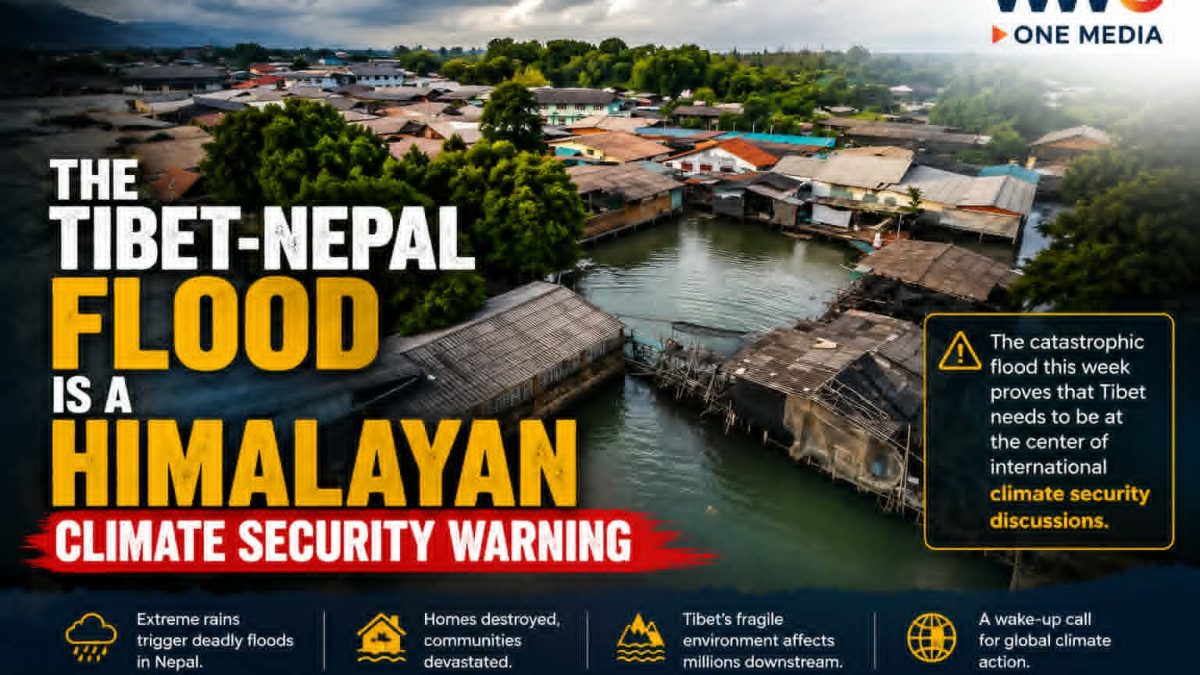
A glacier-linked disaster on the Nepal–China border has exposed a much bigger problem: the Himalayas are becoming a high-risk zone where climate change, fragile infrastructure, water security and cross-border disaster response increasingly collide.
On August 26, 2026, a catastrophic flash flood and debris flow struck communities along Nepal’s Bhote Koshi River after a rapid slope failure involving glacier material in the Langtang area near the China border.
According to the U.S. Geological Survey, the resulting debris flow and flood traveled nearly 100 kilometers, sweeping through river valleys and severely damaging communities, roads and critical infrastructure, including the Rasuwagadhi border area. USGS said preliminary analysis indicated the slope failure generated energy equivalent to a magnitude-5.2 earthquake.
The scale of the disaster has since become staggering.
As of September 2, Reuters reported that Nepal had recorded at least 1,050 confirmed deaths, with nearly 4,000 people still missing. China has reported 16 deaths and 546 missing in Tibet. Search operations continue, but authorities are increasingly shifting toward recovery, rehabilitation and reconstruction.
The numbers remain subject to revision as rescue teams reach isolated areas and authorities reconcile missing-person reports.
THIS WAS MORE THAN A FLOOD
Calling the disaster simply a flood risks missing the larger story.
The event demonstrates how rapidly a hazard originating high in the Himalayas can become a humanitarian and infrastructure crisis hundreds of kilometers downstream.
A collapsing mass of ice, rock, water and debris entered river systems and transformed them into powerful channels capable of destroying settlements and infrastructure with little time for people downstream to react. USGS describes the event as a catastrophic debris avalanche and flash flood rather than an ordinary monsoon flood.
That distinction matters.
The Himalayas are warming, glaciers are retreating and frozen mountain landscapes are becoming increasingly unstable. Scientists have warned that climate change can amplify hazards involving glaciers, permafrost, landslides and glacial lakes.
But climate change should not automatically be presented as the sole direct cause of this individual event. The immediate trigger was a geological failure involving glacier material, while researchers are still examining precisely how warming conditions contributed to the collapse.
Reuters reported that experts believe climate change has increased the risk of dangerous Himalayan disasters, while emphasizing the complex combination of geological, climatic and human factors involved.
THE WARNING EXTENDS BEYOND NEPAL AND TIBET
The Himalayas are not isolated mountains.
They are the source region for major river systems that supply water to hundreds of millions of people across Asia.
That makes mountain instability a regional security issue, not simply an environmental story.
When glaciers collapse, landslides block rivers or glacial lakes suddenly release enormous amounts of water, the consequences can cross national borders.
The recent disaster has already highlighted another vulnerability: information sharing.
Reuters reported that Nepal had sought greater access to Chinese information on glacier conditions and water levels before the catastrophe, while China said its data-sharing had been timely. The disagreement illustrates a fundamental challenge: rivers and mountain hazards do not respect political boundaries.
INFRASTRUCTURE IS ALSO IN THE LINE OF FIRE
The destruction went far beyond homes.
Roads, bridges, hydropower facilities and other critical infrastructure were damaged or destroyed. Nepal’s government said the August 26 flood severely affected riverbank areas in Rasuwa, Nuwakot, Dhading and Gorkha districts.
Reuters also reported that the disaster damaged major infrastructure and that Nepal’s reconstruction bill could run into several billion dollars.
That creates a dangerous cycle.
Himalayan countries need hydropower, roads, tourism infrastructure and trade corridors. But many of those same assets are located in valleys and along rivers—the precise places exposed to floods, landslides and debris flows.
THE CLIMATE-SECURITY QUESTION
The bigger question now is not simply:
“Why did this flood happen?”
It is:
“Are governments prepared for the next one?”
A warming climate does not mean every glacier collapse is directly caused by global warming. But scientists and international officials increasingly warn that a warmer Himalaya can create conditions that increase the risk of multiple hazards.
Reuters reported this week that a senior U.N. official warned that the Himalayan region faces escalating risks from glacial floods as climate change accelerates glacier melt and changes mountain environments.
That means climate adaptation in the Himalayas cannot stop at planting trees or building flood walls.
It increasingly requires:
- Real-time glacier and river monitoring
- Cross-border early-warning systems
- Satellite-based hazard mapping
- Rapid communication between Nepal, China, India and other downstream countries
- Stronger rules for construction in high-risk valleys
- Climate-resilient roads, bridges and hydropower projects
- Evacuation systems that can function when telecommunications fail
- Greater investment in disaster insurance and recovery financing
The recent catastrophe has shown what happens when an extreme mountain event meets vulnerable infrastructure and limited warning time.
THE MESSAGE FROM THE HIMALAYAS
The Himalayas are sometimes described as the “Third Pole” because of their enormous stores of snow and ice.
But they are also becoming a frontline of climate risk.
The disaster on the Nepal–China border is therefore more than a tragedy measured in deaths, missing people and destroyed buildings.
It is a warning about water security, infrastructure security, food security, energy security and regional cooperation.
And the most uncomfortable question may be the simplest:
If a single glacier-related collapse can send destruction racing through valleys and across borders, what happens when the next event is larger—or when several disasters happen at the same time?
That is why the Tibet–Nepal disaster deserves to be treated not merely as another natural catastrophe, but as a Himalayan climate-security warning.
WWC ONE MEDIA G.A



Leave a Reply