
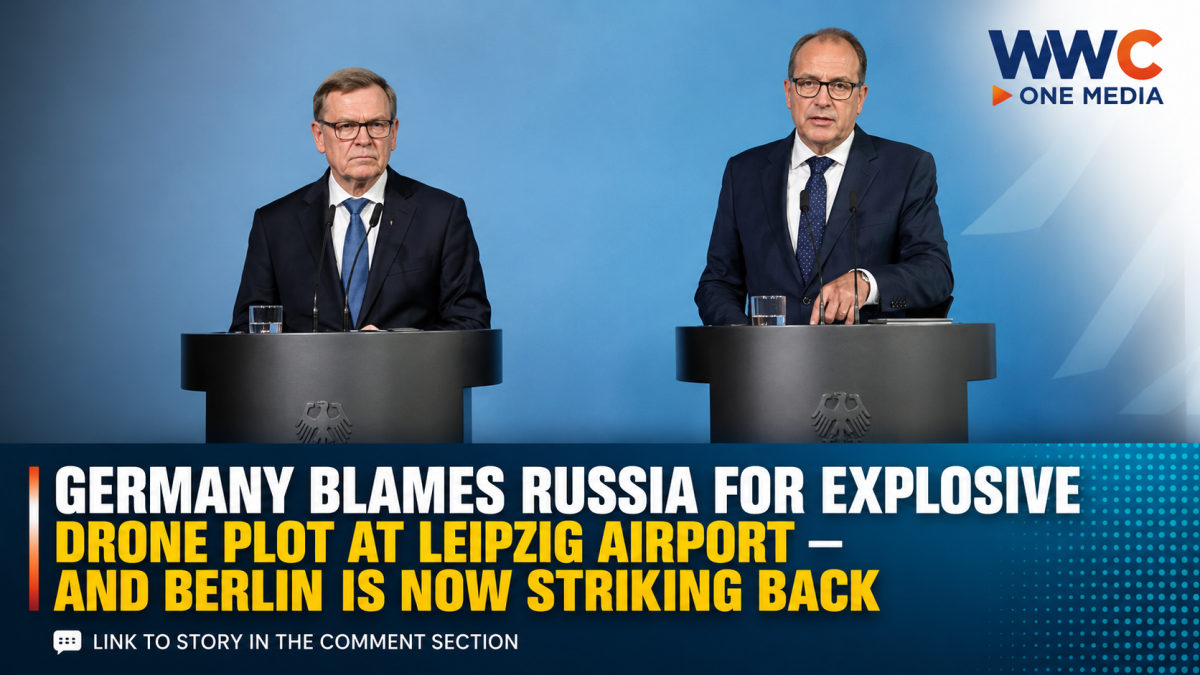
BERLIN — Germany has formally accused Russia of orchestrating an attempted drone attack at Leipzig/Halle Airport last month, escalating an already tense confrontation between Berlin and Moscow and raising fresh concerns about Russian hybrid operations across Europe.
German authorities say an explosives-laden drone was discovered at the airport on Aug. 4, close to Ukrainian cargo aircraft. The device was safely defused, but investigators believe the incident was a deliberately planned attack rather than an ordinary drone intrusion.
German Interior Minister Alexander Dobrindt said police investigations, intelligence findings and similarities with previous Russian operations point to people acting on behalf of Russian state agencies. Officials said the drone’s configuration, explosives and detonator showed a high degree of technical expertise and planning.
But Moscow strongly rejects the accusation, calling Berlin’s claims baseless and warning that Germany’s response represents a serious escalation in relations.
What happened at Leipzig/Halle?
The incident unfolded on the night of Aug. 4–5 at one of Germany’s most strategically important cargo airports.
Workers discovered a drone carrying explosives in a restricted area near a runway and close to Ukrainian Antonov cargo aircraft. The device was subsequently neutralised by specialists. Airport operations were temporarily disrupted, while several flights were diverted.
A separate aircraft incident occurred around the same time. A DHL cargo aircraft reportedly encountered an unidentified object after takeoff and was diverted to Hanover. Investigators have not publicly established that the object was the same drone, and the drone itself has not been recovered.
The case became even more serious later in August when investigators reportedly found another drone and suspected military explosives near the airport.
Why would Leipzig Airport be targeted?
Leipzig/Halle is far more than a civilian passenger airport.
It is a major international freight and military-logistics hub, including facilities used by Ukrainian Antonov aircraft and NATO’s Strategic Airlift International Solution, known as SALIS. The airport supports the movement of equipment for NATO and European missions.
That connection to Ukraine makes the airport particularly sensitive amid Russia’s ongoing war.
German officials therefore view the incident within the broader context of attempts to disrupt European infrastructure and weaken Western support for Ukraine.
Berlin says this was part of a wider Russian campaign
Dobrindt said the evidence fits a broader pattern of what Germany describes as Russian hybrid operations across Europe.
These activities can include sabotage, cyberattacks, espionage, disruption of infrastructure and other operations that fall below the threshold of conventional warfare.
Germany’s Foreign Minister Johann Wadephul said Berlin does not regard Leipzig as an isolated incident. He described it as part of a wider pattern of Russian activity aimed at creating insecurity and undermining European support for Ukraine.
The Associated Press has identified roughly 200 incidents of sabotage and malign activity across Europe that Western officials have attributed to Russia since the full-scale invasion of Ukraine in 2022, although Moscow rejects accusations that it is conducting such a campaign.
Germany is taking direct action against Moscow
Berlin’s response has been unusually forceful.
Germany announced plans to:
- Close Russia’s consulate general in Bonn by Sept. 18
- Terminate the agreement governing the Russian House cultural centre in Berlin
- Tighten entry controls for Russian nationals
- Push for additional EU sanctions against people connected to Russian hybrid operations
- Increase pressure on Russia’s so-called shadow fleet
Germany has also summoned Russia’s ambassador.
Foreign Minister Wadephul said Germany would not allow hostile actions to intimidate the country or undermine its support for Ukraine.
Russia denies everything
Moscow has rejected Germany’s accusations.
The Russian Embassy described the allegations as unsubstantiated and absurd, while Kremlin spokesman Dmitry Peskov said Germany had not presented evidence publicly and accused Berlin of pursuing further escalation.
Russian President Vladimir Putin went further, accusing Germany of fabricating evidence to blame Moscow for the incident. He did not provide evidence for that claim.
The competing claims mean the political consequences are already clear even as much of the underlying intelligence evidence remains classified.
NATO and Europe rally behind Germany
Germany has received support from European allies following the accusation.
NATO Secretary-General Mark Rutte said the alliance stands in full solidarity with Germany, while European Commission President Ursula von der Leyen also expressed support for Berlin. EU officials have indicated that further measures against Russia are being considered.
The incident comes as European governments increasingly focus on protecting airports, power grids, communications networks and other critical infrastructure from drones and sabotage.
Germany itself faced another alarming incident on Sept. 1, when authorities reported sabotage targeting high-voltage infrastructure in Brandenburg. Officials have not established who was responsible.
A warning far beyond one German airport
The Leipzig incident is significant because it illustrates how the security environment in Europe is changing.
A drone carrying explosives does not require a conventional military strike to create disruption. A relatively small device can potentially threaten aircraft, infrastructure and public confidence while leaving authorities with difficult questions about who ordered the operation.
Germany is now treating the incident as part of a much larger security challenge.
The question is no longer simply who was behind the Leipzig plot.
It is whether Europe is entering a period in which airports, energy networks, logistics hubs and other civilian infrastructure increasingly become targets in a shadow conflict fought through sabotage, cyberattacks and covert operations.
And with Berlin promising further action against Moscow, the Leipzig drone case could become the latest flashpoint in an already rapidly deteriorating relationship between Germany and Russia.
WWC ONE MEDIA J.M.D




Leave a Reply