
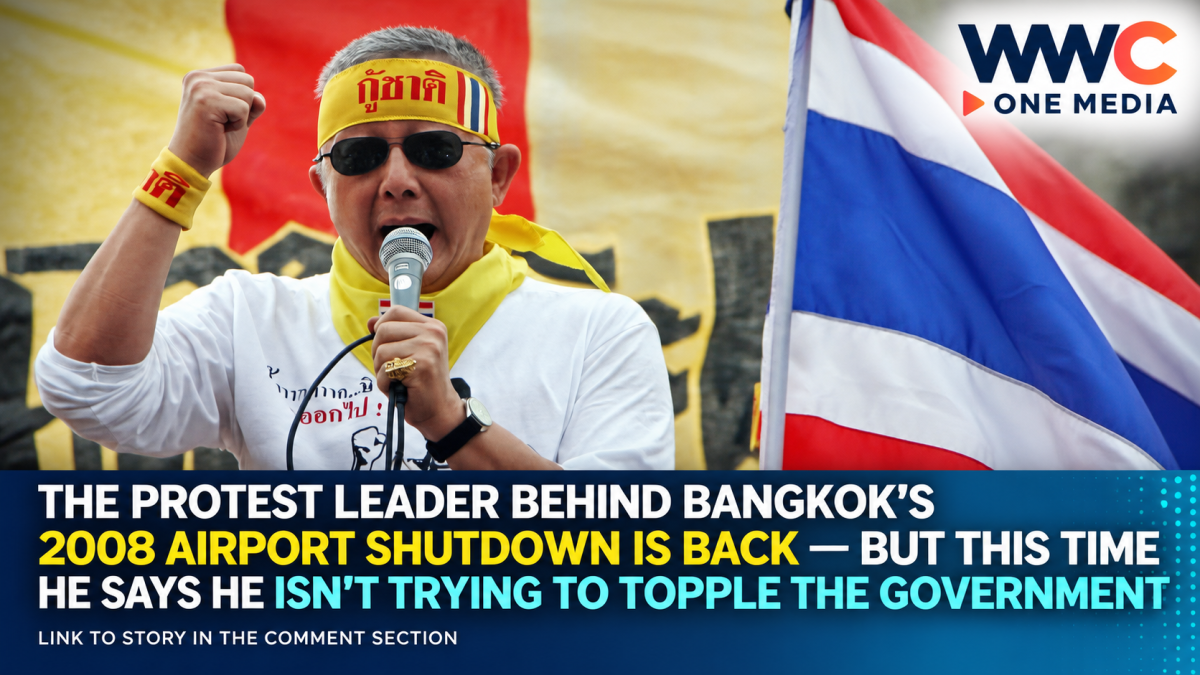
BANGKOK — One of the most recognisable figures from Thailand’s era of mass street confrontation is trying to build a political movement again, nearly two decades after protesters from the movement he led helped shut Bangkok’s airports and intensify a crisis that ended with another government removed from power.
Sondhi Limthongkul, the 78-year-old former media tycoon and co-founder of the Yellow Shirt People’s Alliance for Democracy, has launched a new campaign he calls “Take Back Thailand.”
His target is the government of Prime Minister Anutin Charnvirakul.
But Sondhi insists his immediate objective is not to demand Anutin’s resignation.
Instead, he says he wants to organise dissatisfied citizens into a permanent pressure movement capable of scrutinising whoever holds power.
That distinction matters.
Thailand has repeatedly seen protest movements grow from street demonstrations into political crises with consequences far beyond the original grievances.
Sondhi knows that history better than almost anyone.
In 2008, thousands of Yellow Shirt protesters occupied Suvarnabhumi and Don Mueang airports for more than a week, severely disrupting international aviation and leaving hundreds of thousands of travellers affected or stranded.
Now he is trying to mobilise again.
But Thailand in 2026 is not Thailand in 2008.
Sondhi says this is his “last mission”
In an interview with Bloomberg, Sondhi described the new campaign as what he considers his “last mission” in politics.
His stated goal is to create a movement that can pressure governments regardless of which party is in office.
He said he wants to bring together people dissatisfied with the government and give them ways to demonstrate and question those in power.
His campaign is built around several different grievances rather than one single issue.
They include:
rising living costs,
allegations of corruption,
claims of political interference with institutions,
concern about foreign-linked criminal and opaque business networks,
and dissatisfaction with government enforcement of Thai laws involving foreign visitors and investors.
Those are Sondhi’s stated concerns and allegations. They should not be presented as established findings unless supported by separate investigations or court decisions.
His first big street action targeted the Israeli Embassy
On September 10, hundreds of demonstrators joined Sondhi outside Israel’s embassy in Bangkok.
The protesters called for stronger enforcement of Thai laws involving foreign visitors and businesses, with particular attention to allegations surrounding some Israeli nationals, nominee ownership structures and property-related activity.
Sondhi accused some foreign visitors and businesses of disrespecting Thai law and local communities.
Israel’s diplomatic representatives responded by acknowledging concerns surrounding individual incidents and discussing measures intended to promote appropriate conduct among Israeli tourists. Thailand’s government has also stressed that foreign visitors of any nationality are expected to comply with Thai law.
The distinction is important because misconduct by particular individuals should not be generalised to an entire nationality.
Sondhi’s September 10 rally was nevertheless significant for another reason.
It provided the first visible test of whether his large online following could once again be converted into people physically assembling on Bangkok’s streets.
His online audience is enormous
Sondhi is entering this new campaign with a media machine that looks very different from the one he used two decades ago.
Bloomberg reported that his Facebook presence exceeds five million followers, while the Sondhi Talk YouTube channel has around 2.5 million subscribers.
Sondhi claims his programmes collectively generate about 100 million views a month across major platforms, rising to 171 million in August as he prepared his latest mobilisation.
Those are Sondhi’s own audience claims rather than independently audited political-support figures.
And he acknowledges the limitation.
Millions of online views do not automatically translate into millions of demonstrators.
That may be the central organisational test of his comeback.
In 2008, his movement could paralyse Bangkok
The historical comparison is unavoidable.
Sondhi was one of the central leaders of the People’s Alliance for Democracy, whose supporters were widely known as the Yellow Shirts.
The movement emerged as a powerful opponent of former prime minister Thaksin Shinawatra, drawing substantial support from Bangkok’s middle classes, sections of the business community and conservative political networks.
Thaksin was removed in a 2006 military coup.
But political parties aligned with him subsequently returned to government through elections, reigniting the Yellow Shirt movement.
By 2008, the confrontation had escalated dramatically.
PAD supporters occupied Government House and later took control of Bangkok’s two airports in an attempt to pressure the government led by Prime Minister Somchai Wongsawat, Thaksin’s brother-in-law.
Suvarnabhumi Airport was shut for eight days.
Contemporary reports estimated around 230,000 to 250,000 foreign travellers were stranded or affected by the broader disruption.
The airport siege ended after a court removed the government
The protesters ended their airport occupations after Thailand’s Constitutional Court dissolved the ruling People Power Party and disqualified Somchai from office over an electoral case.
PAD declared that its objectives had been achieved and withdrew from the airports.
That sequence is important when describing Sondhi’s history.
The protesters exerted enormous political pressure and paralysed critical infrastructure.
But Somchai was formally removed through a court ruling, not directly by the protesters themselves.
Saying the Yellow Shirts simply “overthrew the government” would compress a much more complicated chain of events.
Courts later dealt with the airport occupation itself
The legal aftermath lasted for years.
In 2017, Thailand’s Supreme Court ordered 13 Yellow Shirt leaders, including Sondhi, to pay 522 million baht plus interest in a civil case concerning damage arising from the airport occupations.
Separate terrorism prosecutions ultimately had a different outcome.
In 2024, Thai courts dismissed terrorism charges against groups of defendants connected with the airport occupations, ruling that the protests in the cases before them did not meet the terrorism charge as prosecuted. Some defendants still faced or had faced other penalties connected with emergency-law violations.
That legal history is worth spelling out because neither of two simplified narratives is accurate:
It is wrong to imply the airport occupation had no legal consequences.
It is also wrong to say Sondhi was ultimately convicted of terrorism for the airport seizure.
Sondhi also spent nearly three years in prison—but for another case
Sondhi’s later imprisonment was separate from the airport occupation.
Thailand’s Supreme Court upheld a 20-year prison sentence in 2016 over securities and corporate-document offences connected with a large bank loan.
He served about three years before being released in 2019 following a royal pardon.
Days after his release, Sondhi publicly said his days of leading street protests were over.
Seven years later, he is organising again.
That reversal gives the current campaign an added historical dimension.
But his political target is very different this time
Two decades ago, Sondhi’s mobilisation was overwhelmingly associated with opposition to Thaksin and parties tied to the Shinawatra political network.
In 2026, his focus is Anutin Charnvirakul and the Bhumjaithai-led government.
Anutin entered the year in a considerably stronger electoral position than before.
His Bhumjaithai Party won a clear victory in the February 8 general election, securing about 193 seats in the 500-member House according to Reuters calculations from Election Commission data.
The reformist People’s Party finished second and Pheu Thai third.
Bhumjaithai subsequently struck a coalition agreement with Pheu Thai, giving the government a substantial parliamentary majority.
That means Sondhi is not mobilising against a government that lacks an electoral base.
He is challenging an administration formed after a strong election result only months ago.
Anutin says protests could hurt ordinary Thais
Anutin has responded publicly to Sondhi’s renewed activism.
Asked about the movement on September 12, the prime minister argued that disruptive protest activity could hurt the public more than his administration and said his government remained focused on working for the country.
He also said he believed Thai people were still willing to give his government a chance.
That is the government’s position.
It should not be treated as evidence that public dissatisfaction is absent.
Recent polling suggests views are mixed.
A new poll shows Thailand is divided over whether this is the moment to protest
A Suan Dusit Poll conducted September 8–11 among 1,149 respondents found that 40.56% thought the current period was not appropriate for political demonstrations, while 35.60% thought it was and 23.84% were uncertain.
The largest share therefore opposed the timing, but it was not an outright majority.
When respondents were asked what issues could trigger demonstrations, economic and cost-of-living problems were cited by 69.54%, political cases and alleged Senate collusion by 68.76%, and transparency or corruption concerns by 68.32%.
Respondents could give multiple answers, so those percentages should not be added together.
That survey offers some evidence for Sondhi’s argument that dissatisfaction exists.
It does not establish that voters support his movement or would attend his demonstrations.
Those are different questions.
Thailand’s economic backdrop helps explain the frustration
Anutin won February’s election while promising stability after another turbulent period in Thai politics.
But the government inherited a difficult economy.
Reuters reported after the election that Thailand grew just 2.2% in 2025, with 2026 growth then projected around 2%, while high household debt, an ageing population and external trade pressure remained major structural problems.
Those conditions give opposition figures of different ideological backgrounds space to focus on household finances and living costs.
But economic frustration does not automatically translate into a single political movement.
Sondhi is competing with parties, civic organisations and other activists seeking to channel dissatisfaction in different ways.
Even Sondhi says the old Yellow-versus-Red divide is no longer enough
One of the most striking elements of his latest interview is his rejection of the old political map.
Thailand’s politics for years were often described through the rivalry between:
the Yellow Shirt, broadly royalist and anti-Thaksin camp,
and the Red Shirt movement associated with Thaksin-aligned governments and their supporters.
Sondhi now argues that those categories no longer adequately describe Thai politics because parties, businesses and political interests have realigned.
That is his interpretation.
There is factual evidence of significant realignment around him.
Most notably, Pheu Thai—the party rooted in the Shinawatra political tradition—joined a governing coalition with Anutin’s Bhumjaithai following the February election.
For a veteran anti-Thaksin activist such as Sondhi, that alone makes the political battlefield very different from the one on which he built his Yellow Shirt movement.
And he has even offered qualified praise for the People’s Party
Bloomberg reported that Sondhi described the progressive opposition People’s Party as, in principle, “quite OK,” despite their markedly different political histories and constituencies.
That does not constitute an alliance.
Nor is there evidence the People’s Party has joined Sondhi’s campaign.
Rather, it illustrates how difficult it is to map the political relationships of 2026 directly onto the Yellow-versus-Red struggle of the 2000s.
Another political flashpoint arrives on September 28
Sondhi’s provincial organising campaign is unfolding as Thailand approaches a significant Constitutional Court decision.
The court is scheduled to rule on September 28 over whether barcodes and QR codes printed on ballots in the February 8 general election violated constitutional and statutory guarantees of secret voting.
The case arose after complaints argued that unique codes could potentially be linked back to individual voters.
Thailand’s Election Commission disputes that interpretation.
It says the codes were anti-counterfeiting and security measures and that they could not be used, under the system as administered, to determine how an individual voter cast a ballot.
The Constitutional Court accepted the case in March and later heard expert evidence before setting the September 28 ruling date.
What the court will decide should not be predicted
The legal challenge has obvious political importance because it concerns the election that returned Anutin and Bhumjaithai to power.
But there is no factual basis for stating in advance that the court will invalidate the election—or that it will uphold it.
The petition challenges the legality of the ballot design.
The Election Commission contests the allegation that ballot secrecy was compromised.
The court has not issued its final ruling.
Sondhi intends to build public pressure ahead of the ruling, according to Bloomberg.
That does not mean the court’s judgment will be influenced by his movement.
Those are separate processes.
A Senate controversy is adding another layer
Thailand is simultaneously dealing with a separate controversy surrounding alleged collusion in the Senate-selection process.
Civil-society group iLaw and People’s Party figures recently marched in Bangkok calling for action against people accused in that case.
The Election Commission has been considering different groups of respondents and has declined to pursue some allegations against certain Bhumjaithai-linked figures while other proceedings continue.
These are allegations and administrative or judicial proceedings—not findings that everyone named committed wrongdoing.
The important political point is that Sondhi’s mobilisation is arriving when several disputes over institutions, elections and political accountability are already active.
That makes September unusually crowded politically
Sondhi formally launched his movement on September 7.
His first major embassy rally followed on September 10.
Election Commission decisions on the Senate controversy arrived days later.
And the Constitutional Court’s ballot ruling is scheduled for September 28.
That sequence creates political attention.
It does not establish that Thailand is headed toward another 2008-style confrontation.
Indeed, the available evidence cuts both ways.
There is measurable dissatisfaction.
There are active street demonstrations.
But polling also shows a plurality saying now is not the right time for protests.
The biggest question is whether digital influence becomes street power
This is where Sondhi’s return becomes genuinely different from his previous movement.
In the 2000s, television, radio, newspapers and physical rallies were central to mobilisation.
In 2026, Sondhi commands a huge digital audience.
But he himself acknowledges that clicking, watching and sharing are easier than physically joining a protest.
That creates a measurable test.
Not whether his videos receive millions of views.
Not whether his speeches trend.
But whether substantial numbers of people repeatedly show up in Bangkok and the provinces around the issues he has chosen.
No reliable evidence yet establishes the eventual scale of that mobilisation.
And Sondhi is deliberately avoiding one demand—for now
Perhaps the most important difference from his earlier campaigns is what he says he is not demanding.
He has stopped short of calling for Anutin’s resignation.
His public position is that the government should respond to the issues being raised and face sustained public scrutiny.
That position could change; political movements frequently evolve.
But reporting should describe the campaign as it exists now rather than assume it will inevitably become a government-toppling movement.
So “the airport protest leader is back” is true—but incomplete
Sondhi’s history gives the story its obvious headline.
He helped lead a movement capable of shutting Thailand’s principal international airport and placing extraordinary pressure on elected governments.
That legacy cannot be separated from his return.
But repeating 2008 is not something that can simply be assumed.
The parties are different.
Political alliances have changed.
Anutin emerged from a strong national election only months ago.
Pheu Thai and Bhumjaithai are now governing together.
Social media has replaced much of the media environment Sondhi once mastered.
And Sondhi himself says his immediate goal is pressure, not removal.
That is what makes the comeback politically interesting.
The man is familiar.
The battlefield is not.
Whether “Take Back Thailand” becomes a durable nationwide pressure movement will depend on factors that are not yet settled: public participation, economic conditions, legal developments and the government’s response.
For now, one fact is already clear.
After years away from the front line of Thai street politics, Sondhi Limthongkul is organising again.




Leave a Reply