
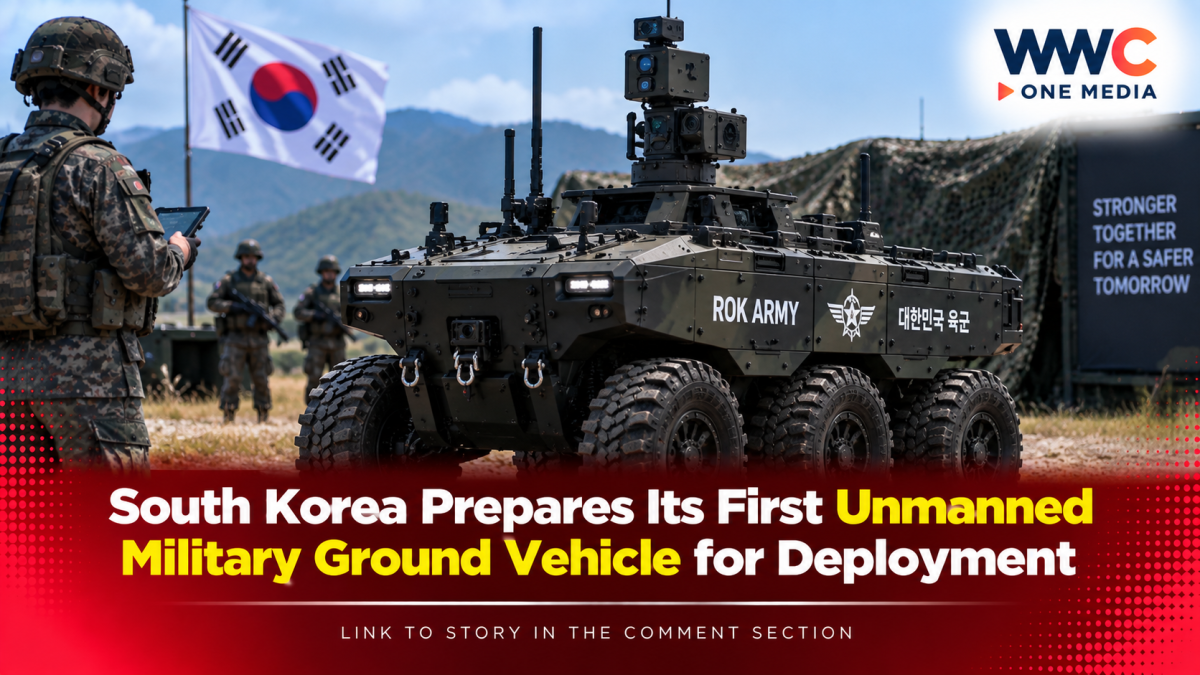
South Korea is moving closer to deploying its first multipurpose unmanned ground vehicle, marking a major step in the country’s push to incorporate robotics and autonomous technology into military operations.
The vehicle, known as Arion-SMET, was demonstrated this week at Hanwha Aerospace’s Changwon Plant 2 in South Gyeongsang Province. The company says the system can follow soldiers autonomously, transport supplies without a driver and navigate off-road environments.
A new era for South Korea’s military robotics
The Arion-SMET is a six-wheeled electric unmanned ground vehicle designed to support infantry units while reducing the physical burden and exposure to danger faced by personnel.
The latest version can carry approximately 450 kilograms and travel at speeds of up to 60 kilometers per hour, according to Hanwha Aerospace. Its autonomous functions allow it to follow a designated soldier and travel toward preset destinations without someone sitting behind the wheel.
South Korea’s Defense Acquisition Program Administration selected Hanwha’s vehicle for the country’s first military UGV acquisition program in July. The initial project was valued at approximately 49.6 billion won, with the possibility of a substantially larger follow-on program depending on future military requirements.
Deliveries expected to begin in 2027
Hanwha Aerospace signed the mass-production contract with DAPA on September 4, according to The Korea Times.
Deliveries to South Korean Army and Marine Corps infantry units are scheduled to begin next year, with the vehicles introduced in stages.
The development has been years in the making. Work on the Arion-SMET began in 2016 through a civil-military cooperation project, while an earlier-generation vehicle underwent testing through a U.S. Department of Defense program in 2023.
Most components are made in South Korea
The project also reflects Seoul’s effort to build a domestic ecosystem for advanced defense technology.
Hanwha says at least 98% of the vehicle has been localized, with around 40 Korean suppliers contributing components. The company says domestic production could help with maintenance and logistical support.
The company plans to expand beyond the Arion-SMET, with a goal of establishing six common unmanned ground-vehicle platforms across different weight classes by 2030.
Humans remain responsible for critical decisions
Despite its autonomous capabilities, the Arion-SMET is not designed to operate without human oversight for every function.
Hanwha engineers told The Korea Times that artificial intelligence can assist with identifying and tracking objects, while human operators remain responsible for critical decisions. The company said an AI recommendation alone is not sufficient for determining whether a target is hostile.
That distinction highlights one of the central issues surrounding military autonomy: technological systems may increasingly perform navigation, transportation and detection tasks, while governments and militaries continue to establish rules governing human responsibility and oversight.
South Korea’s broader push toward unmanned systems
The Arion-SMET is part of South Korea’s broader effort to modernize its armed forces amid declining troop numbers and rapid advances in autonomous technology.
Hanwha Aerospace has also been developing larger unmanned platforms and manned-unmanned teaming systems. The company has demonstrated technologies designed to allow crewed and uncrewed systems to operate alongside one another.
The development reflects a wider international trend. Recent conflicts have accelerated interest in unmanned systems, while militaries around the world are examining how robots can perform logistics, reconnaissance and other tasks without placing personnel in every location.
For South Korea, however, the immediate milestone is more straightforward: the country is moving from testing military ground robots toward actually putting one into service.
The Arion-SMET’s arrival with Army and Marine Corps units in 2027 will provide an important real-world test of how effectively these technologies can complement human personnel.
WWC ONE MEDIA G,A




Leave a Reply