
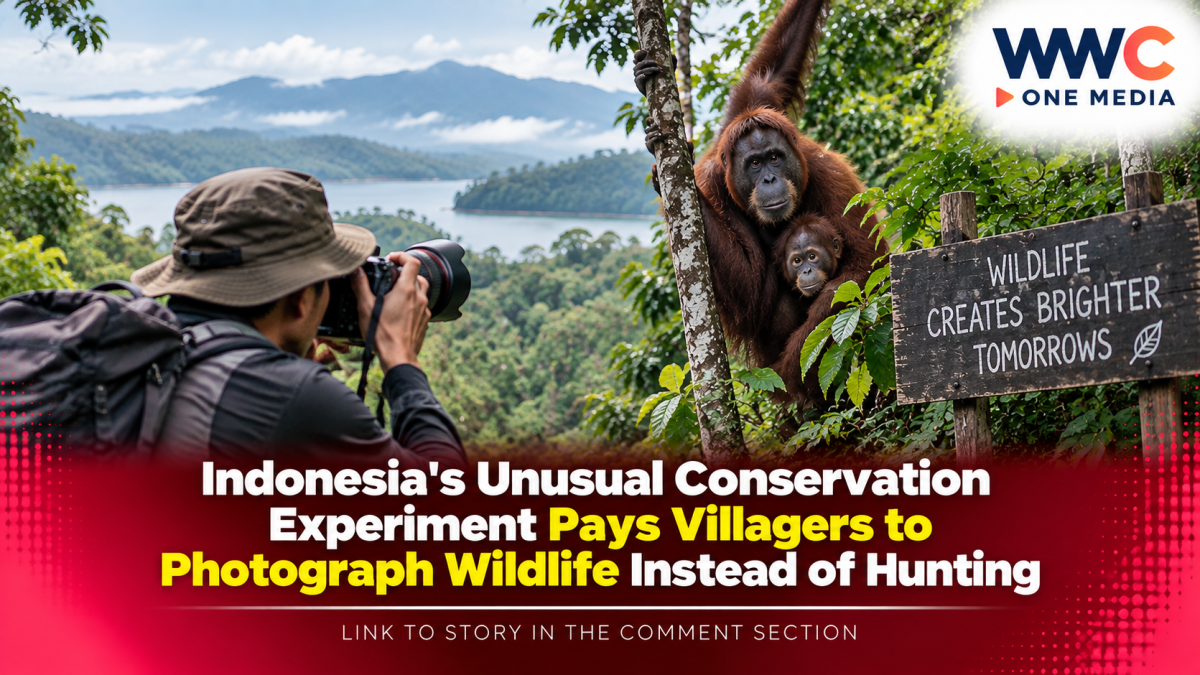
In the forests of West Kalimantan on the Indonesian island of Borneo, a novel conservation program is changing the economics of wildlife hunting: instead of capturing animals, villagers can earn money by photographing or recording them.
The KehatiKu initiative, operated by environmental consultancy Borneo Futures, pays residents in nine participating villages for verified sightings of wildlife. The goal is straightforward—make living animals financially more valuable to communities than hunting them.
From hunting wildlife to documenting it
For years, some communities in Borneo have earned income by capturing wild songbirds for the domestic market. KehatiKu is attempting to change that incentive.
Participants use mobile phones to photograph animals or record their calls. Payments depend on the species: observations of common birds can earn around 5,000 Indonesian rupiah, while an observation of an endangered orangutan can bring as much as 130,000 rupiah.
The most successful observers can reportedly earn as much as 10 million rupiah a month, or roughly US$570, according to AFP reporting. For rural households, that can represent a significant supplementary income.
More than 350,000 wildlife observations
The program has also created a growing database of wildlife sightings.
According to AFP, participants have submitted more than 350,000 observations, with about half subsequently validated and paid. The project covers 73 species, including birds, monkeys, wild cats and deer.
An app developed for the project helps residents submit their observations, while an AI-assisted system is used to help verify the records.
That means participants are not simply being paid to take random photographs—the observations can also contribute information about where wildlife is found and how populations may be changing.
Two villages introduce voluntary hunting bans
One of the most notable signs of behavioral change has come at the community level.
Borneo Futures Indonesia director Nardiyono told AFP that two participating villages have voluntarily introduced hunting bans since the project began.
The economic calculation is central to the strategy. A bird that might previously have been sold for about 50,000 rupiah can instead remain alive while repeated sightings generate income over time.
The concept turns wildlife from a one-time commodity into a continuing source of potential income.
The program is also changing lives
The financial benefits extend beyond conservation.
AFP reported that participant Octavius, a former wildlife hunter, received about 4 million rupiah in one monthly payment. He said the additional income helps support his family and children’s education.
Other residents have used their earnings for household purchases. One participant, Antonia Uneng, said the income gave her greater financial independence while her husband works abroad.
For older residents, the activity can also encourage regular walks through the forest while creating another reason to pay attention to wildlife.
Why Borneo matters
Borneo is one of the world’s most important biodiversity hotspots and is home to iconic species including orangutans and numerous bird and mammal species.
Indonesia’s government has separately been expanding enforcement against illegal wildlife trafficking. In August, the Environment Ministry said authorities had rescued more than 54,000 wild animals from illegal trade during 2025, while also highlighting the growing role of online monitoring and community participation in conservation.
That broader enforcement effort illustrates why community-based approaches such as KehatiKu are significant: protecting wildlife requires more than arrests and patrols when local livelihoods are also connected to forests.
The biggest challenge: keeping the money flowing
The experiment is promising, but researchers caution that its long-term success will depend partly on sustained funding.
The KehatiKu program has received about US$300,000 in philanthropic funding so far, with financing currently secured through 2028. Two additional villages are expected to join the program.
Researcher Paul Ferraro of Johns Hopkins University told AFP that the model could produce environmental and social benefits, but warned that participants could return to previous behaviors if financial incentives become too small or enthusiasm fades.
That makes the program’s long-term test clear: can conservation remain economically attractive after the novelty wears off?
A different way to protect wildlife
The KehatiKu experiment is built around a simple reversal of incentives.
Instead of asking communities to protect wildlife without compensation, it creates a direct financial reason to keep animals alive and observable.
For former hunters and other residents, the forest is becoming not just a place where wildlife can be captured—but a place where wildlife can generate income precisely because it remains free.
And in a region where conservation has often been measured by what people are prevented from taking, Indonesia’s experiment is asking a different question: what if protecting wildlife could pay?
WWC ONE MEDIA G,A




Leave a Reply