
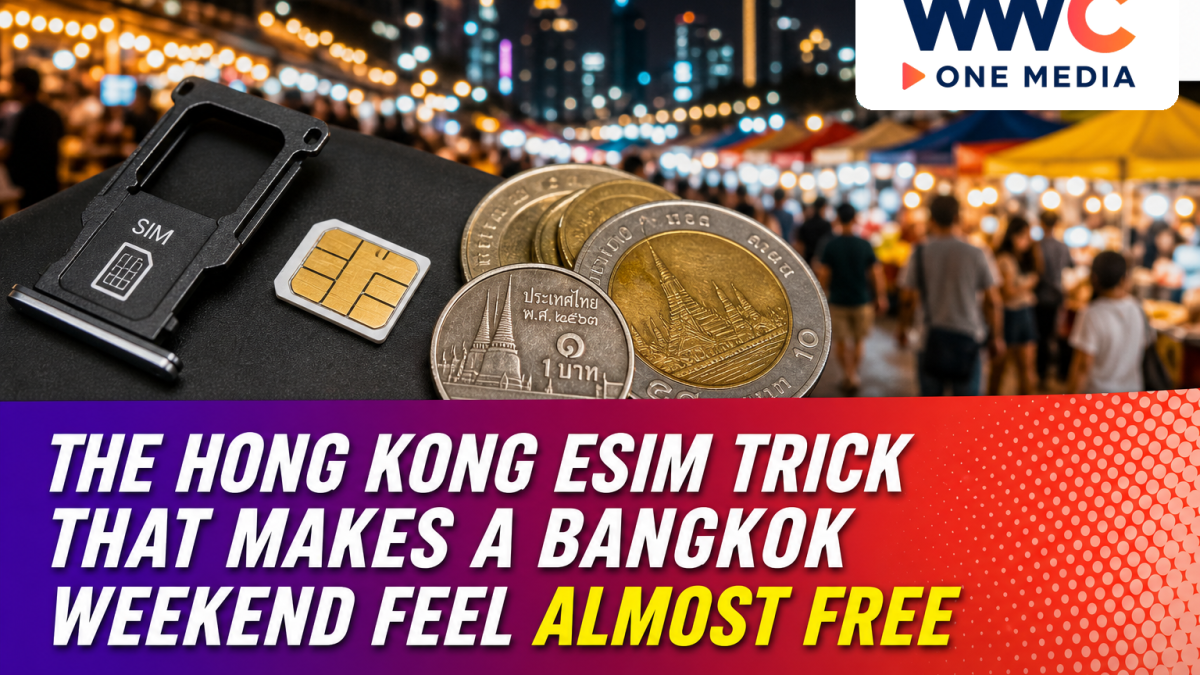
HONG KONG — The man in front of us at Suvarnabhumi was still fighting a plastic SIM with a paperclip he had borrowed from a stranger. Friday night flight, queue at immigration already a rumour behind him, phone on 12 percent, the expensive operator “travel pack” poster glowing over a counter that had no interest in his weekend.
A Bangkok hop from Hong Kong should not cost a second fare in roaming. Locals who do this regularly stopped buying that poster pack and stopped relying on a dead mall Wi-Fi at the airport. The trick is an eSIM you install before you leave Kowloon, not a card you fight with after the jet bridge.
This is a setup, not a hack. Do it on home Wi-Fi. Take screenshots of QR codes. Keep your Hong Kong number alive on the physical SIM for Octopus-linked SMS if you still need them.
We ran this on a Friday-night flight because the desk had a photographer who still thought roaming “just for maps” was a small expense. It was not. The eSIM was. The weekend felt almost free in the only way that matters: the phone worked, and the bill did not become a third tourist attraction.
1. Install it in the flat, not in the jetway
Buy from a known travel-eSIM brand or a Thai operator’s tourist plan, but complete installation at home with stable Wi-Fi. Name the plan “Bangkok data.” Toggle it off until you land.
Trying to add an eSIM on airplane Wi-Fi is how you start the weekend already annoyed, standing in a jetway that smells like recycled air, QR code refusing to parse, the person behind you already sighing in two languages.
Screenshot the QR. Screenshot the activation steps. Screenshot the support chat, because if it fails you will not remember which email you used. Store those shots in a folder, not in the Camera Roll swamp you will later open in a tuk-tuk.
A slightly opinionated line: the airport SIM counter is a tax on people who packed last. Pay it if you enjoy that kind of theatre. The rest of us can do this on a Wednesday night in Kowloon with a mug of something and the MTR still running outside.
2. Hong Kong number for calls, Thai data for maps
Leave the Hong Kong SIM for iMessage, WhatsApp, and bank SMS. Make the eSIM the mobile-data line the moment you have immigration behind you. Turn off data roaming on the Hong Kong line so a background app cannot “helpfully” use it at HKD rates.
This one toggle is the whole money save.
Phones are loyal in the wrong direction. They will prefer the SIM they know. Maps will spin up on the Hong Kong line because it has a signal, and the signal has a price. You will not notice until you are on the BTS toward Asok and the roaming SMS arrives like a small insult.
We missed this toggle once. Once is educational. The bill was not a catastrophe. It was enough to make the next trip’s first act, before suitcase, before charger, the roaming switch. Off. Named. Confirmed.
Keep the HK line for the bank OTP that still thinks you live in Mong Kok. You probably still do, Monday to Thursday.
One more small thing people miss: iMessage and WhatsApp will keep using the Hong Kong number if that SIM stays in the phone. Fine. That is the point. What you do not want is Maps, Grab, and a forgotten App Store update quietly riding the HK data line because “cellular” was left on automatic. After immigration, look at the status bar. The data icon should belong to Bangkok data, not to the SIM you have had since university.
3. Maps and Grab while you still have MTR Wi-Fi
Offline Google Maps for your hotel district, the BTS lines you will actually ride, and the walk from the Airport Rail Link. Install Grab before you fly. Thai PromptPay QR is not your Octopus. You will want a ride app that works on local data without a fight.
Download the hotel pin. Download the night-market blob you already know you will visit — Chatuchak if it is weekend daylight, a Soi 38 or Yaowarat stretch if it is not. You do not need the entire kingdom. You need the weekend’s walking radius.
Grab in Bangkok is a different animal from Grab in Hong Kong, and it still wants an account that is not being created on 4 percent battery in an arrivals hall. Do it on the sofa. Add a card or a wallet you actually use. Then leave it alone until wheels down.
A photographer we travel with still tries to “just use hotel Wi-Fi for Grab.” Hotel Wi-Fi in this city has opinions. The eSIM does not. Use the eSIM for the car. Use the hotel for FaceTime.
4. Airport Wi-Fi is for one webpage, if that
Suvarnabhumi and Don Mueang guest networks are crowded and nosy. Use them for a single webpage if the eSIM is slow to wake. Do not log into HSBC, Hang Seng, or work email on a public SSID.
If the eSIM fails, tether from a travel companion you trust, not from a “free charging and Wi-Fi” booth that has seen a thousand USB cables and one too many “trusted accessory” prompts.
We watched a man enter a banking password on Suvarnabhumi Wi-Fi while standing under a sign about tourist SIM prices. He may have been fine. We were not going to ask. The eSIM, when it woke, made the question unnecessary.
One webpage. Weather, maybe. A hotel confirmation. Then get off.
5. Cap the data so a video call does not eat the weekend
Hotel Wi-Fi for FaceTime. eSIM for maps, Grab, and LINE. Cap mobile data in phone settings so a friend who “just wants to show you the night market” does not stream 20 minutes of video on your tourist plan.
You can be generous on Wi-Fi. Be boring on the eSIM.
Chatuchak heat plus a live video to a group chat in Hong Kong is how a 5GB plan becomes a 5GB plan with a warning banner near Chatuchak Gate 1, which is a miserable place to discover you are now roaming on the HK line again because the phone panicked.
Set the cap lower than you think. You are walking, eating, riding BTS. You are not rendering a film. If you need to post, post at the hotel, in the aircon, like a civilised person who has already paid for Wi-Fi in the room rate whether you wanted to or not.
If the eSIM fails on landing
Do not buy the first counter pack in a panic. Switch the Hong Kong line’s data roaming off again (it toggles back on some phones), enable the eSIM data line, and restart once.
If it still fails, use a companion’s hotspot for Grab to the hotel, then fix it on hotel Wi-Fi. Pay with banking apps only when you are back on a network you trust. Bangkok will still be there after 20 minutes of boring troubleshooting.
We have done the restart in the Airport Rail Link, phone between knees, the city arriving in pieces through the window. It came up before Phaya Thai. That is the story you want. Not the paperclip.
Hong Kong to Bangkok is a short hop. Roaming charges are the part that makes it feel long. Install the eSIM at home, keep the HK number for SMS, kill data roaming on that line, preload maps and Grab, and stay off airport Wi-Fi for banking.
Almost free is not a miracle. It is five toggles you set before you ride the Airport Express — and a power bank, because Suvarnabhumi will not care that you did everything else right.




Leave a Reply