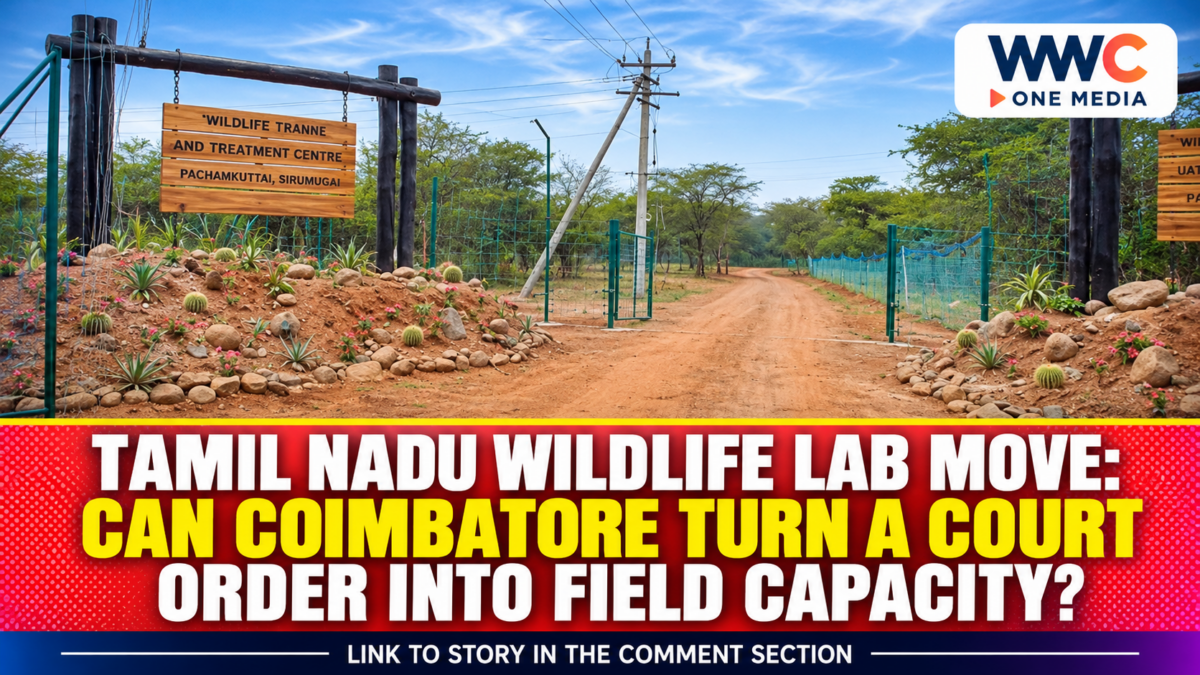
COIMBATORE, India — November 26, 2026 — Tamil Nadu’s Madras High Court has directed the state Forest Department to station its existing mobile wildlife forensic-cum-diagnostic laboratory in Coimbatore, bringing a specialised animal-health and investigation facility closer to several major protected forest areas. The court’s October 30 order also requires the authorities to provide qualified personnel, making staffing a central part of the proposed relocation.
The decision places renewed attention on Pethikuttai, where the state has been developing a wildlife rescue, treatment and rehabilitation centre. The potential value of bringing mobile diagnostic capacity to the site goes beyond moving a vehicle: it could improve access to field-level testing, but only if the department can provide trained operators, veterinary support and a reliable system for handling samples and responding to cases.
Why the wildlife forensic lab is being moved
The Madras High Court considered the issue in S. Muralidharan v. Principal Chief Conservator of Forests, a proceeding concerning wildlife protection and related facilities in Tamil Nadu.
In its October 30 order, the court recorded that the department’s air-conditioned Mobile Wildlife Forensic-cum-Diagnostic Laboratory was then stationed in Tiruchirappalli. The bench said it should be stationed in Coimbatore to serve the needs of Anamalai Tiger Reserve, Sathyamangalam Tiger Reserve and Mudumalai Tiger Reserve.
The order also identified other areas that could benefit, including parts of Coimbatore, Erode and Dindigul, as well as Kodaikanal and Valparai.
That geography matters. A mobile facility is intended to bring diagnostic capacity closer to field operations rather than requiring every sample or animal-health concern to depend on a distant fixed laboratory. The court’s direction is therefore about regional access, not simply a change of address.
The Forest Department’s own administrative directory lists Pethikuttai’s Wildlife Transit and Treatment Centre under the Coimbatore Division and Sirumugai range. That makes the site a logical location to examine as the department implements the court’s direction.
What the mobile laboratory can actually do
The court order records the equipment available inside the mobile unit. Its listed facilities include a mobile centrifuge, compound microscope, haematology analyser, serum biochemistry analyser, two refrigerators, minus-20-degree Celsius freezers, micropipettes and an inverter.
These are practical diagnostic tools rather than a complete substitute for every specialised laboratory service.
The serum biochemistry analyser can help assess organ function and identify possible metabolic imbalances. The haematology analyser provides information about blood parameters and an animal’s immune status. The unit can also conduct preliminary microscopic screening for blood parasites and examine faecal samples for parasites.
For wildlife teams, that kind of preliminary testing can help inform decisions about treatment, disease surveillance and the next steps in an investigation. It does not mean every disease can be diagnosed on site, nor does the presence of equipment alone guarantee that tests can be conducted whenever needed.
A separate state facility illustrates the role of more specialised testing. The Advanced Institute for Wildlife Conservation’s Centre for Wildlife Forensic Sciences says it accepts wildlife samples for DNA-based species, sex and individual identification, as well as DNA sequencing and fragment-length analysis. Those services show how field-level screening and laboratory-based forensic analysis can serve different but complementary purposes.
Why Pethikuttai matters beyond the relocation
Pethikuttai already has a place in Tamil Nadu’s wildlife-care plans. A state government press release dated January 12, 2024, announced a Wildlife Rescue, Treatment and Rehabilitation Centre at Modur-Pethikuttai Reserve Forest in the Sirumugai range.
The announcement described a planned facility across 53 hectares, with a role in rescuing injured, orphaned and sick wild animals, scientific quarantine, rehabilitation and release into identified habitats. It also identified consultation and guidance on human-wildlife conflict as part of the centre’s intended work.
Placing a mobile diagnostic unit in the same broader operational area could connect animal rescue and treatment with more immediate testing support. In principle, that could help veterinary teams assess cases and collect information closer to where animals are found.
But the two facilities should not be confused. The rescue and rehabilitation centre is a site-based operation, while the mobile laboratory is a vehicle equipped for specific diagnostic and preliminary forensic tasks. Their functions can complement each other without being interchangeable.
The wider conservation challenge is also about prevention and response. WWC’s report on India’s elephant tracking and village-alert systems examines why technology must be connected to trained field teams and community communication. A diagnostic vehicle faces a similar operational test: equipment is useful only when people can deploy it effectively.
The staffing question the court made explicit
One of the strongest parts of the October 30 order concerns personnel. The bench stated that merely stationing the mobile laboratory without appointing people with the necessary capacity to handle it “will not serve any purpose.” It directed the authorities and the state government to engage qualified personnel and submit a report.
That requirement matters because diagnostic equipment needs trained operators, proper sample handling and coordination with veterinary officers. A mobile laboratory that is physically present but cannot be staffed when needed may offer little practical improvement to field teams.
The same court order also examined the department’s veterinary arrangements. The status report recorded veterinary officers and assistant surgeons serving in different locations, including Coimbatore and Anamalai Tiger Reserve. The bench asked the department to provide further information on the veterinary posts and personnel needed exclusively for forest work.
This is a broader capacity issue. Wildlife rescue, treatment, disease surveillance and forensic investigation depend on overlapping skills, but they are not identical jobs. The department needs to show how the laboratory will be operated and how its findings will connect to veterinary care and any further forensic analysis.
WWC’s report on the need for veterinary investigation after an elephant death in Bandipur explains why reliable examination and laboratory findings are important before authorities or the public draw conclusions about wildlife deaths.
What the move could mean for conservation
If properly staffed and deployed, a Coimbatore-based mobile laboratory could shorten the distance between field teams and preliminary diagnostic support across several important forest landscapes. It may also strengthen the department’s ability to respond to wildlife-health concerns and collect evidence in cases requiring further investigation.
However, the court order does not establish that the relocation has already improved response times, increased testing capacity or reduced wildlife mortality. Those outcomes would need to be demonstrated through operational records.
Useful indicators would include how often the vehicle is deployed, the areas it reaches, the types of tests conducted, the availability of qualified staff and the time taken to communicate results to field veterinarians. The department could also clarify how samples requiring DNA analysis or more advanced testing are transferred to specialised facilities.
The importance of professional animal care is reflected in conservation institutions elsewhere in the region. WWC’s coverage of the Philippine Eagle Center’s animal-welfare certification looks at the veterinary, husbandry and institutional standards involved in caring for wildlife. The species and setting differ, but the operational principle is relevant: facilities need capable people and dependable procedures, not just infrastructure.
What happens next
The Madras High Court listed the matter for November 27, 2026, and directed the authorities to file a status report covering the laboratory’s relocation and staffing, alongside other veterinary-related issues.
The next public update should help establish what steps the department has taken to implement the direction and whether qualified personnel have been assigned. Until an official implementation record is available, the relocation’s completion and the laboratory’s operational readiness should not be treated as confirmed.
For Pethikuttai, the opportunity is clear: connect a developing wildlife-care centre with mobile diagnostic support serving a wider forest region. Whether that becomes a meaningful conservation improvement will depend on deployment, staffing and transparent reporting of actual field use.
Frequently asked questions
What is a mobile wildlife forensic-cum-diagnostic laboratory?
It is a vehicle equipped with diagnostic instruments that can support preliminary animal-health testing, disease surveillance and wildlife forensic work in the field.
Where is Tamil Nadu’s mobile wildlife laboratory being directed to move?
The Madras High Court directed that the existing unit, then stationed in Tiruchirappalli, be stationed in Coimbatore. Pethikuttai is listed by the Forest Department as a Wildlife Transit and Treatment Centre under the Coimbatore Division.
What tests can the mobile laboratory perform?
The court order lists serum biochemistry, haematology and preliminary microscopic screening of blood and faecal parasites among its testing capabilities.
Has the laboratory relocation been completed?
The October 30 court order directs the move and calls for a status report. The order itself does not confirm that the vehicle has completed relocation or begun operations from Pethikuttai.
Why did the court emphasise staffing?
The court said the facility would serve no purpose if it were stationed without personnel qualified to operate it. Trained staff are essential for testing, sample handling and coordination with veterinary teams.