
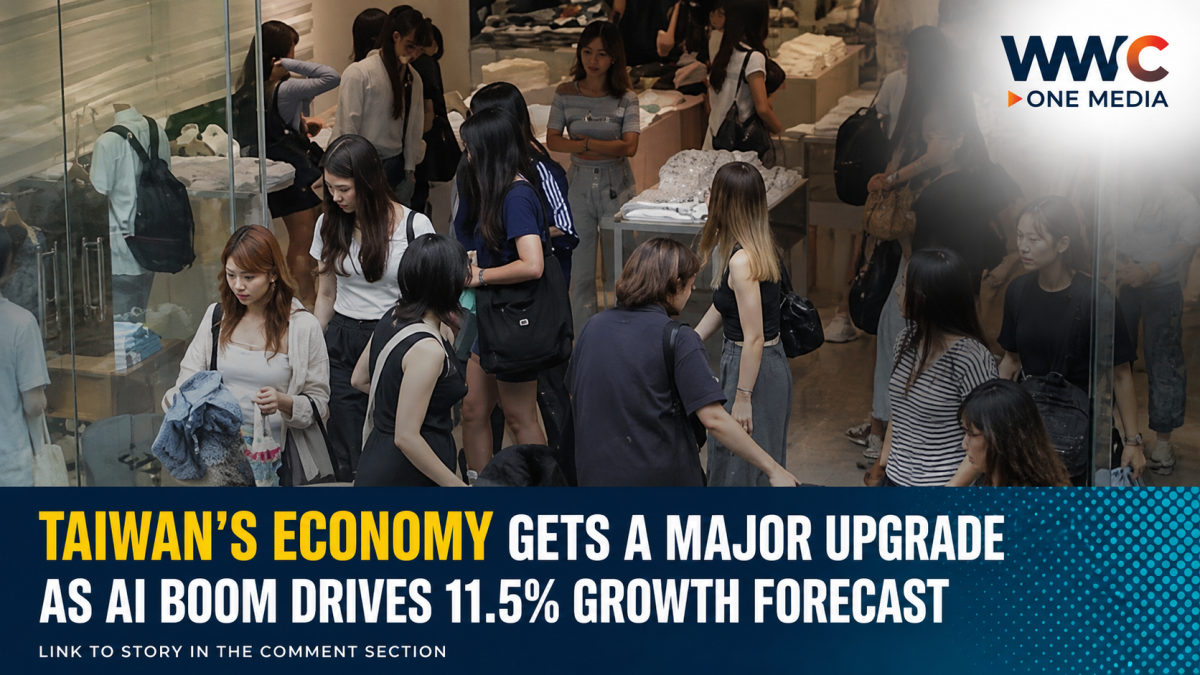
Taiwan’s economy is on track for one of its strongest expansions in decades, with Standard Chartered raising its 2026 growth forecast to 11.5% from 9.5%.
The upgrade reflects stronger-than-expected second-quarter growth, booming demand for artificial intelligence technology and increasing investment across Taiwan’s semiconductor and AI supply chains.
Standard Chartered also lifted its 2027 forecast to 6.5%, up from 5%. That remains above Taiwan’s government projection of 6.04%.
The AI boom is at the center of the optimism. Taiwan’s technology companies are rapidly expanding capacity to meet global demand for advanced chips, AI infrastructure, memory, packaging and other components. Government data shows second-quarter GDP grew 12.93% year on year, following 15.43% growth in the first quarter.
Taiwan’s official statistics agency expects the economy to grow 11.05% this year, already its fastest pace in 39 years. It also projects exports of goods and services to rise 21.28% in 2026, while private investment is expected to grow 11.58%.
But Standard Chartered warns that growth could slow sharply from the fourth quarter as Taiwan faces a higher comparison base. The bank nevertheless expects the AI “supercycle” to continue supporting exports and investment into 2027.
The benefits may also be spreading beyond Taiwan’s technology giants. Standard Chartered expects stronger domestic demand and consumer spending as the AI boom generates broader economic gains.
At the same time, Taiwan faces potential inflation pressure. Standard Chartered kept its 2026 and 2027 inflation forecasts at 2.1% and 2%, respectively, and expects two 12.5-basis-point interest-rate increases, potentially taking the central bank’s discount rate to 2.25%.
The bigger story is clear: Taiwan’s semiconductor dominance is increasingly tied to the global AI boom, and the latest forecasts suggest that demand for AI hardware could continue powering the economy well beyond this year.
WWC ONE MEDIA J.M.D

Leave a Reply