
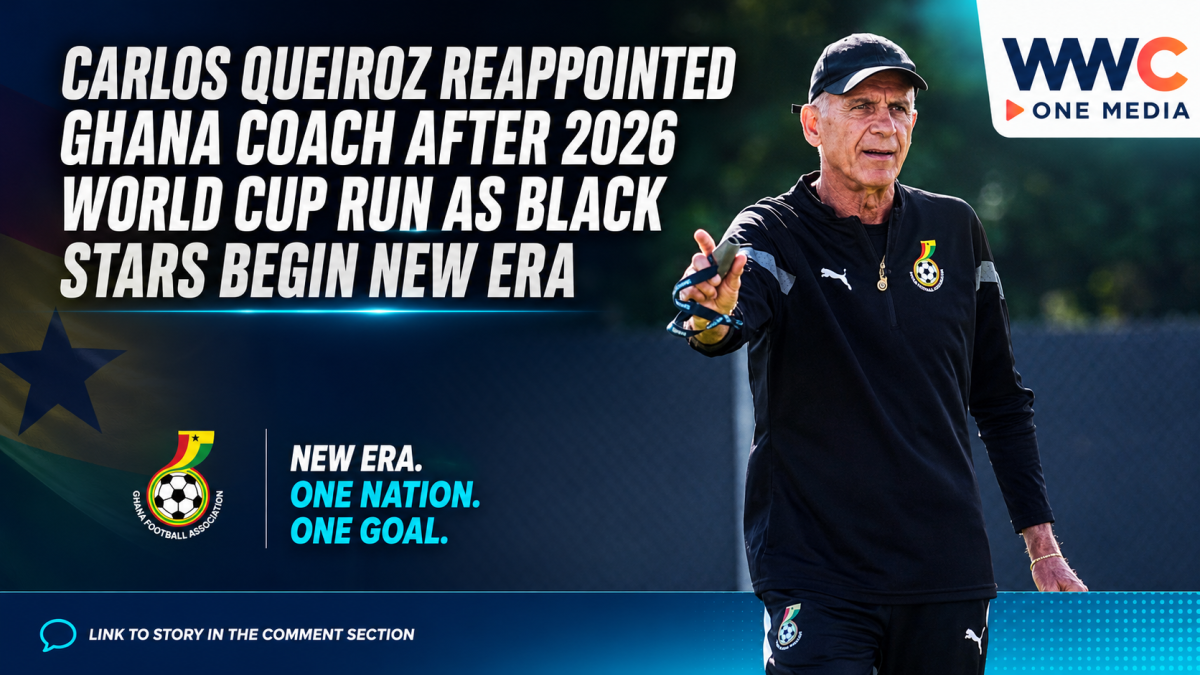
ACCRA, Ghana — Carlos Queiroz is staying with the Black Stars.
The Ghana Football Association has officially reached a new agreement with the veteran Portuguese coach, handing him another mandate to lead Ghana only weeks after the conclusion of his World Cup assignment — and after a confusing period in which he was widely reported to have stepped down.
The GFA announced on September 2 that Queiroz would take charge of the “next phase” of Ghana’s national-team programme, beginning with the upcoming international window. The association did not reveal the length or financial terms of the new agreement.
For Ghana, the decision is a vote for continuity after a 2026 FIFA World Cup campaign that restored some optimism around the Black Stars.
But the story of Queiroz’s return is more complicated than a simple resignation followed by a comeback.
Did Carlos Queiroz Actually Resign?
Immediately after Ghana were eliminated from the World Cup, international reports said Queiroz had stepped down.
Reuters reported on July 5 that the 73-year-old had left the position following Ghana’s Round-of-32 defeat to Colombia, while FIFA also described Queiroz as having confirmed his departure.
His emotional message thanking Ghana’s players, officials and supporters was widely interpreted as a farewell.
But days later, Queiroz disputed that interpretation.
“I didn’t resign. I sent a message of gratitude,” he said in remarks reported by Ghanaian outlet MyJoyOnline on July 10. Ghana’s sports minister had also said earlier that authorities had received no formal resignation letter.
The GFA’s latest announcement carefully avoids describing the situation as a resignation.
Instead, the association says Queiroz’s previous “mandate,” which covered the World Cup, had concluded and that talks involving the coach, the GFA and Ghana’s Ministry of Sports and Recreation produced an agreement on a new assignment.
That distinction matters.
Rather than a dramatic U-turn after quitting, the latest agreement can also be viewed as Ghana extending its relationship with a coach whose short-term World Cup contract had effectively run its course.
Queiroz Had Almost No Time Before the World Cup
Queiroz originally took charge of Ghana in April 2026, replacing Otto Addo just 72 days before the World Cup.
It was an unusually short preparation window for a national team entering football’s biggest tournament. Reuters reported that Queiroz had overseen only one friendly before the World Cup began.
Yet Ghana proved difficult to beat.
The Black Stars opened their Group L campaign with a 1-0 victory over Panama, followed by an impressive 0-0 draw with England.
They then lost 2-1 to Croatia, finishing third in the group but advancing to the expanded tournament’s Round of 32 as one of the best third-place teams.
Their run ended against Colombia, who defeated Ghana 1-0 in Kansas City.
CAF said Jhon Arias scored the decisive goal as Ghana struggled to create enough clear chances despite staying competitive throughout the match.
Still, reaching the knockout phase represented meaningful progress for a Ghana team that had endured difficult World Cup campaigns since its memorable quarter-final appearance in 2010.
Why Ghana Chose Queiroz Again
The GFA made its reasoning clear.
Officials pointed to Queiroz’s international experience, technical expertise and familiarity with the current Black Stars squad as reasons for extending the partnership.
“The GFA believes Queiroz’s extensive international experience, technical expertise and knowledge of the Black Stars position him strongly to lead the team into this next chapter,” the association said.
Queiroz brings one of the most extensive international résumés in world football.
Before Ghana, he had managed national teams including Portugal, Iran, Egypt, Colombia, Qatar and the United Arab Emirates, while earlier in his career he also worked at Real Madrid and served on Sir Alex Ferguson’s coaching staff at Manchester United.
His World Cup experience was a major reason Ghana hired him in the first place.
The Ghana Football Association noted when appointing him in April that Queiroz had guided South Africa through qualification for the 2002 World Cup, coached Portugal at the 2010 tournament and led Iran at the 2014 and 2018 editions.
Now Comes the Harder Part
The World Cup provided Queiroz with an immediate tournament and a relatively short-term objective.
His second mandate could prove more revealing.
Instead of preparing a squad for one competition in a matter of weeks, Queiroz now has an opportunity to shape Ghana over a longer period — establishing a tactical identity, developing younger players and building greater consistency around a Black Stars team that has struggled to reproduce the heights of previous generations.
The next international window will begin that process.
CNA, citing Reuters, reported that Ghana are moving toward their 2027 Africa Cup of Nations qualifying programme, although the GFA said full details of Queiroz’s new mandate and the team’s schedule would be announced separately.
That means the biggest question is no longer whether Queiroz is staying.
It is what Ghana expects him to build.
The Portuguese coach proved during the World Cup that he could make the Black Stars competitive with almost no preparation time.
Now Ghana is giving him something he did not have before: continuity.
And whether that continuity can turn a respectable World Cup campaign into sustained success may ultimately determine whether bringing Queiroz back was Ghana’s smartest decision — or simply an extension of a promising but unfinished experiment.
WWC ONE MEDIA MJE

Leave a Reply