
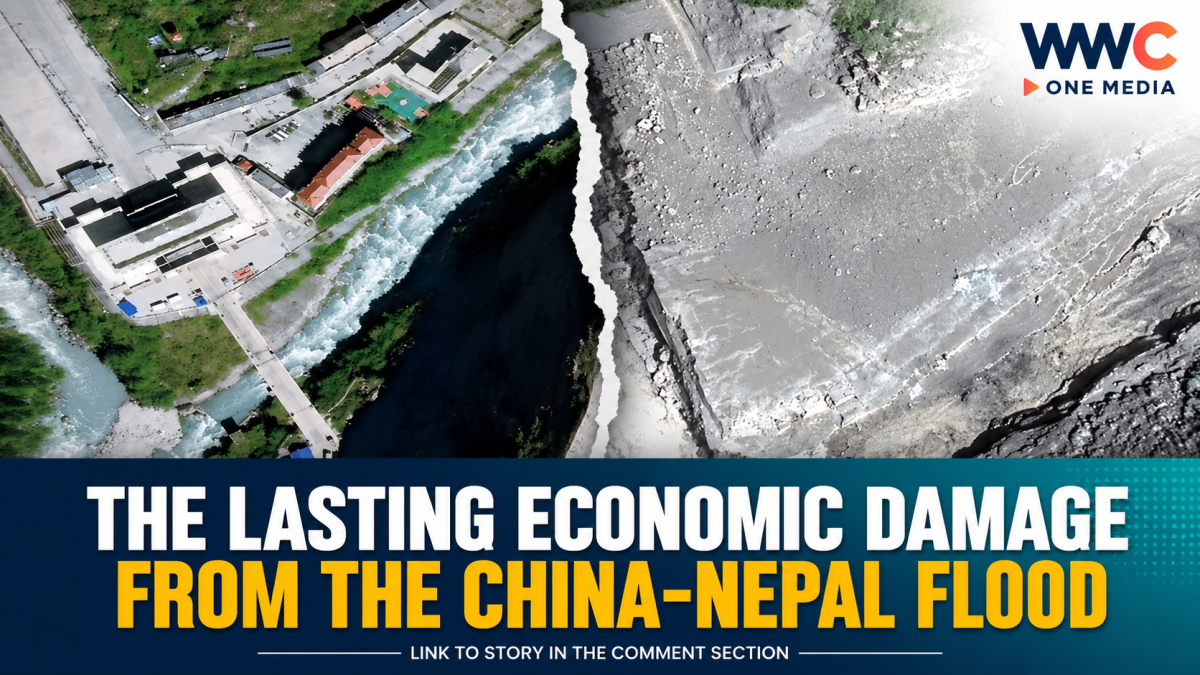
KATHMANDU, Nepal — The floodwaters that tore through Nepal’s Himalayan border corridor have begun to recede, but the country’s economic crisis is only starting to emerge.
The August 26 disaster devastated Nepal’s Rasuwa district and neighboring Tibet, destroying homes, roads, bridges, border facilities, hydropower infrastructure and vital trade links with China.
For communities along the route, the immediate emergency is survival. For Nepal’s economy, the bigger challenge is rebuilding a corridor that disappeared in minutes.
The flood may be over, but its economic consequences could last for years.
The disaster struck the Bhote Koshi–Trishuli river corridor after an ice-and-rock avalanche and associated glacial collapse triggered a powerful surge toward the Nepal-China border. Scientific assessments have described the event as a cascading mountain hazard rather than a conventional rain-driven flood.
The destruction was extensive.
According to the Stimson Center, the flood destroyed the Rasuwagadhi border facilities, the main bridge connecting Nepal and China, the Timure dry port and much of the surrounding settlement. About 40 kilometers of highway and 19 bridges were also damaged, while more than 430 megawatts of power-generation capacity was reportedly affected.
Nepal is now facing three interconnected crises: a humanitarian emergency, an infrastructure disaster and a major disruption to cross-border trade.
Rasuwagadhi: Nepal’s damaged trade lifeline
The economic impact is especially serious because Rasuwagadhi had become one of Nepal’s most important gateways to China.
Data reported by OnlineKhabar show that Nepal imported goods worth approximately Rs45.73 billion through Rasuwagadhi during the six months after trade resumed in January 2026. Exports during the same period totaled about Rs894.6 million.
In fiscal year 2024/25, the crossing handled approximately Rs85.23 billion in imports and Rs2.04 billion in exports.
Those figures show why the destruction of the corridor could affect businesses and consumers far beyond Rasuwa.
Goods entering Nepal through the route include electronics, clothing, footwear, food products, machinery, hydropower equipment and electric vehicles. Nepal’s exports through the crossing are considerably smaller, highlighting the country’s deep trade imbalance with China.
But the damage is not limited to the value of goods that can no longer cross the border.
The bigger problem is uncertainty.
When roads collapse, trucks stop moving. When bridges are destroyed, supply chains must be rerouted. When customs facilities are damaged, goods may face delays even after reaching the border.
For importers, retailers and manufacturers, those delays can mean higher transportation costs, rising prices, canceled orders and lost customers.
Nepal has already experienced the consequences of prolonged disruption. The Rasuwagadhi crossing was severely affected by flooding in 2025 and remained closed for months before trade resumed.
The latest disaster is therefore more than a temporary setback. It is another major blow to a trade corridor that had only recently returned to operation.
The damage extends beyond trade
The flood also struck Nepal’s energy infrastructure.
The 111-megawatt Rasuwagadhi hydropower project was among the facilities affected. Reuters reported that rescue teams searched hydropower tunnels where workers were believed to have survived after being trapped by floodwaters and debris.
Damage to electricity-generation facilities could create another economic burden for Nepal, where hydropower is central to national development, industrial growth and future electricity exports.
The Asian Development Bank has provided a $5 million emergency grant for rescue and relief operations. The bank said the floods and debris flows caused extensive damage to homes, infrastructure and essential services across Rasuwa, Nuwakot and Dhading.
That funding is vital for the immediate response, but it represents only a fraction of the eventual cost.
The larger bill will come with the reconstruction of roads, bridges, power plants, telecommunications systems, settlements and border infrastructure.
Reconstruction could reshape Nepal’s economy
The final cost of the disaster has not yet been established.
Reuters reported that recovery could cost the equivalent of roughly one-tenth of Nepal’s annual economic output. The Financial Times separately cited estimates of $4 billion to $5 billion for reconstruction, including damage to infrastructure, tourism and the wider economy.
These figures remain estimates, not a final official assessment. Access to some affected areas is still limited, thousands of people remain unaccounted for and authorities continue to evaluate the damage.
Even so, the economic challenge is already clear.
Nepal will need enormous financial resources simply to restore the infrastructure that existed before August 26. The country may also need to borrow more, redirect development spending and seek additional international assistance.
That could place pressure on public finances for years.
Rebuilding the same roads, bridges and facilities in the same vulnerable locations could also leave Nepal exposed to another disaster. Designing stronger infrastructure, relocating settlements and improving early-warning systems would cost more initially—but failing to do so could create even greater losses in the future.
A warning about Himalayan disaster preparedness
The flood has also renewed questions about disaster-information sharing between Nepal and China.
Three months before the disaster, officials and experts from both countries met in Kathmandu to discuss cooperation on floods, glaciers and other mountain hazards.
Nepali officials told Reuters they wanted greater access to information about glacier movements and water levels. China, however, said it had maintained timely cooperation in meteorology, water resources and disaster prevention.
The disagreement highlights a major challenge: Himalayan hazards do not stop at national borders.
The disaster began in a high-altitude environment connected to the Tibetan side of the watershed before sweeping into Nepal. Scientists and disaster experts have repeatedly warned that risks in such terrain require cross-border monitoring, rapid communication and coordinated emergency planning.
Nepal is reportedly preparing to strengthen its early-warning systems along the Chinese border. Proposed measures include seismic sensors, cameras and satellite communications that could continue operating when conventional networks fail.
Nepal has also sought stronger real-time information sharing with China on glacier movements and water levels.
China has restored road access, but trade recovery will take longer
There has been one important development.
China reopened the only road leading to the Gyirong border crossing on September 2, allowing heavy machinery to enter the disaster zone after sections of the G216 highway were destroyed by flooding.
The reopening is crucial for rescue operations and reconstruction.
But restoring road access does not mean the trade corridor is fully operational.
Border facilities have been destroyed. Bridges and highways require major repairs. Customs operations have been disrupted. Communities that depended on cross-border commerce have lost homes, businesses and income.
The Rasuwagadhi trade network cannot restart simply because one road has reopened.
It will require the reconstruction of an entire system linking the Chinese border with Nepal’s markets, transport routes, power infrastructure and local communities.
Local communities face the longest recovery
The economic consequences are ultimately measured in human lives and livelihoods.
Timure and Syabru Besi were not merely locations on a trade map. They were communities whose economies depended on transportation, tourism, hotels, shops, customs-related services and cross-border commerce.
The Guardian reported that entire sections of settlements were destroyed, while thousands remained missing and access to some communities was restricted by damaged roads and unstable terrain.
For families who lost homes, shops and sources of income, national reconstruction figures can feel distant.
The immediate concern is rebuilding a livelihood.
A shopkeeper needs inventory and customers. A hotel needs tourists. A truck operator needs a functioning road. A customs worker needs a border crossing. Farmers need access to markets.
The flood disrupted all of those economic links at the same time.
The effects could continue through lost wages, reduced tourism, higher prices, business closures and migration from damaged communities.
Nepal faces a difficult choice
Nepal must now decide whether to rebuild the trade and infrastructure networks that existed before the disaster or redesign them for a Himalayan environment where cascading hazards are becoming increasingly difficult to predict.
The second option will cost more in the short term.
But rebuilding without addressing the underlying risks could prove even more expensive if another disaster destroys the same infrastructure again.
The August 26 flood exposed a vulnerability larger than any single bridge, highway or border checkpoint.
Nepal’s dependence on a narrow Himalayan trade corridor has collided with a rapidly changing and increasingly dangerous mountain environment.
The immediate priority remains rescuing survivors, supporting displaced families and restoring essential services.
After that, Nepal will face a much longer race against time: rebuilding its economic connection with China while ensuring that the next disaster does not erase the same lifeline again.
The flood destroyed a trade route in minutes. Rebuilding it—and making it resilient enough to survive the future—could take years.
WWC ONE MEDIA G.A




Leave a Reply