
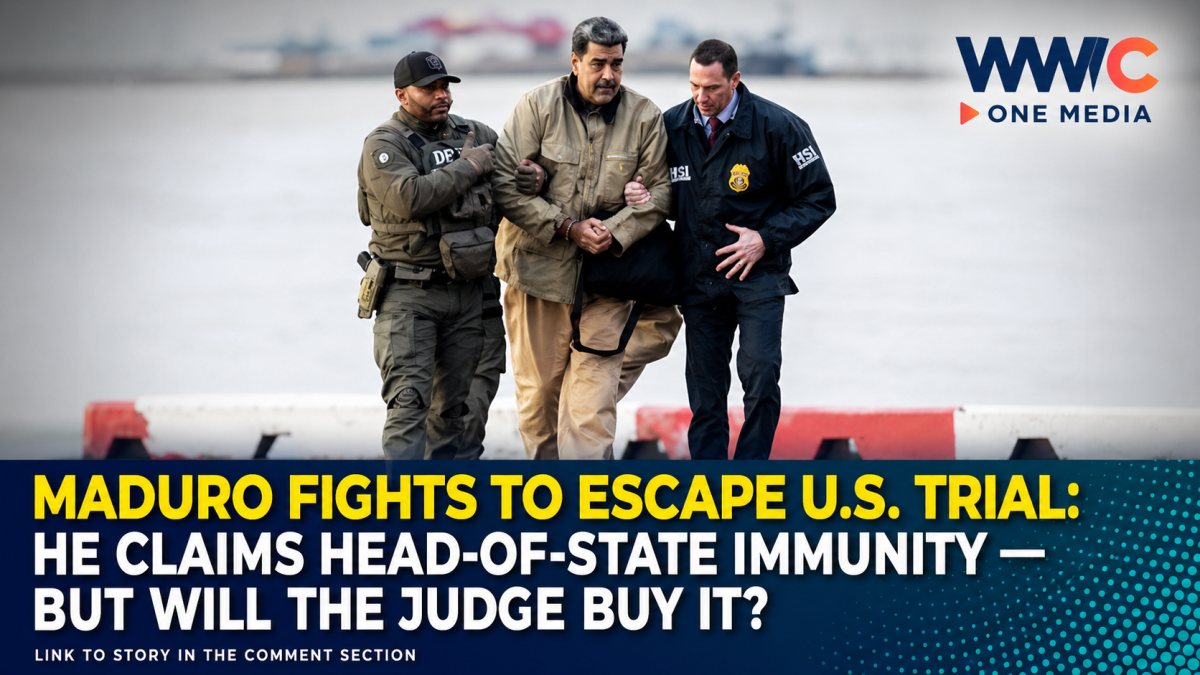
NEW YORK — Former Venezuelan president Nicolás Maduro is making a major legal push to stop his U.S. criminal case before it reaches trial, arguing that he is protected by the longstanding principle of head-of-state immunity.
Maduro’s lawyers filed a motion in Manhattan federal court seeking dismissal of the charges, arguing that a sovereign foreign leader cannot be prosecuted by a U.S. court for conduct allegedly carried out while serving as Venezuela’s head of state.
The move sets up a potentially historic legal battle over the limits of sovereign immunity, U.S. recognition of foreign governments and the power of American courts to prosecute foreign leaders.
Maduro has pleaded not guilty and has consistently denied the allegations against him.
THE LEGAL BATTLE NOW MOVES TO THE JUDGE
Maduro’s attorney Barry Pollack argues that U.S. District Judge Alvin Hellerstein does not have jurisdiction over the former Venezuelan leader because heads of state traditionally receive protection from criminal jurisdiction in foreign courts.
The defense also argues that the conduct alleged in the indictment was connected to Maduro’s official functions as Venezuela’s president.
The U.S. government, however, does not recognize Maduro as Venezuela’s legitimate president. Washington withdrew recognition of his government in 2019, and the issue of who qualifies as Venezuela’s legitimate leader could become a central factor in Hellerstein’s decision.
Reuters reported that prosecutors are expected to respond to Maduro’s dismissal request by October 2, while the judge has scheduled a hearing for November 17.
MADURO’S ARGUMENT FACES A STEEP LEGAL ROAD
Legal experts cited by Reuters say Maduro could face an uphill battle.
One of the most important historical comparisons is the case of former Panamanian military ruler Manuel Noriega, who was captured by U.S. forces in 1990 and brought to Miami to face drug-trafficking charges.
Noriega unsuccessfully invoked head-of-state immunity. U.S. courts ultimately allowed the criminal case to proceed.
The comparison is particularly significant because Maduro, like Noriega, was captured abroad by U.S. forces and subsequently brought to the United States to face drug-related charges.
Reuters also noted that U.S. courts have historically been reluctant to dismiss criminal cases simply because a defendant was brought into the country through circumstances that allegedly violated international law or an extradition arrangement.
THE CAPTURE ITSELF IS ANOTHER LEGAL FLASHPOINT
Maduro’s lawyers are also challenging the circumstances surrounding his capture.
The former Venezuelan leader was seized during a U.S. military operation in Caracas in January and transported to New York, where he was arraigned on federal charges.
CNA previously reported that Maduro’s defense questioned the legality of the operation and argued that his status as Venezuela’s sitting leader should have protected him from prosecution. Maduro declared in court that he was innocent and remained the constitutional president of Venezuela.
But prosecutors have another powerful argument: U.S. courts have repeatedly held that the manner in which a defendant is brought before the court does not necessarily prevent a criminal prosecution from proceeding.
Reuters pointed to longstanding U.S. precedent stretching back more than a century, including cases involving defendants forcibly brought to the United States from abroad.
MADURO STILL FACES FOUR FEDERAL COUNTS
The criminal case against Maduro is extensive.
He faces four felony counts, including allegations involving narco-terrorism conspiracy, cocaine-importation conspiracy and weapons-related offenses.
U.S. prosecutors allege that Maduro used his position and Venezuela’s political and security apparatus to facilitate large-scale cocaine trafficking into the United States.
Maduro has denied the allegations.
His wife, Cilia Flores, is also facing charges and has pleaded not guilty. Both have been held in federal detention in Brooklyn.
If convicted, Maduro could face a potential life sentence, according to reporting from Reuters and Associated Press.
WHY THIS CASE COULD BECOME A LANDMARK
The case goes beyond Maduro personally.
At its core is a difficult question: Can a U.S. court prosecute a foreign leader who claims to have been a sitting head of state when the alleged conduct occurred?
International law generally recognizes protections for sitting heads of state in foreign jurisdictions because such immunity is considered important to relations between sovereign nations.
But the situation becomes considerably more complicated when the prosecuting country does not recognize that individual as the legitimate leader of the foreign state.
The Washington Post reported that Maduro’s lawyers are also challenging the prosecution on broader international-law grounds, arguing that the U.S. operation that brought him to American soil was unlawful. The newspaper noted that existing U.S. legal precedent creates significant obstacles for those arguments.
VENEZUELA’S POLITICAL TRANSITION ADDS ANOTHER TWIST
The legal fight is unfolding against the backdrop of a dramatic political transformation in Venezuela.
Following Maduro’s removal, Delcy Rodríguez has emerged as the country’s interim leader, while relations between Caracas and Washington have undergone a major shift.
CNA has reported extensively on the changing U.S.-Venezuela relationship, including Washington’s growing involvement in Venezuela’s oil industry. The Trump administration has defended a major oil arrangement with Venezuela, while the country’s National Assembly has backed the agreement.
That changing political relationship could add another layer of complexity to Maduro’s immunity argument, particularly if the current Venezuelan authorities do not actively pursue an immunity claim on his behalf.
Reuters reported that Venezuelan authorities initially demanded Maduro’s return and described him as the country’s legitimate president, but their position has subsequently become less prominent as relations with Washington have changed.
THE CLOCK IS NOW TICKING
For Maduro, the immediate objective is not to win a trial — it is to prevent one from happening at all.
The judge is expected to consider the immunity challenge and other defense arguments before the case moves toward trial.
If Hellerstein rejects Maduro’s attempt to dismiss the indictment, the current schedule calls for the trial to begin on June 1, 2027.
That leaves the November hearing as a crucial moment.
A ruling in Maduro’s favor could dramatically alter the case and potentially raise broader questions about the prosecution of foreign leaders in U.S. courts.
A ruling against him would clear a major obstacle for prosecutors and move one of the most extraordinary U.S. criminal cases in recent history closer to trial.
For now, Maduro remains behind bars — and his legal team is betting that immunity can keep him from ever facing a jury.
WWC ONE MEDIA MJE
Leave a Reply