
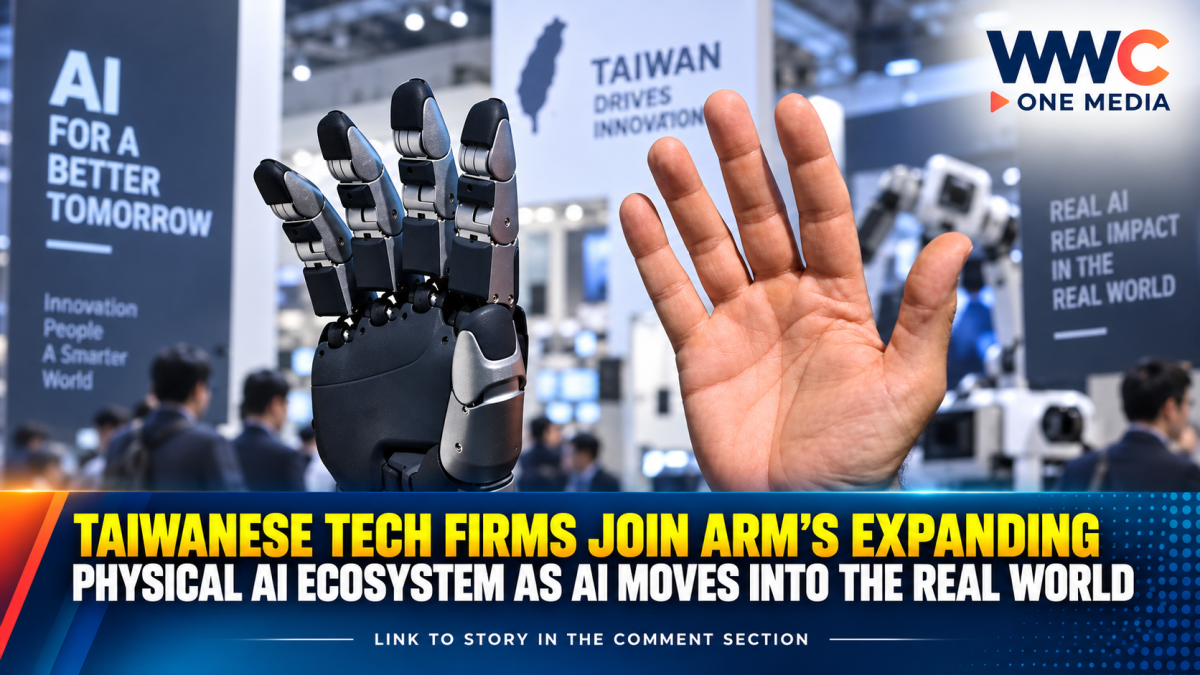
TAIPEI — Taiwan’s semiconductor and technology industry is stepping deeper into the next phase of artificial intelligence, with several Taiwanese companies joining Arm’s rapidly expanding ecosystem for “physical AI” — technology designed to give machines the ability to sense, reason and act in the real world.
Arm announced on September 8 that more than 80 companies had joined its new Arm Total Design for Physical AI initiative. The ecosystem spans the technology stack, including processors, sensors, software, AI models, cloud services and complete end-user systems.
Among the Taiwanese companies listed as participants are TSMC, Realtek Semiconductor, Artery Technology, Aaeon Technology, EverFocus Electronics, Nexcobot and Insyde Software, according to Taiwan News, citing CTEE.
The development gives Taiwan another prominent role in the emerging physical-AI supply chain as the industry moves beyond AI that exists primarily on screens and servers toward intelligent machines operating in factories, warehouses, vehicles and other real-world environments.
From AI that thinks to machines that act
Physical AI refers to AI systems embedded in machines that can interact with their surroundings.
Unlike conventional software applications, these systems must process information from cameras and other sensors, make decisions and respond through motors, actuators or other physical mechanisms — often under tight power, safety and timing constraints.
Arm says the technology could transform industries ranging from manufacturing and transportation to agriculture, logistics and resource extraction. The company estimates that these sectors could represent an annual $200 billion computing opportunity in the 2030s.
Arm’s strategy is therefore not simply about designing another processor. It is attempting to bring together the many companies required to build complete autonomous systems.
Why Taiwan matters
Taiwan’s participation is significant because the island sits at the center of the global semiconductor and electronics manufacturing ecosystem.
TSMC, the world’s leading contract chipmaker, brings advanced semiconductor manufacturing expertise to the broader ecosystem, while companies such as Realtek contribute connectivity technologies. Other Taiwanese participants cover areas including embedded computing, imaging, robotics and software.
That combination could become increasingly important as physical AI systems demand more than raw computing power.
Robots and autonomous machines need processors, sensors, connectivity, operating software, AI models and efficient edge computing to work together. Arm’s initiative is designed to reduce the complexity of integrating those components.
Arm creates a common framework for robotics
One of Arm’s major announcements is the creation of a Robotics Capability Framework, intended to provide a common language for describing and advancing robotic capabilities.
The company argues that fragmentation across hardware and software can slow development. Establishing common foundations could make it easier for companies to build systems that scale from prototypes into commercially deployable machines.
The initiative includes major players across the technology stack. Arm specifically highlighted participants including AWS, ECARX, Hugging Face, Liquid AI, NXP, PlusAI, PSYONIC, QNX, Qwen, Siemens and Unitree Robotics, alongside other companies.
Taiwan’s AI hardware advantage meets robotics
The development comes as Taiwan’s technology industry is increasingly positioning itself around the physical infrastructure needed for the global AI boom.
Reuters reported this week that Taiwan used the 2026 SEMICON Taiwan trade show to promote its semiconductor ecosystem and deepen international technology partnerships. Major Taiwanese companies including TSMC and Foxconn remain central to global AI hardware supply chains.
Foxconn, meanwhile, said recently that strong AI-related demand was helping drive expectations for stronger-than-anticipated third-quarter performance. The company has become a major manufacturer of AI infrastructure and systems for global technology companies.
That broader momentum suggests Taiwan’s role in AI may increasingly extend beyond producing chips for data centers.
The next opportunity could be helping build the machines that bring AI into the physical world.
The robotics race is accelerating
Arm’s announcement comes as the global robotics industry enters a more competitive phase.
Companies are developing humanoid robots, autonomous vehicles, industrial robots and other machines capable of operating with greater independence.
Arm has already highlighted the shift from laboratory demonstrations toward real-world deployment. In July, the company said humanoid, quadruped and other autonomous robots were beginning to perform practical tasks in areas such as manufacturing, logistics and warehousing.
The broader investment community is also increasingly treating physical AI as a major technology trend. A recent UBS analysis identified actuators, sensors, edge computing and power infrastructure as important parts of the emerging physical-AI ecosystem.
A new battleground for Taiwan’s technology industry
For Taiwan, the opportunity could be larger than simply supplying individual components.
If physical AI develops into a mass-market technology, manufacturers will need entire ecosystems capable of producing reliable computing platforms, sensors, communications hardware, software and robotic systems at scale.
Taiwan already has deep capabilities across many of those areas.
The challenge will be turning that manufacturing and semiconductor strength into complete physical-AI platforms while keeping pace with rapidly changing AI models, robotics architectures and software standards.
Arm’s new ecosystem is one attempt to address that challenge by bringing companies together before the industry becomes even more fragmented.
What comes next?
The immediate impact may not be visible in consumer products.
But the strategic direction is becoming clearer: AI is moving from the cloud into machines that can physically interact with the world.
Taiwanese companies are now positioning themselves inside that transition.
With more than 80 companies already participating in Arm’s physical-AI initiative, the competition is shifting from simply asking who can build the smartest AI model to a much bigger question:
Who can turn AI intelligence into machines that actually work in the real world?
Taiwan’s semiconductor and electronics industry appears determined to be part of that answer.
WWC ONE MEDIA G.A




Leave a Reply