
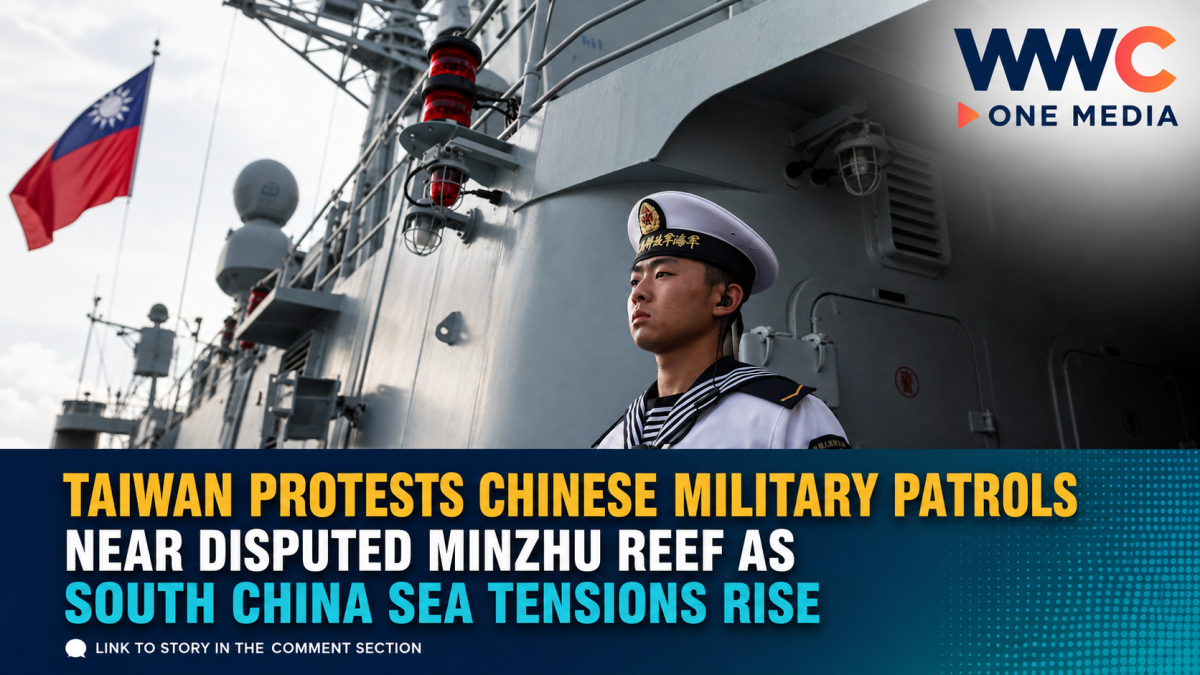
Taiwan has protested China’s latest military activity around Minzhu Reef in the South China Sea, accusing Chinese forces of conducting dangerous maneuvers that interfered with normal aircraft operations and warning against what Taipei described as increasingly assertive actions in disputed waters.
The development, reported by Taiwan News on September 3, 2026, adds another layer to growing tensions surrounding the reef, which is known as Minzhu Reef in Taiwan, Huangyan Island in China and Bajo de Masinloc or Panatag Shoal in the Philippines.
Taiwan condemns Chinese activity
Taiwan’s Ministry of Foreign Affairs said Chinese military forces conducted patrols in waters and airspace around Minzhu Reef on Wednesday. Taipei characterized the reported maneuvers as unsafe, irresponsible and provocative, saying they attempted to interfere with normal aircraft operations.
Taiwan also objected to what it described as unilateral attempts to expand authority in the South China Sea through military deployments and other so-called gray-zone activities.
The ministry called on Beijing to follow international law and resolve territorial disputes peacefully, while saying Taiwan would continue working with regional partners to preserve stability in the South China Sea.
China and the Philippines also claim the disputed reef.
Beijing says the patrols are about maritime rights
The latest confrontation follows Chinese military and coast guard activity around the same feature.
According to Reuters, China conducted joint naval and air combat-readiness drills around Scarborough Shoal in August, with Beijing describing the exercises as a response to what it considered actions by other countries that threatened regional peace and stability. China said the exercises were designed to test and improve its ability to defend what it considers its territorial sovereignty and maritime rights.
The competing descriptions underscore the increasingly sensitive nature of the area. Beijing views Huangyan Island as Chinese territory, while Manila maintains its claim over Bajo de Masinloc and Taiwan has its own longstanding claim under the name Minzhu Reef.
Why the Philippines is watching closely
For the Philippines, the location is particularly significant.
Scarborough Shoal sits within the Philippines’ 200-nautical-mile exclusive economic zone, although sovereignty over the feature itself remains disputed. China has maintained a persistent presence around the shoal since the 2012 standoff with Manila.
Reuters reported in April that China had deployed vessels and a floating barrier near the entrance of the shoal, temporarily tightening control over access. Philippine officials said Chinese maritime forces had been monitoring Filipino fishing activity in the area.
Manila has also repeatedly monitored increased Chinese naval and coast guard activity around Bajo de Masinloc. In May, Philippine officials said Chinese military and coast guard vessels had been detected near the shoal, although Philippine authorities disputed Beijing’s characterization of some activity as coordinated military drills.
That distinction is important: the presence of Chinese vessels does not automatically mean that a new military exercise is taking place. Reports from the Philippines and China have sometimes characterized the same activity differently.
The dispute is becoming more complicated
The latest Taiwan protest comes amid a broader pattern of Chinese maritime activity across the region.
Reuters reported in August that China and Indonesia also planned a joint naval navigation exercise in waters east of Taiwan, an area where Beijing has increasingly sought to assert its maritime claims.
Meanwhile, Reuters reported that China carried out another seabed survey east of Taiwan between August 10 and 31. Beijing said the survey was intended to gather geological information for territorial planning and resource management, while Taiwan monitored the activity and rejected China’s jurisdictional claims around the island.
Taken together, these developments show that maritime pressure is occurring across several strategically important areas rather than at a single flashpoint.
What makes Minzhu Reef so sensitive?
Minzhu Reef, Huangyan Island and Bajo de Masinloc are different names for the same disputed feature, better known internationally as Scarborough Shoal.
The shoal is strategically important because of its location near the Philippines and its position along heavily contested waters of the South China Sea.
It is also a longstanding fishing ground. Reuters has reported that China has maintained control around the shoal since 2012, while Filipino fishermen and Philippine government vessels have continued operating in the broader area.
A 2016 international arbitration ruling rejected key elements of China’s expansive South China Sea claims, although the arbitration did not determine sovereignty over Scarborough Shoal itself. Reuters has noted that the tribunal found China’s interference with traditional fishing rights at the shoal inconsistent with international law.
What happens next?
Taiwan’s latest protest does not mean an armed confrontation is imminent. However, repeated military, coast guard and maritime activities around disputed features are increasing the number of opportunities for dangerous encounters.
For the Philippines, the situation deserves particular attention because Bajo de Masinloc is one of the country’s most sensitive maritime flashpoints.
For Taiwan, the episode is another example of what Taipei describes as China’s expanding use of gray-zone pressure—actions below the threshold of outright armed conflict designed to reinforce a territorial claim or establish a more persistent operational presence.
The immediate question is therefore not simply who claims the reef.
It is how far the competing maritime powers will go to enforce those claims—and what happens if their vessels or aircraft meet again in increasingly crowded waters.
WWC ONE MEDIA G.A




Leave a Reply