
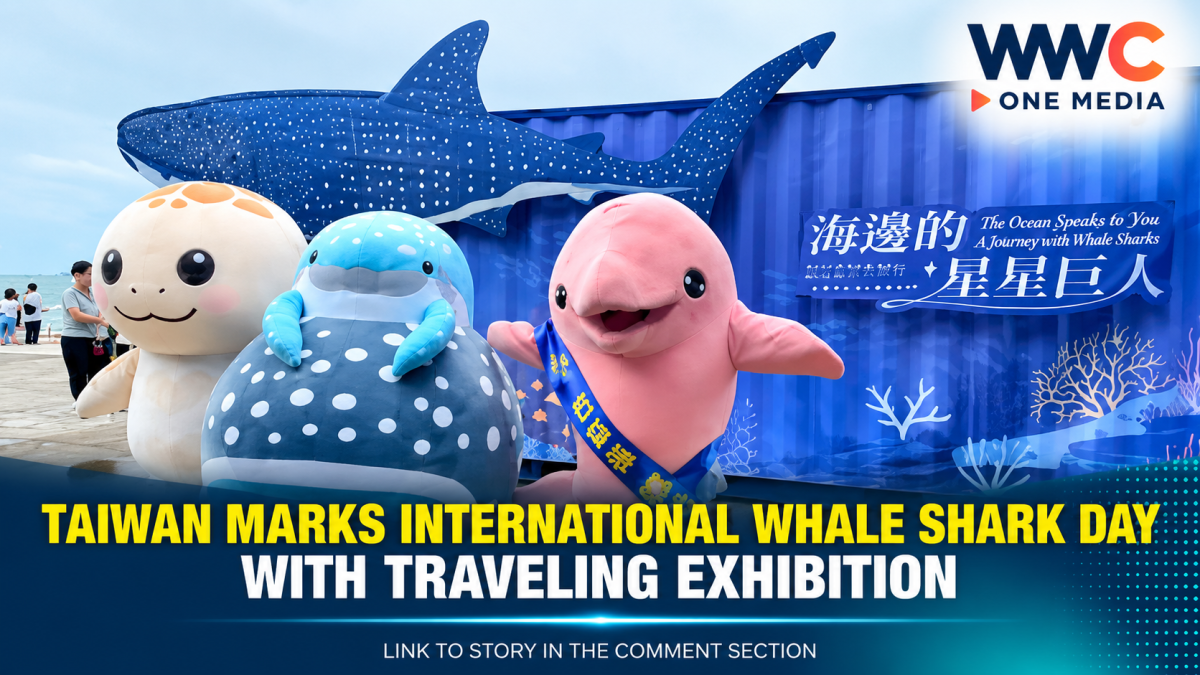
TAIPEI, Taiwan — Taiwan is bringing the world of whale sharks closer to the public with a traveling marine conservation exhibition launched in Kaohsiung on Aug. 30, coinciding with International Whale Shark Day.
Organized by Taiwan’s Ocean Conservation Administration (OCA), the “Starry Giant by the Sea” whale shark-themed mobile container exhibition transforms two 20-foot shipping containers into an immersive marine experience. The exhibition opened at KW2 in Kaohsiung Harbor before beginning a nationwide journey through several Taiwanese cities.
The exhibition combines whale shark specimens, scientific research, interactive experiences and picture-book storytelling, giving visitors an opportunity to learn about one of the ocean’s most recognizable—and threatened—giants.
From Kaohsiung to Cities Across Taiwan
Following its Kaohsiung debut, the exhibition is scheduled to travel to Tainan, Taichung, Hualien and Taipei, bringing marine education beyond traditional museums and into public spaces.
The Kaohsiung leg is scheduled to run through Oct. 28, 2026, at the seaside plaza of KW2. The broader traveling program is expected to continue through Oct. 3, 2027, according to Taiwan’s Ocean Conservation Administration.
The planned stops include the Tainan Cultural and Creative Industries Park, National Museum of Natural Science in Taichung, Taiwan Cement’s DAKA Park in Hualien, and Taipei Zoo.
The exhibition is designed around changing ocean environments and uses lighting, sound and interactive technology to create an immersive experience. Visitors can also see a juvenile whale shark specimen donated by the National Museum of Marine Biology and Aquarium.
Why Whale Sharks Matter
Whale sharks are the largest fish species in the world, despite their name. Unlike whales, they are fish and breathe through gills.
They are generally considered gentle animals and feed largely on plankton and small fish. One of their most distinctive features is the pattern of white spots covering their bodies.
Those markings are unique to individual whale sharks and can function almost like a natural identification card, allowing researchers to recognize individuals and track their movements.
But their enormous size does not make them immune to threats.
As highly migratory marine animals, whale sharks travel across large areas of ocean and can face risks including fishing bycatch, vessel activity, marine pollution and environmental change, according to Taiwan’s Ocean Conservation Administration.
That makes whale shark conservation part of a much broader challenge: protecting healthy marine ecosystems across the animals’ migration routes.
Taiwan Steps Up Whale Shark Protection
Taiwan classifies whale sharks as protected marine wildlife, meaning they are covered by the country’s wildlife conservation laws.
Officials are urging people who encounter a whale shark at sea to avoid chasing, touching, surrounding or blocking the animal’s movement. Instead, people should keep an appropriate distance and observe it without interfering.
The message is simple: an encounter with a whale shark should remain an encounter with a wild animal—not an opportunity to get closer for a photograph.
The OCA hopes the traveling exhibition can turn that message into everyday awareness by bringing marine conservation directly into communities.
A “Starry Giant” Comes to the City
The exhibition is part of a wider OCA campaign built around the whale shark’s distinctive constellation-like markings.
Earlier in August, Taiwan also launched a whale shark-themed light-rail train in Kaohsiung, extending the campaign into the city’s public transportation system. The train operated from Aug. 1 through Sept. 7, while additional transportation promotions are planned as the exhibition travels around Taiwan.
At the exhibition’s opening, OCA’s whale shark, white dolphin and green sea turtle mascots also appeared together publicly for the first time, adding a family-friendly element to the conservation campaign.
The goal goes beyond simply teaching visitors about whale sharks.
Taiwan’s marine authorities want the traveling exhibition to encourage people to connect the health of individual species with the condition of the ocean itself—particularly as pollution, human activity and environmental changes increasingly affect marine ecosystems.
More Than an Exhibition
The whale shark may be the star of the show, but the larger story is about how people interact with the sea.
By taking a marine exhibition out of conventional museum spaces and moving it between cities, Taiwan is attempting to make ocean conservation part of everyday life.
For visitors, the experience offers a close look at the biology and behavior of one of the world’s most remarkable fish.
For conservationists, however, the message is bigger: protecting a whale shark means protecting the ocean it depends on.
And as the “Starry Giant by the Sea” exhibition continues its journey from Kaohsiung to other parts of Taiwan, the country is turning one of the ocean’s most recognizable animals into a moving reminder of what is at stake beneath the waves.
WWC ONE MEDIA G.A



Leave a Reply