
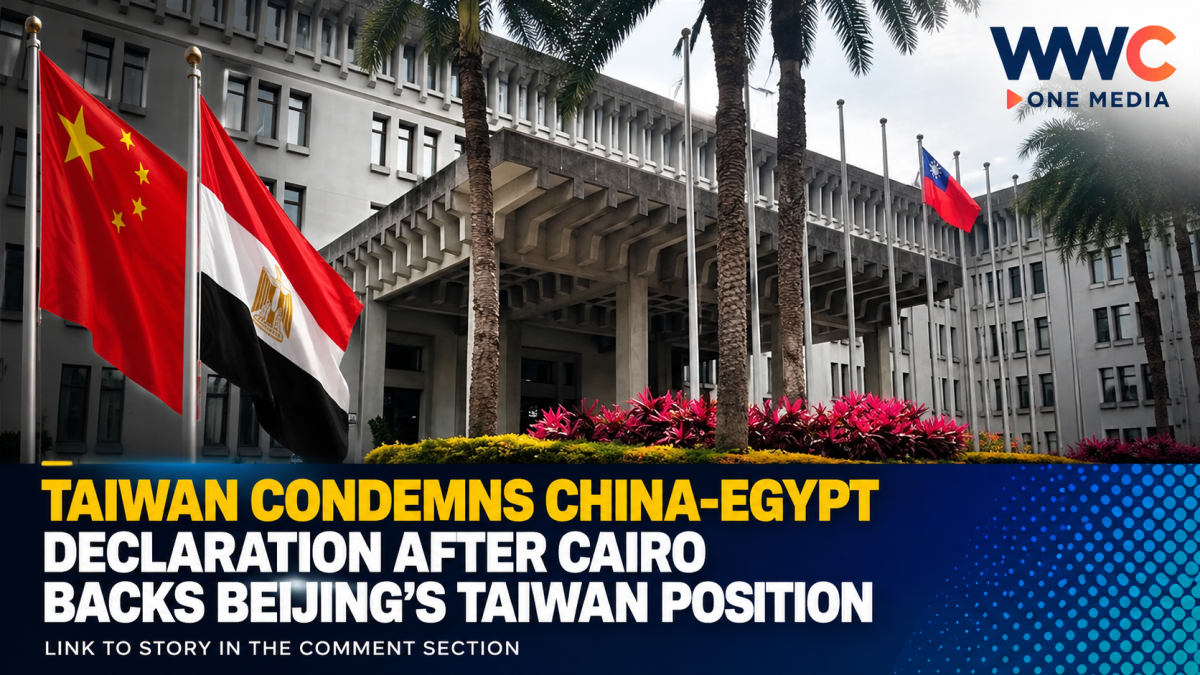
Taiwan has sharply condemned a new China-Egypt joint declaration after Egypt reaffirmed Beijing’s position on Taiwan during Chinese President Xi Jinping’s state visit to Cairo.
The dispute erupted after China and Egypt issued a joint statement on September 2 following Xi’s two-day visit. The declaration said Egypt would continue to adhere to the One-China principle and described Taiwan as an “inalienable part” of the territory of the People’s Republic of China.
Taiwan’s Ministry of Foreign Affairs responded on September 3, accusing Beijing of using international diplomacy to promote what Taipei called a misleading narrative about Taiwan’s status.
Taipei said the declaration “seriously distorts” the objective situation and lodged a strong protest against what it described as China’s efforts to persuade other governments to repeat Beijing’s position.
Taiwan’s foreign ministry further asserted that the Republic of China (Taiwan) is a sovereign state separate from the People’s Republic of China and said Chinese pressure would strengthen Taiwan’s determination to defend its democratic system.
Why the China-Egypt statement matters
The language on Taiwan was part of a much larger agreement between Beijing and Cairo.
Xi visited Egypt on September 1 and 2, marking his first visit to the country in a decade and coinciding with the 70th anniversary of China-Egypt diplomatic relations. Egypt was the first Arab and African country to establish diplomatic relations with the People’s Republic of China in 1956.
The two governments agreed to deepen their comprehensive strategic partnership across infrastructure, manufacturing, energy, technology, finance and security.
They also backed greater cooperation involving semiconductors, artificial intelligence, electric vehicles, renewable energy, critical minerals, data centers, cybersecurity and the Suez Canal Economic Zone.
More than 20 cooperation documents were reportedly signed during the visit, covering areas including the digital economy, science and technology, education, transportation and industrial cooperation.
Egypt’s position was explicit
The Taiwan language was not merely implied.
The official Egypt-China communiqué states that Egypt reaffirmed its commitment to the One-China principle and recognized Taiwan as an inalienable part of the territory of the People’s Republic of China, while supporting Beijing’s position on sovereignty and territorial integrity.
Chinese state media also reported that Egyptian President Abdel Fattah el-Sisi reaffirmed Egypt’s adherence to the One-China principle during his talks with Xi.
For Beijing, such language reinforces its diplomatic campaign to secure international recognition of its position on Taiwan.
For Taipei, however, the declaration represents another example of what it sees as Beijing’s effort to narrow Taiwan’s international space.
Taiwan faces a broader diplomatic pressure campaign
The confrontation with Egypt comes as Taiwan faces similar diplomatic pressure elsewhere.
On September 2, Taiwan also criticized Kyrgyzstan after it endorsed the One-China principle, according to Taiwan News. At the same time, Taipei has been pushing for greater participation in international institutions as the United Nations General Assembly opens.
The issue is unfolding against a backdrop of increased Chinese military and maritime activity around Taiwan.
Taiwan’s Defense Ministry has continued reporting Chinese naval and official vessels operating around the island. On September 3, Taiwan News reported that five Chinese naval vessels and three official ships were tracked around Taiwan over a 24-hour period, with Taiwanese forces deployed to monitor the activity.
Reuters has separately reported that China conducted a seabed survey in waters east of Taiwan during August while Chinese coast guard activity in the area continued. Taiwan characterized the moves as provocative.
But the Egypt deal is about much more than Taiwan
The Cairo declaration also shows why Egypt is strategically important to Beijing.
China and Egypt are seeking closer economic integration, with cooperation extending to the Suez Canal Economic Zone, manufacturing, renewable energy, digital infrastructure and supply chains.
Egypt also wants to strengthen its position as a regional hub connecting Asia, Africa and Europe, while China is seeking deeper relationships across the Global South. The two sides explicitly pledged to increase coordination in international forums and amplify the voice of developing countries.
The two governments additionally discussed regional conflicts, including Gaza and Sudan. They called for support for a Gaza ceasefire and humanitarian aid and backed efforts toward a political settlement in Sudan.
Xi also proposed a new regional security framework for the Middle East, calling for greater regional ownership of security issues and opposition to external interference.
The bigger geopolitical picture
The latest dispute illustrates how the Taiwan question increasingly extends beyond East Asia.
For Beijing, securing statements from governments such as Egypt strengthens its diplomatic narrative that Taiwan is part of China.
For Taipei, countering those statements has become an important part of its international strategy, particularly as Beijing expands economic, political and diplomatic engagement with countries across the Global South.
The China-Egypt declaration therefore carries significance beyond the wording of a single paragraph.
It is another indication that Taiwan’s international status is becoming increasingly entangled with China’s expanding diplomatic relationships — from the Middle East and Africa to the Pacific.
And with Beijing continuing to press its One-China position while Taipei pushes back, the next diplomatic battleground may not be in the Taiwan Strait at all.
It could be thousands of kilometers away, inside the capitals of countries being courted by both sides.
WWC ONE MEDIA G.A



Leave a Reply