
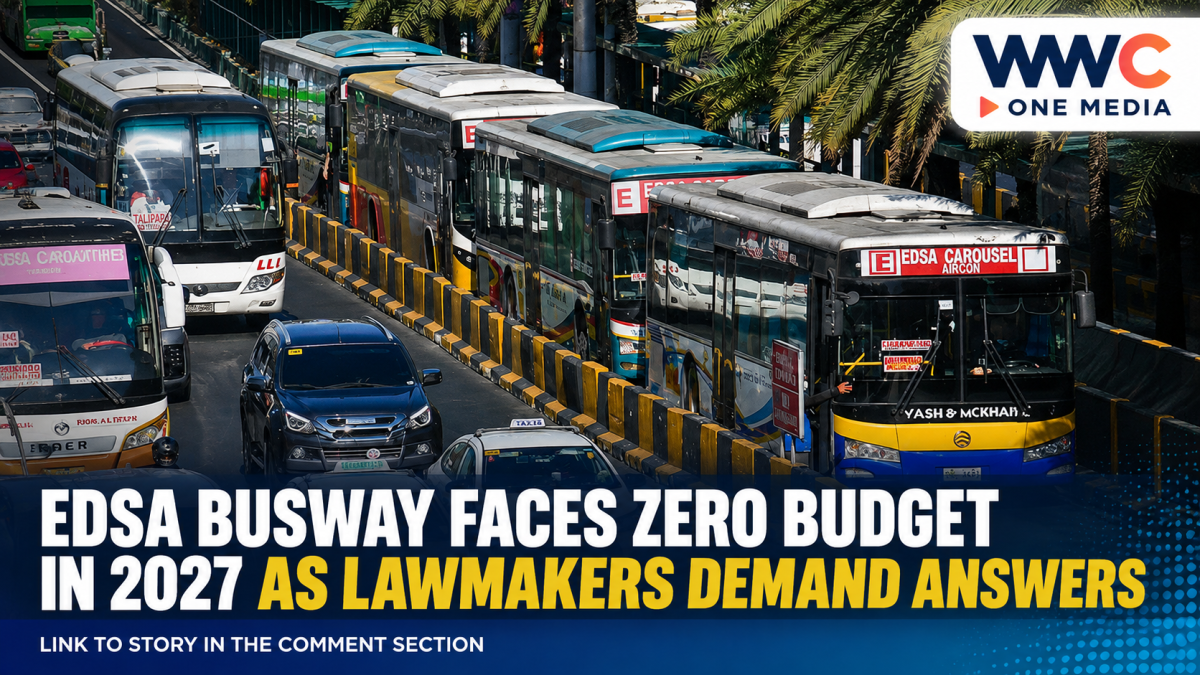
MANILA, Philippines — The proposed 2027 national budget is facing scrutiny after the EDSA Busway, the Service Contracting Program and transport fuel subsidies were given zero allocations in the Department of Transportation’s proposed spending plan.
The issue surfaced during the House of Representatives’ deliberations on the Department of Transportation’s proposed 2027 budget, where Akbayan Party-list Rep. Percival Cendaña questioned why funding for the EDSA Busway and related commuter-support programs was not included.
Cendaña urged Congress to restore funding for the EDSA Bus Carousel, stressing that millions of Filipinos rely on public transportation for their daily commute.
The proposed reduction is significant. The EDSA Busway received ₱88.7 million in the 2026 budget, while the Service Contracting Program had ₱1 billion and the fuel subsidy program had ₱2.5 billion. Under the proposed 2027 National Expenditure Program, all three are listed with no allocation, according to transport advocates and reports on the budget proposal.
DOTr: The funding gap is not necessarily a permanent shutdown
Transportation Secretary Giovanni Lopez explained during the House budget briefing that the absence of funding in the proposed NEP does not mean the government cannot eventually provide money for the programs.
Lopez said similar funding was not included in the 2026 NEP but was later provided as Congress responded to the effects of the Middle East crisis and rising fuel prices.
He pointed to the government’s limited fiscal space and the DOTr’s spending obligations as factors behind the proposed allocations. As of July 2026, the department’s obligation rate had reached 82.4 percent, according to the transport secretary.
Lopez also backed the call for Congress to consider restoring funding for the EDSA Busway.
Why the EDSA Busway funding matters
The EDSA Busway is not simply another road project. It is a major public transport corridor serving commuters along one of Metro Manila’s busiest arteries.
The government has also used service contracting to support public utility vehicle operators and drivers by compensating them based on kilometers traveled. During the 2026 oil-price crisis, the program was expanded to help protect transport workers while maintaining public transport services.
GMA News previously reported that the service contracting program included EDSA Busway buses, with operators and drivers receiving support based on their routes and kilometers traveled. The program was designed to help sustain services while reducing the financial pressure caused by higher fuel costs.
The DOTr had also rolled out fuel assistance in 2026. In April, Lopez said the department had a ₱2.5-billion fuel subsidy budget and had already disbursed ₱1.5 billion at that point. The assistance was part of a broader package of measures ordered amid rising fuel prices.
Transport groups had already sounded the alarm
The funding issue was not raised for the first time during Thursday’s congressional hearing.
Move As One Coalition previously warned that the proposed 2027 budget would eliminate funding for the EDSA Busway, Service Contracting Program and fuel subsidies.
The coalition said the EDSA Busway’s ₱88.7-million allocation in 2026 would fall to zero in the proposed 2027 budget. It also flagged a reduction in funding for active transport programs, including infrastructure for pedestrians and cyclists.
Transport advocates argued that the proposed cuts are difficult to reconcile with the government’s stated goal of improving public transportation and supporting commuters.
The concern comes as transportation costs remain sensitive to international fuel prices. Any renewed oil-price shock could place additional pressure on drivers, operators and commuters if support programs have no dedicated allocation.
The bigger budget picture
The controversy comes despite the proposed Department of Transportation budget increasing substantially in headline terms.
The DOTr’s proposed 2027 budget is about ₱300.96 billion, according to reports on Thursday’s congressional deliberations, up by ₱163.11 billion from the amount allocated to the department in the 2026 General Appropriations Act.
However, the department had initially sought a much larger amount—about ₱624.48 billion—for its proposed programs and projects. Only a portion of the proposed projects received funding in the 2027 NEP.
The national government is proposing a ₱7.2-trillion budget for 2027, about 6 percent higher than the ₱6.793-trillion 2026 budget.
The Department of Budget and Management has said the 2027 spending plan was prepared amid limited fiscal space and competing mandatory obligations. The agency said the budget prioritizes social services, economic services, infrastructure and other high-impact programs while maintaining fiscal discipline.
What happens next?
The most important detail for commuters is that the zero allocation is not yet the final 2027 budget.
The ₱7.2-trillion National Expenditure Program is now undergoing congressional deliberations. Lawmakers can propose changes, restore funding or realign allocations before the final General Appropriations Act is enacted.
That leaves the EDSA Busway at a critical point.
For commuters, the question is no longer simply how much the government plans to spend on transportation. It is whether the final 2027 budget will provide enough support to keep one of Metro Manila’s most important bus corridors running efficiently—and whether the government will have resources available if another fuel-price shock hits.
Cendaña is calling on Congress to restore the EDSA Bus Carousel budget.
The final decision will now be made during the budget process, with millions of daily commuters watching closely.
WWC ONE MEDIA MJE


Leave a Reply