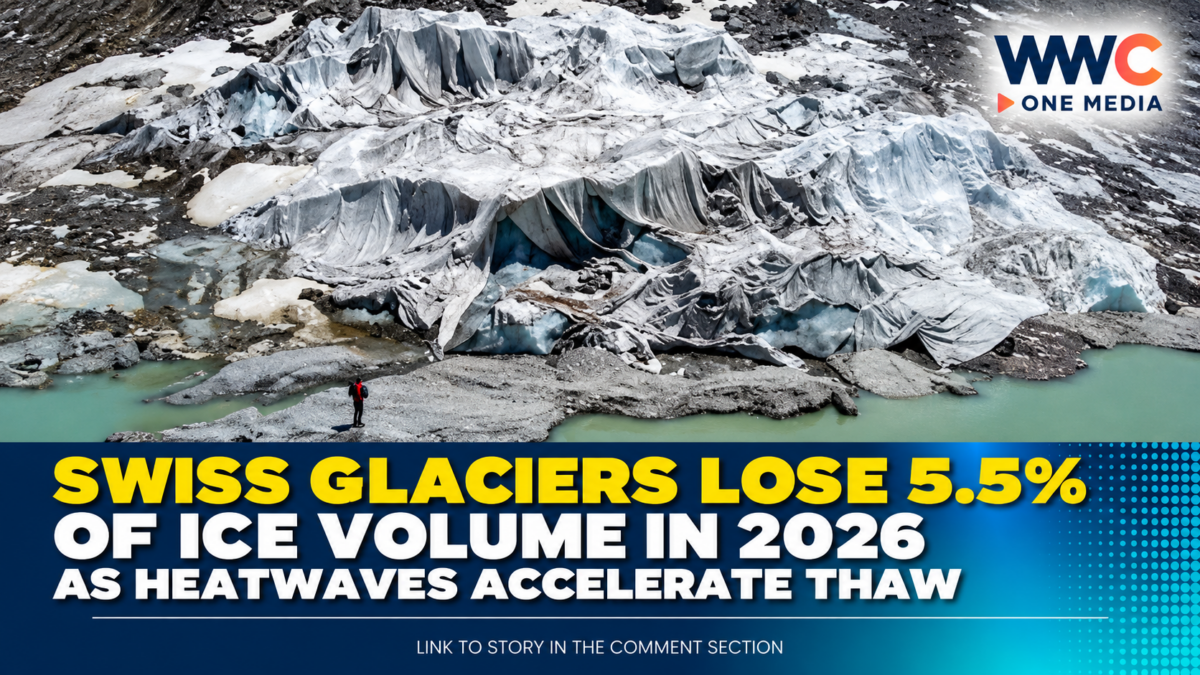
Switzerland’s glaciers lost 5.5 per cent of their total ice volume in 2026, marking the second-largest annual decline on record as unusually high temperatures and low winter snowfall accelerated melting across the Alps.
The latest assessment from the Swiss Glacier Monitoring Network, known as GLAMOS, and the Swiss Academy of Sciences found that the country’s glaciers lost nearly one-fifth of their total volume over the past five years.
The scale of this year’s melt was particularly significant because glaciers entered the summer with much less protective snow than usual. Winter snowfall was unusually low, leaving more exposed ice vulnerable to the intense heat that followed.
Scientists said average glacier thickness declined by around 2.5 to 4 metres during the year, while some glacier tongues lost as much as 10 metres of ice. Several glaciers, including the Aletsch, Rhône and Clariden, recorded their largest annual melt on record.
The Aletsch Glacier, the largest glacier in the Alps, experienced its biggest-ever annual melt in 2026. At Glacier de Tsanfleuron, the average thickness dropped by more than four metres.
The melting also released an enormous amount of water. Scientists estimated that Swiss glaciers lost around 2.2 trillion litres of water between July and September alone, equivalent to more than four times the country’s annual household drinking-water consumption.
The additional meltwater can temporarily help reduce water shortages during dry summer periods. However, scientists warn that this benefit will diminish as the glaciers continue to shrink and there is less stored ice available to release.
The situation was already severe earlier in the summer. On June 29, Switzerland reached its so-called “Glacier Loss Day,” when accumulated winter snow reserves were exhausted and the glaciers began losing older ice with every litre of meltwater. It was the second-earliest occurrence recorded, behind 2022.
Scientists have linked the rapid loss to the combination of insufficient winter snowfall and repeated heatwaves. Snow normally protects the underlying glacier ice from direct sunlight and provides material that can accumulate at high elevations and eventually form new ice.
Without that protective layer, darker ice and exposed surfaces absorb more heat, allowing melting to accelerate during periods of extreme temperatures.
The loss of Swiss glaciers has implications beyond the mountains themselves. Switzerland is often described as a water source for Europe because meltwater from its Alps contributes to major river systems including the Rhine, Rhône, Po and Danube.
Scientists say the continuing retreat shows how quickly Alpine glaciers are changing. While 2026 did not surpass the record percentage loss recorded in 2022, the latest figures add to a sustained pattern of severe ice loss across Switzerland.
With glaciers becoming progressively smaller, researchers warn that the Alps will have less ice available to provide water during future periods of heat and drought.