
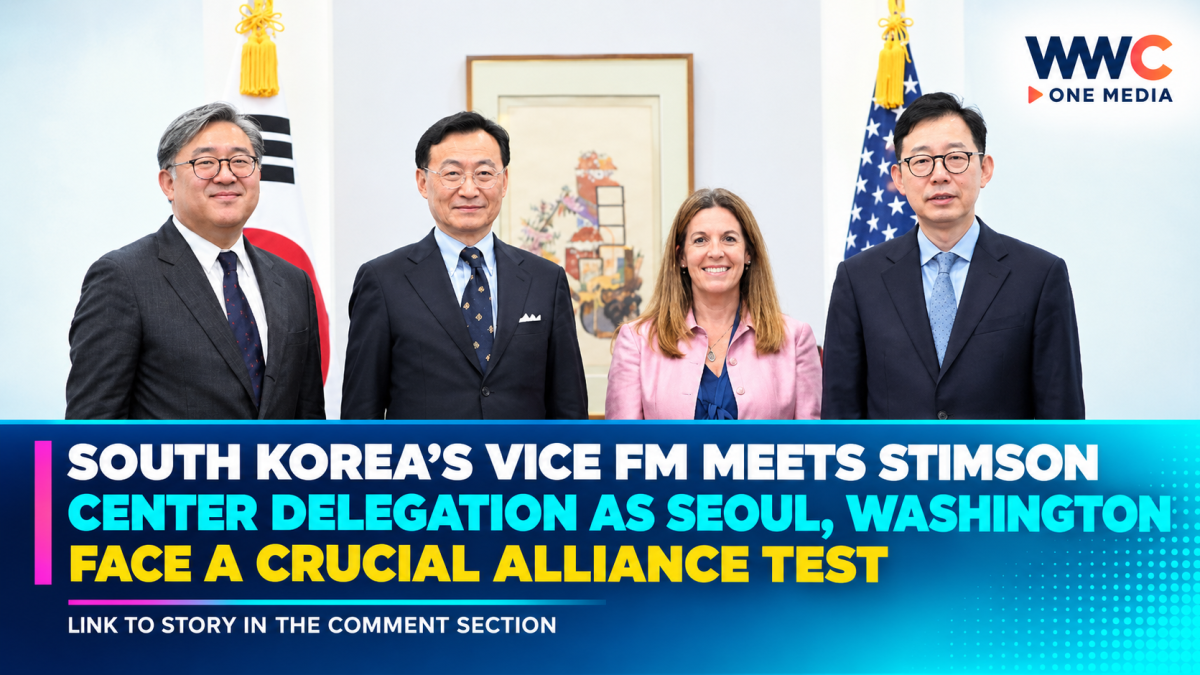
South Korea’s Vice Foreign Minister Park Yoon-joo met with a delegation from the Washington-based Stimson Center for discussions focused on the future of the U.S.–South Korea alliance, strategic cooperation and security challenges on the Korean Peninsula, as Seoul and Washington navigate an increasingly complicated regional security environment.
The meeting comes at a sensitive moment for the alliance. South Korea and the United States continue to strengthen cooperation on defense and broader strategic issues, while differences over military exercises, operational command arrangements and the future direction of regional security policy have added new pressure to the relationship.
The Stimson Center, a Washington-based foreign-policy and national-security think tank, has extensive expertise on East Asian security and Korean Peninsula affairs. Its 38 North program provides analysis focused specifically on North Korea and developments affecting the peninsula.
Alliance Under Pressure—and Opportunity
Park’s engagement with U.S. policy experts is significant because Seoul is seeking to translate high-level political commitments with Washington into concrete cooperation.
Recent South Korean-U.S. discussions have included alliance coordination, defense cooperation, nuclear-energy issues, shipbuilding and other elements of the broader strategic relationship. At the same time, Seoul and Washington have faced questions over the timing and scope of wartime operational-control arrangements and the future structure of combined defense planning.
The alliance debate has become even more important after Washington announced plans to reduce the scale of some joint military exercises with South Korea. Reuters reported that the move raised questions about how the United States intends to balance deterrence on the Korean Peninsula with President Donald Trump’s broader approach toward North Korea. Seoul, meanwhile, has continued to emphasize the importance of its defense partnership with Washington.
North Korea Adds Another Layer of Risk
The talks also come as North Korea continues expanding its military capabilities and strengthening strategic relationships with countries including Russia.
Recent reporting indicates that Pyongyang remains highly critical of U.S.-South Korean military cooperation. North Korea has also continued developing new naval capabilities, including the commissioning of a second 5,000-ton destroyer, according to The Associated Press. The development coincided with a U.S.-South Korea-Japan military exercise and underscored the increasingly complex security environment surrounding the peninsula.
At the same time, Washington has signaled interest in renewed engagement with Pyongyang. Reuters reported in August that Trump expressed a desire to meet North Korean leader Kim Jong Un again, but Pyongyang responded cautiously and indicated that major changes in U.S. policy would be necessary before meaningful diplomacy could resume.
That creates a difficult strategic equation for Seoul: maintaining a strong U.S. alliance while ensuring that any future U.S.-North Korea diplomacy does not sideline South Korean security interests.
Why the Stimson Center Meeting Matters
The Stimson Center is not a government institution, but its policy experts have long contributed to debates over U.S. strategy in Asia, alliance management, nuclear policy and North Korea.
Its Korea-focused 38 North project regularly examines North Korean military developments, diplomatic signals, economic trends and strategic decision-making. That makes consultations between South Korean officials and Stimson experts relevant to the wider policy conversation surrounding the peninsula.
The discussions therefore should not be interpreted as a new formal agreement or military commitment by themselves. Rather, they form part of a broader policy dialogue in which Seoul is trying to assess how the alliance should evolve as the regional balance of power changes.
The Bigger Regional Picture
South Korea’s security calculations are no longer limited to the traditional North Korea threat.
Seoul increasingly has to consider the strategic competition among the United States, China and Russia, North Korea’s growing military cooperation with Moscow, developments involving Japan and the wider Indo-Pacific security architecture.
Recent regional developments have reinforced those concerns. Reuters reported that Philippine Defense Secretary Gilberto Teodoro warned that reductions in some U.S.-South Korean exercises could create opportunities for China to expand its influence, highlighting how developments on the Korean Peninsula are increasingly viewed as part of a broader Indo-Pacific security picture.
For Seoul, this means the U.S.–ROK alliance is becoming more than a mechanism for deterring North Korea. It is increasingly connected to questions about regional stability, emerging military technologies, supply chains, maritime security and the future balance of power in Asia.
What Comes Next?
The immediate significance of the Vice Foreign Minister’s meeting with Stimson Center experts is therefore less about a single announcement and more about the direction of South Korea’s strategic thinking.
Seoul is trying to preserve the strength of its alliance with Washington while gaining greater strategic flexibility of its own. Washington, meanwhile, is reassessing how much military capability and diplomatic attention it wants to commit to different parts of the world.
And North Korea is watching.
With Pyongyang continuing to strengthen its military capabilities, Washington considering renewed dialogue with Kim Jong Un, and Seoul pushing for a more clearly defined role within the alliance, the next phase of U.S.–South Korea relations could have consequences well beyond the two countries.
The central question now is whether Seoul and Washington can adapt the alliance quickly enough to deal with a Korean Peninsula that is becoming more strategically complicated by the day.


Leave a Reply