
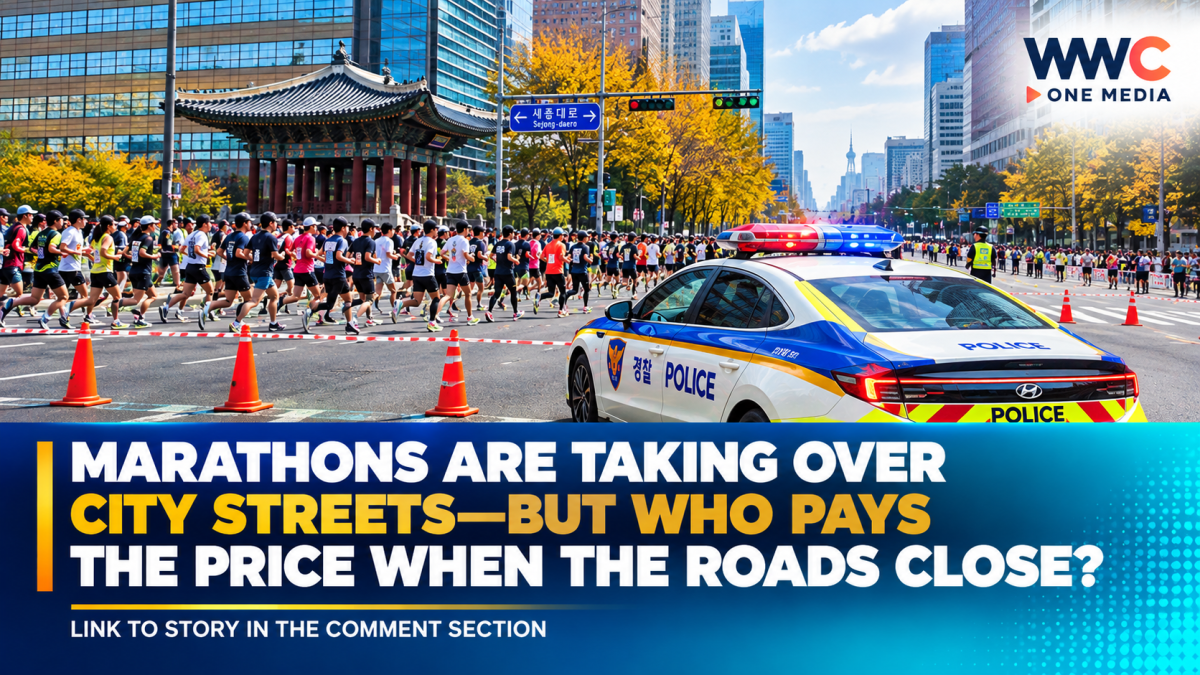
Marathons are supposed to celebrate health, endurance and the energy of a city. But as major road races increasingly take over central business districts and major highways, another question is becoming harder to ignore:
How much inconvenience should ordinary residents be expected to accept for a one-day sporting event?
From Metro Manila to Cape Town, marathon organizers and city authorities are facing the same urban dilemma. Thousands of runners need safe, traffic-free roads, while residents, commuters, workers and businesses still need to move through the city.
The conflict is particularly visible when races occupy major arteries rather than peripheral roads.
In Metro Manila, the 2026 Manila Marathon drew an expected field of about 25,000 runners and required a carefully coordinated traffic plan. The Metropolitan Manila Development Authority said road closures would be implemented by segments and reopened as runners passed, while portions of EDSA were configured to keep some lanes available to motorists and public transport. Authorities also planned alternative transportation for affected commuters.
But the debate did not end with the traffic plan.
AltMobility Philippines director Patricia Mariano criticized the arrangement, arguing that major events should not be organized in a way that compromises ordinary commuters and public-transport users. At the same time, she acknowledged that races can promote health, tourism and the use of public spaces.
That tension captures the bigger problem facing city marathons: the event may benefit the city as a whole while imposing its immediate costs on people who live along the route.
When a celebration becomes a transportation problem
The inconvenience can be substantial.
During another large Metro Manila race in June, more than 20,000 runners participated in an overnight marathon. Portions of Diokno Boulevard and Macapagal Boulevard in Pasay were temporarily closed, contributing to heavy traffic in surrounding areas. The Daily Tribune reported that some motorists and drivers were left stuck in congestion for extended periods.
For residents living directly along race routes, the problem can go beyond slower traffic.
Road closures can affect access to homes, workplaces, deliveries, taxis, public transportation and emergency movement. Parking restrictions can also force residents to relocate vehicles well before the race begins.
This is not uniquely a Philippine problem.
In Cape Town, South Africa, road closures connected to the city’s marathon triggered political criticism after residents reportedly complained that they were unable to leave some neighborhoods or reach workplaces. The criticism focused not on the marathon itself, but on the scale and communication of the restrictions.
Portland, Oregon, has taken a different approach by publishing detailed neighborhood-specific traffic information for its 2026 marathon. Organizers warn residents that some roads cannot be crossed while runners are present and that parking restrictions can begin well before race day.
Boston follows a similar model, with extensive advance traffic restrictions and public transportation recommendations surrounding the Boston Marathon. City officials also increase emergency medical resources to protect both participants and residents.
But marathons can deliver real economic benefits
Critics of road closures face an important counterargument: major marathons can generate substantial economic activity.
The 2025 Chicago Marathon, for example, generated an estimated $755.9 million in economic impact for the Chicago metropolitan area, according to an independent study commissioned by Bank of America. The event attracted more than 55,000 participants and visitors and supported thousands of full-time-equivalent jobs.
That economic argument is particularly powerful for cities seeking international tourism.
Runners travel. They book hotels, eat at restaurants, use transportation, shop and often stay beyond race day. The event can also provide revenue and visibility for local businesses and charities.
That means the debate should not simply be framed as runners versus residents.
The more important question is whether cities can capture the economic and social benefits of large races without transferring too much of the inconvenience to the people who happen to live along the route.
The real issue may be planning—not running
The growing controversy suggests that the future of urban marathons may depend less on whether cities should host them and more on how they host them.
Better advance notices, clearly published closure schedules, neighborhood-level traffic maps, emergency-access plans, public-transport alternatives and guaranteed access arrangements for residents could significantly reduce the disruption.
Race organizers also have an incentive to design routes more carefully.
A marathon does not necessarily have to consume the same roads for the same amount of time. Segment-based closures, overnight scheduling, staggered reopening and better coordination with public transportation can reduce the period during which residents are effectively cut off.
Manila’s 2026 traffic plan demonstrated one possible approach: authorities sought to keep portions of EDSA operating while runners occupied designated sections and to reopen affected areas as soon as possible.
The challenge is making sure those measures work not only on paper, but also for the person trying to get to work, the family trying to leave its neighborhood, the delivery driver making a scheduled trip or the business losing customers because its street is inaccessible.
A city belongs to more than the race
The popularity of marathon running is unlikely to disappear. If anything, major races are becoming increasingly attractive tools for tourism, branding and community engagement.
But a successful marathon should not be measured only by the number of finishers crossing the line.
It should also be measured by how well the host city continues functioning around them.
Residents should not have to choose between supporting a major sporting event and being able to move around their own neighborhoods.
The future of city-center marathons may therefore depend on a simple principle:
If the entire city is invited to celebrate the race, the entire city should also be considered when the roads are closed.


Leave a Reply