
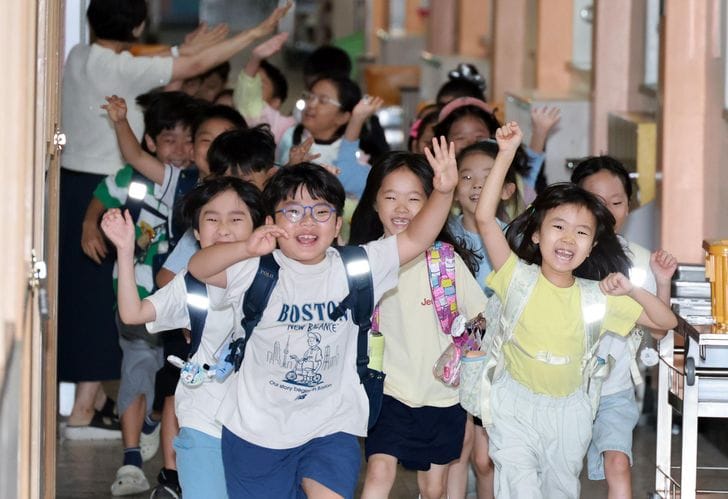
SEOUL — South Korea is considering a controversial change to elementary education that could keep first- and second-grade students in school until around 3 p.m., with policymakers arguing that longer school hours could help close childcare gaps and reduce families’ reliance on private academies known as hagwons.
But the proposal has immediately triggered a major backlash from teachers, parents and education groups, who warn that simply keeping younger children in classrooms for longer could increase fatigue without addressing the deeper reasons Korean families turn to private education.
The debate was brought into the spotlight this week at a policy forum organized by the National Education Commission, the National Assembly Futures Institute and the Korean Educational Development Institute. The September 3 forum was the commission’s first public event specifically examining whether instructional hours for lower elementary grades should be expanded.
The proposal: More time at school
Researchers presenting at the forum argued that Korea’s elementary students receive fewer formal classroom hours than the OECD average.
They proposed gradually increasing instructional time for first- and second-graders toward the OECD average, saying longer school hours could provide a stronger public response to childcare gaps faced by working parents.
One analysis presented at the forum cited 845 hours as the OECD average and said Korean elementary education was about 190 hours below that figure. However, opponents challenged the way the comparison was constructed, arguing that international differences in how school years and age groups are classified make the headline comparison less straightforward.
That distinction matters.
The OECD’s own 2025 Korea country note reports 655 hours of compulsory instruction per year in Korean primary education, compared with an OECD average of 804 hours. At the same time, it notes that Korean students often compensate with substantial learning outside school.
In other words, less classroom time does not necessarily mean less total study time.
Would longer school days actually defeat hagwons?
That is the central question.
Supporters believe extending the school day could give children more structured educational and care time while reducing the window in which parents need to arrange private tutoring or other after-school activities.
Critics aren’t convinced.
Parent and teacher representatives argued at the forum that Korean children already spend significant amounts of time studying outside school. Simply adding more formal classroom hours, they say, could shift the burden rather than eliminate it.
The Korean Teachers Union has also raised concerns about student fatigue, reduced opportunities for play and rest, and additional pressure on teachers.
A separate survey cited by the Korea Herald’s reporting found overwhelming teacher opposition: 99.1% of 22,768 elementary teachers surveyed said they opposed the proposed 3 p.m. dismissal plan. The survey also found that large majorities expected greater student stress and fatigue and increased teacher workloads.
Children themselves are raising concerns
Opposition is not coming only from adults.
According to Yonhap, a survey of 29,136 first- and second-graders found that 65.5% said they would feel very tired if they had classes through the sixth or seventh period and went home at 3 p.m.
Only 3.7% said they would be comfortable with spending more time studying in the classroom.
That has strengthened calls for policymakers to consider the developmental needs of very young children before simply extending their academic schedules.
The hagwon problem is bigger than school hours
South Korea’s private education system has become deeply embedded in family life, particularly as parents compete for access to prestigious schools and universities.
Government statistics show just how significant the market remains.
Private education spending reached a record 29.2 trillion won in 2024, according to government data. Elementary students accounted for 13.2 trillion won of that amount.
But there is an important update that should not be overlooked.
Private education spending actually fell in 2025.
The latest government survey put total spending at approximately 27.5 trillion won, down 5.7% from 2024. Private education participation also declined from 80% to 75.7%, while average weekly participation time fell from 7.6 hours to 7.1 hours.
So the current debate is not simply about a private-education market that keeps expanding every year.
Instead, policymakers are confronting a more complicated problem: how to make public education and childcare sufficiently effective that families do not feel compelled to purchase additional services after school.
Working parents are at the heart of the debate
One of the strongest arguments for extending school hours is childcare.
For many dual-income families, the gap between a young child’s school dismissal and the end of the working day can create a difficult logistical problem.
Private academies can fill that gap.
Government data and previous reporting have linked private education spending to the needs of working households, with parents often relying on hagwons and other programs for supervision after school.
Supporters therefore argue that strengthening the public system could offer families a safer and more universal alternative.
But critics say childcare should not automatically become more classroom instruction.
They argue that if the primary objective is childcare, Korea should improve dedicated after-school and care programs rather than adding academic periods to the regular curriculum.
Teachers want the existing system fixed first
This is one of the biggest fault lines in the debate.
Education groups have pointed to existing after-school and childcare programs and asked why the government would extend formal instruction before addressing problems with those programs.
Concerns include staffing, regional disparities, accessibility and program quality.
The Korean Federation of Teachers’ Associations has also warned that expanding regular instructional hours would require additional teachers and significant changes to the curriculum.
The Korea Herald’s report likewise found opposition from teachers, school principals and hagwon operators, although their reasons differ.
Korea has tried to curb private education before
The controversy is part of a much longer struggle.
South Korean governments have repeatedly introduced measures intended to reduce excessive private tutoring and ease the intense competition surrounding university admissions.
Yet experts have long argued that the demand for hagwons is tied to broader structural pressures — particularly competition for prestigious universities and the perceived connection between educational credentials and future employment.
That means changing the school timetable alone may not be enough.
The bigger question: education or childcare?
At its core, South Korea’s latest proposal raises a deceptively simple question:
Should young children spend more time in school because they need more education — or because their parents need more childcare?
Those are two very different policy problems.
If the objective is educational improvement, policymakers must demonstrate that additional instructional time benefits children’s learning and development.
If the objective is childcare, critics argue that the solution should focus on high-quality care and after-school programs rather than simply adding lessons.
And if the ultimate goal is to reduce hagwon dependence, the government faces an even harder challenge: convincing parents that public education can provide enough value to make expensive private tutoring less necessary.
For now, no final nationwide decision has been announced. The proposal remains under discussion, with policymakers, educators and parents sharply divided over whether longer school days would solve the problem — or simply move it to a later hour.
And that leaves the biggest question unanswered:
If children stay at school until 3 p.m., will the hagwon vans really disappear — or will they simply arrive later?
Editor’s accuracy check
- This is a proposal under debate, not an enacted nationwide policy. The National Education Commission held a public policy forum on September 3 to examine expanded instructional time for lower elementary grades.
- The discussion centers on first- and second-graders, with a potential shift from dismissal around 1 p.m. toward approximately 3 p.m.
- Teacher opposition is substantial, including a reported 99.1% opposition rate in a Korean Teachers Union survey of 22,768 elementary teachers.
- The 2025 private-education figures are important context: total spending fell 5.7% to 27.5 trillion won, so it would be inaccurate to portray private-education spending as continuously rising.
- OECD data also supports the broader point that Korean students have comparatively fewer formal classroom hours but often spend substantial additional time learning outside school.




Leave a Reply