
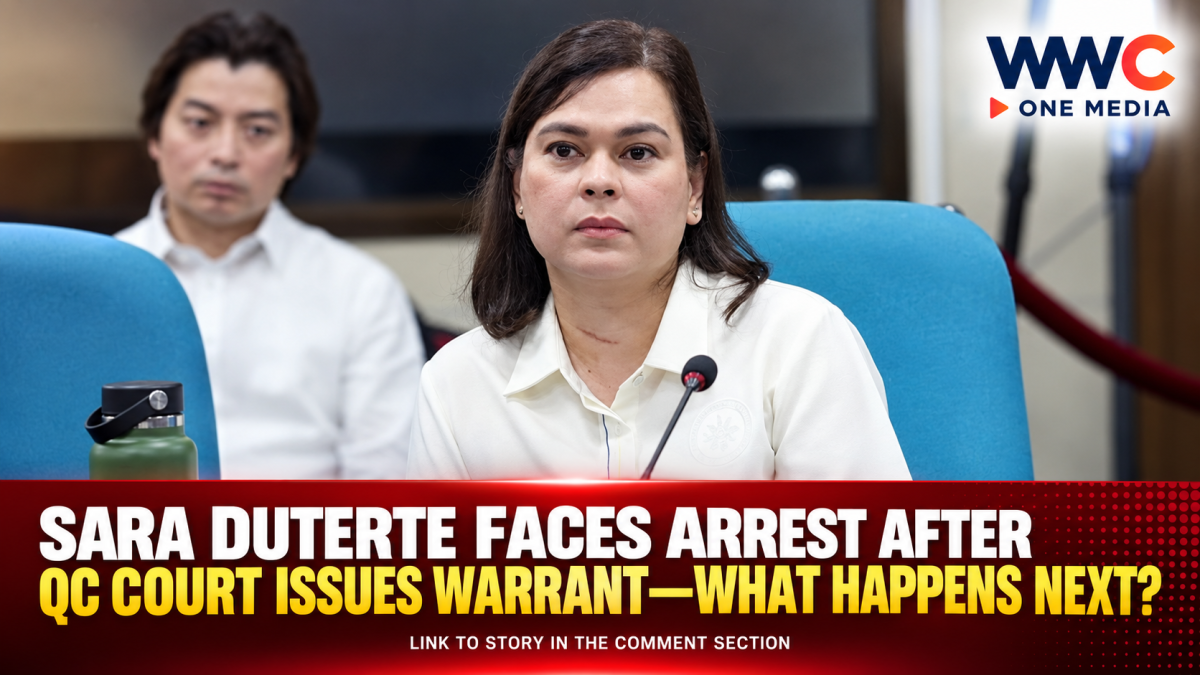
MANILA, Philippines — Vice President Sara Duterte is now facing arrest after the Quezon City Regional Trial Court issued a warrant in connection with a criminal case accusing her of three counts of grave threats.
Duterte’s lawyer, Paul Lawrence Lim, confirmed the issuance of the warrant on Friday, September 4, 2026, saying that the vice president has no intention of evading the law and will continue to pursue available legal remedies.
The warrant was issued by Quezon City Regional Trial Court Branch 98, which found probable cause to hold Duterte for trial. The case stems from statements she made during an online press conference in 2024 involving President Ferdinand Marcos Jr., First Lady Liza Araneta-Marcos, and then-House Speaker Martin Romualdez.
Court finds probable cause
According to the Department of Justice, the court rejected Duterte’s attempt to defer or recall the arrest warrant and determined that there was probable cause for all three grave threats charges.
The DOJ said it respects the court’s ruling and reaffirmed its commitment to the rule of law.
The charges were filed after the National Bureau of Investigation investigated Duterte’s controversial remarks concerning an alleged plot against her.
The criminal complaint was formally filed before the Quezon City RTC in August, according to the DOJ.
Bail set at P120,000 per count
The court set bail at P120,000 for each of the three counts, meaning Duterte’s total bail exposure under the warrant is P360,000 if bail is posted for all three charges. Reuters likewise reported the P120,000-per-count figure.
Interior Secretary Jonvic Remulla later said Duterte’s lawyers had confirmed receiving the warrant and indicated that her camp intended to post bail as soon as possible.
This means the immediate legal issue is not necessarily prolonged detention, but Duterte’s compliance with the warrant and the next stages of the criminal proceedings.
Why Duterte is facing the case
The case traces back to Duterte’s remarks during a virtual press conference in November 2024.
During that appearance, she said she had spoken to a person who would kill Marcos, his wife, and Romualdez if she were killed.
Those statements eventually became the subject of a National Bureau of Investigation investigation and, later, the grave threats complaint filed before the Quezon City court.
The allegations are being treated as three separate counts, involving the individuals named in the complaint.
Arrest case is separate from impeachment trial
The arrest warrant comes at an especially significant moment for Duterte because she is simultaneously facing an impeachment trial before the Senate.
However, the criminal case and the impeachment proceedings are separate legal proceedings.
House prosecutor and Bicol Saro party-list Rep. Terry Ridon stressed that the issuance of an arrest warrant does not itself establish Duterte’s guilt. She will still have the opportunity to present her defenses in the proper court.
Duterte’s impeachment trial, meanwhile, concerns several allegations contained in the articles of impeachment, including accusations involving her use of confidential funds and the controversial threats against Marcos, Araneta-Marcos and Romualdez.
The Senate impeachment court began hearing the case earlier this year, making the simultaneous criminal proceedings an unprecedented development in the political crisis surrounding the vice president.
Duterte camp: She will not evade the law
Duterte’s lawyer said the vice president will continue to challenge the case through legal channels.
“Regardless of the question on jurisdiction,” Lim said in a statement, Duterte has no intention of evading the law and will continue exercising her legal remedies.
Her camp had previously questioned the jurisdiction of the court and sought to have the proceedings against her dismissed or otherwise halted.
Palace says it respects the court
Malacañang said it respects the Quezon City court’s decision.
Palace Press Officer Claire Castro said the administration respects court decisions and orders, signaling that the executive branch would allow the judicial process to proceed.
The Department of Justice likewise said the court’s determination of probable cause came after considering the evidence and arguments presented by both sides.
What happens next?
The immediate development is expected to center on Duterte’s bail and the continuation of the criminal proceedings.
Her legal team is expected to pursue available remedies while the court case moves forward.
At the same time, Duterte remains under intense political scrutiny because the arrest warrant arrives while her impeachment trial is ongoing.
The development therefore creates two parallel fronts for the vice president: a criminal case before the regular courts and an impeachment case before the Senate sitting as an impeachment court.
For now, however, the issuance of the warrant should not be interpreted as a conviction. Duterte remains entitled to defend herself against the allegations as the criminal case proceeds.
The coming days could determine how Duterte’s legal strategy unfolds—and whether the arrest warrant becomes a temporary legal hurdle or the beginning of a much larger battle that could reshape both her political future and the country’s already bitter Marcos-Duterte conflict.
Leave a Reply