
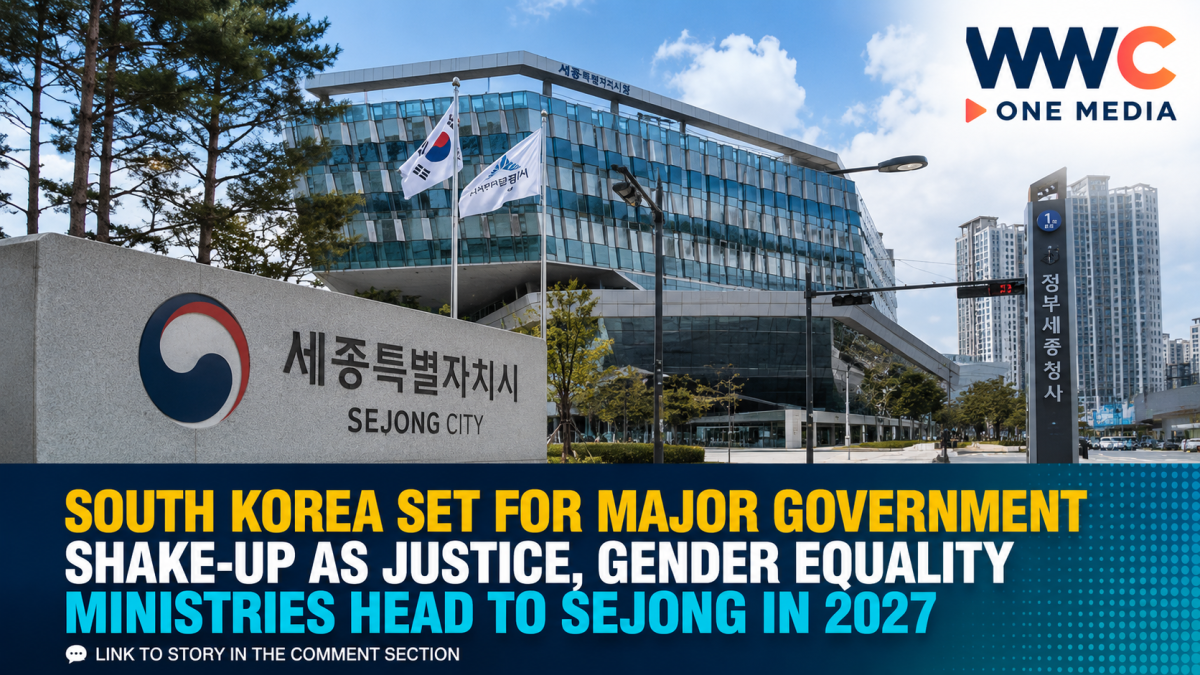
South Korea is preparing for one of its biggest government relocation drives in years, with the Ministry of Justice and Ministry of Gender Equality and Family among the first major ministries expected to move from the Seoul metropolitan area to Sejong beginning in the first half of 2027.
The plan, announced September 3 by Prime Minister Han Seong-sook and Interior and Safety Minister Yun Ho-jung, is part of a broader effort to reduce the country’s heavy concentration of government functions, population, businesses and infrastructure around Seoul and strengthen Sejong as a center of national administration.
The government says the relocation will be carried out in stages, rather than moving every agency simultaneously. Larger institutions and those expected to have a greater impact from relocation will receive priority.
Justice and Gender Equality ministries among the first
The Justice Ministry and Gender Equality and Family Ministry are particularly significant because they are currently among the agencies excluded from relocation under legislation governing the construction of Sejong’s administrative city.
The government therefore plans to pursue legal amendments to remove those ministries from the exemption list before their relocation can proceed. Specific agencies, methods and schedules will ultimately be finalized through the required government consultations and public procedures.
That means the 2027 move is a government plan already announced, but some of the legal and administrative steps still need to be completed.
Police and prosecution agencies will move later
Not every major government body will move at the same time.
The National Police Agency, Prosecution Service and Serious Crimes Investigation Agency will require separate headquarters, meaning their relocation is expected to happen after new office facilities are constructed.
The government says the phased approach is intended to prevent disruption to public services and avoid an administrative vacuum during the transition.
Officials are also examining practical issues for employees and their families, including housing, education, childcare and transportation in Sejong.
About 350 public institutions could be affected
The relocation plan extends well beyond the two ministries.
The government says it will prepare specific relocation plans for approximately 350 public institutions currently located in the Seoul metropolitan area, with moves scheduled to begin next year.
At the same time, the government plans to reduce or restructure 109 public institutions by consolidating overlapping functions, merging smaller organizations and restructuring agencies.
Prime Minister Han described the initiative as more than simply moving offices from one city to another, framing it as part of a wider strategy for balanced national development.
The government also says it wants to cluster related institutions around regional innovation hubs rather than simply distributing agencies across different provinces.
Sejong’s role could become much bigger
Sejong was established as South Korea’s administrative city in 2012, partly to reduce Seoul’s overwhelming concentration of government functions.
According to Yonhap, 44 central government organizations have completed relocation to Sejong since the process began, although several major ministries and national institutions have remained in the capital region.
The new plan represents another major step toward making Sejong a more powerful administrative center.
It also goes beyond ministries.
The government plans to establish a presidential office in Sejong by August 2029, while the National Assembly’s Sejong complex is targeted for completion in the early 2030s. The Korea Times and Yonhap report a 2033 target for the Assembly complex, although Yonhap separately reported the planned completion of the National Assembly hall as 2030, indicating that descriptions of the parliamentary project and its timetable may differ.
Why this matters for Seoul
For Seoul, the plan could eventually mean a significant redistribution of government workers, institutions and related economic activity.
The government’s broader argument is that excessive concentration in the capital region has contributed to regional inequality and demographic decline elsewhere in the country.
Reuters reported that the initiative is intended to address the dominance of the Seoul metropolitan area, while encouraging development outside the capital.
But relocating government agencies is politically and administratively complicated.
Government employees, labor groups, local authorities and other stakeholders are expected to have competing interests over which institutions move, where they go and how quickly the process happens. Prime Minister Han said the government intends to gather views from local governments, labor groups and other stakeholders while developing the relocation plan.
A bigger political transformation may be underway
The significance of the announcement goes beyond a change of office addresses.
If carried out as planned, the second wave of relocations would further shift South Korea’s administrative center toward Sejong while reducing the concentration of central government functions in Seoul.
And with the Justice Ministry and Gender Equality and Family Ministry potentially among the first major ministries to move in 2027, the coming relocation could become a major test of whether South Korea can finally turn Sejong from an administrative satellite into a genuine second center of national governance.
WWC ONE MEDIA G.A




Leave a Reply