
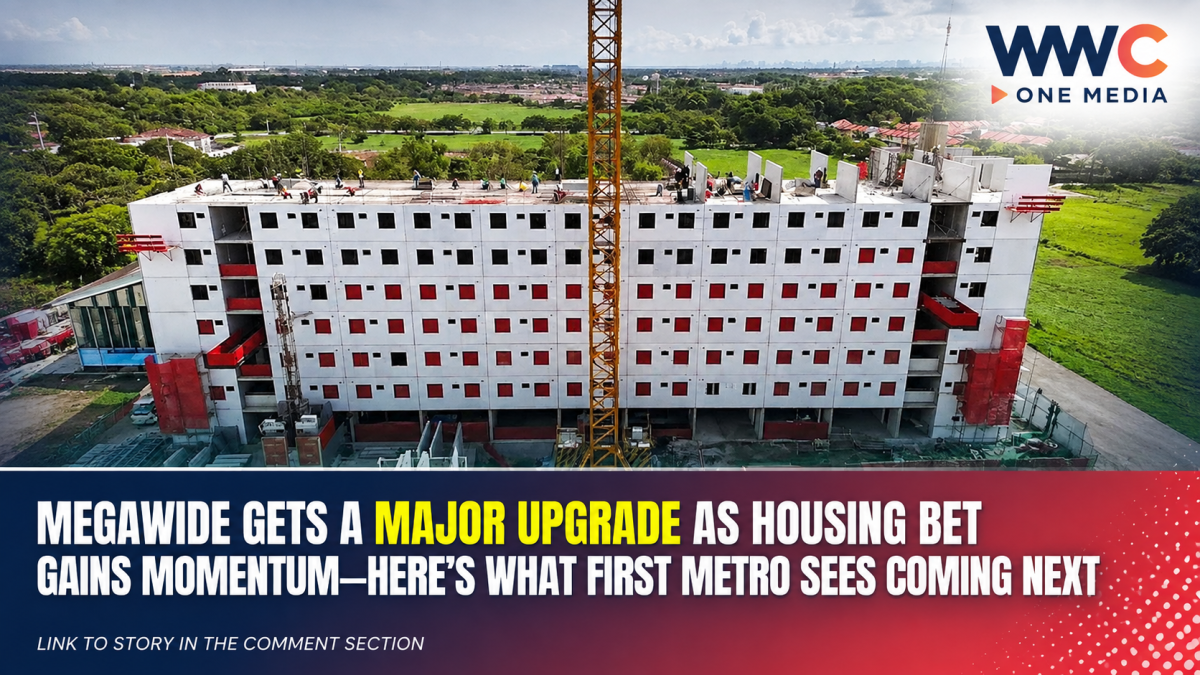
MANILA, Philippines — Megawide Construction Corp. is gaining renewed attention from investors as its aggressive push into affordable housing begins to reshape the company’s growth outlook amid a challenging Philippine construction and property market.
First Metro Securities has upgraded its valuation view on Megawide, raising its price target to ₱7.50 per share from ₱4.50, while maintaining a “Buy” rating. The brokerage said the company’s participation in the government’s Expanded Pambansang Pabahay Para sa Pilipino (4PH) program could provide a significant new source of revenue over the next several years.
The upgrade comes as Megawide moves beyond its traditional construction and infrastructure businesses and expands its role in mass housing, backed by its precast technology, government partnerships and efforts to strengthen its balance sheet.
₱28.3 billion potential revenue from housing
At the center of First Metro’s bullish outlook is Megawide’s 4PH housing pipeline.
According to the brokerage, approximately 16,700 housing units are already incorporated into its forecasts through 2028. Those projects could generate an estimated ₱28.3 billion in additional revenue from the second half of 2026 through 2028.
First Metro estimates that 4PH-related activities could represent as much as 36% of Megawide’s total revenue by 2028, potentially transforming affordable housing from a supplementary business into one of the company’s major growth engines.
The projections are significant because Megawide is targeting an even larger pipeline.
The company has said it aspires to deliver 100,000 socialized housing units over the next five years, with roughly 50,000 units already identified in its pipeline.
Pag-IBIG partnership provides a major boost
Megawide’s housing strategy received a substantial boost from its partnership with the Pag-IBIG Fund.
Under the agreement, Pag-IBIG committed ₱10 billion through preferred shares in Megawide Dreamrise Residences Inc., a wholly owned subsidiary of Megawide. The investment is intended to support the development of at least 7,000 affordable housing units under the Expanded 4PH program.
Reports from GMA News and BusinessMirror said the housing units are expected to be delivered over roughly two to three years, with projects centered on Cavite and other locations.
Pag-IBIG officials have also highlighted the partnership as part of the agency’s effort to expand affordable housing while ensuring that members’ funds generate sustainable returns.
The scale of the agreement is already influencing Megawide’s capacity plans.
Megawide is expanding its construction capacity
The company is investing in its industrialized construction capabilities as it prepares for a substantially larger housing workload.
Megawide’s existing precast facility in Taytay, Rizal, is already operating at high capacity. The company announced plans for another precast facility in Cavite, with reports putting the potential investment at around ₱1.5 billion to ₱2 billion.
The facility is designed to support projects in southern Metro Manila and nearby areas, particularly the company’s 4PH developments.
Precast construction allows structural components—including walls, slabs, beams and columns—to be manufactured in a controlled factory environment before being transported to project sites. The approach can reduce construction time and improve consistency compared with producing every component directly on site.
BusinessMirror reported that Megawide expects its order book to potentially rise to around ₱70 billion to ₱80 billion, compared with previous peak levels of roughly ₱50 billion to ₱60 billion.
From construction contractor to housing platform
The housing push represents a broader strategic shift for Megawide.
The company has increasingly positioned its precast and industrialized construction capabilities as an advantage in delivering large numbers of affordable homes at scale.
Its experience in major infrastructure projects—including airports, transport facilities and public infrastructure—has also given the company experience in managing large, technically complex developments.
Megawide’s latest corporate disclosures confirm that it is currently constructing approximately 7,100 socialized housing units under the Expanded 4PH program and intends to use housing as an anchor for its broader social infrastructure platform.
Profitability could improve sharply
First Metro’s latest projections point to a substantial improvement in Megawide’s earnings profile.
The brokerage expects the company to move from an estimated ₱164 million net loss in 2026 to approximately ₱1.09 billion in net income in 2027.
Revenue is projected to increase by about 32% to ₱28.11 billion in 2027, as housing activity accelerates.
First Metro also sees potential benefits from lower financing costs as Megawide continues reducing debt.
The company has been working to strengthen its balance sheet following the restructuring of its investments, while management has indicated that dividend payments could resume on a more regular basis beginning in 2027.
Why investors are watching Megawide now
The latest upgrade comes after a significant run in Megawide shares.
InsiderPH reported that the stock had gained roughly 65% since the beginning of 2026 and more than 135% over the preceding 12 months as of the latest report.
First Metro’s new ₱7.50 target represents a substantial increase from its previous ₱4.50 target.
The brokerage’s valuation incorporates several methodologies, including earnings, book value and projected cash flows.
But First Metro is also warning investors that the outlook is not without risks.
Potential delays in housing projects, slower collections, weaker property demand and persistently high interest rates could affect the company’s expected growth.
The bigger question: Can Megawide deliver at scale?
That may ultimately determine whether the bullish outlook becomes reality.
Megawide’s 4PH strategy gives the company access to a potentially enormous housing market, while its precast technology provides a way to manufacture and assemble housing components at scale.
Pag-IBIG’s ₱10-billion investment also provides an important financing component for the initial wave of projects.
But moving from thousands of homes to the company’s longer-term 100,000-unit ambition will require sustained execution, financing, demand and government support.
The opportunity is therefore bigger than a single housing contract.
If Megawide can successfully convert its 4PH pipeline into completed projects, the company could emerge as a major private-sector player in the Philippines’ affordable housing drive—while simultaneously transforming its own revenue and earnings profile.
For now, First Metro is betting that the housing pipeline is more than just another project for Megawide.
It could be the catalyst that changes how the market values the entire company.
WWC ONE MEDIA MJE




Leave a Reply