
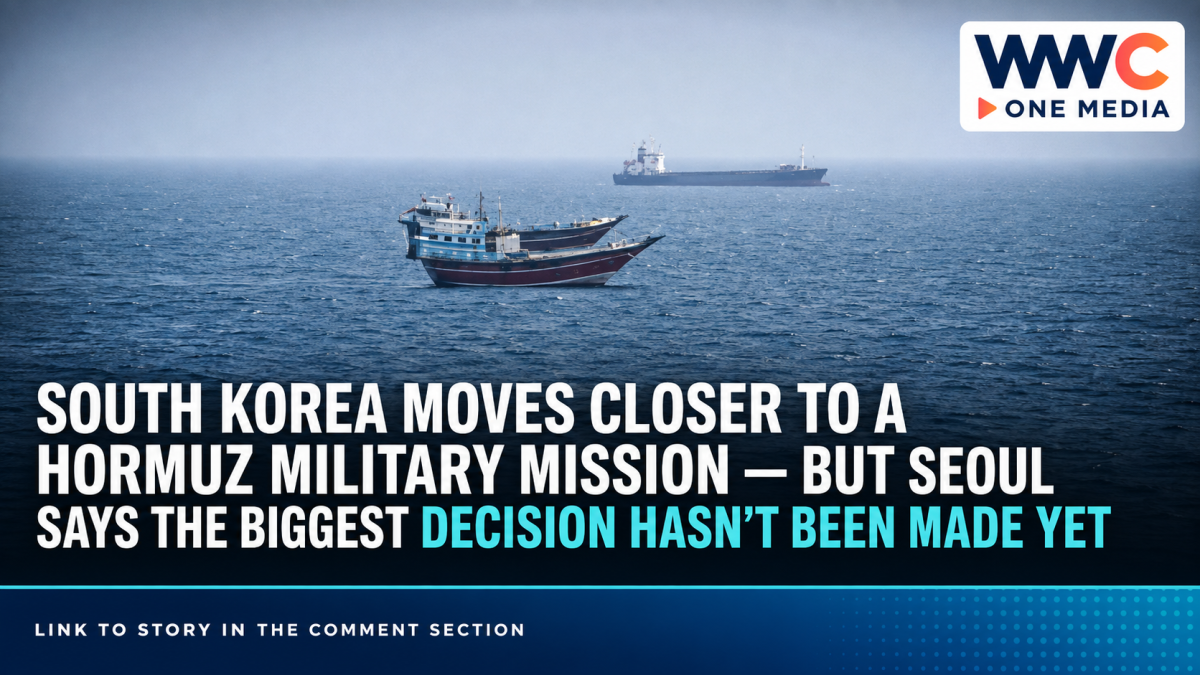
SEOUL — South Korea is reportedly laying the groundwork for a possible military deployment to the Strait of Hormuz, raising the prospect that Seoul could take a much larger security role in one of the world’s most dangerous and economically critical waterways. But there is one major catch: the South Korean government insists that no final decision has been made.
Several South Korean media reports say officials are examining a deployment that could include maritime surveillance aircraft, naval logistical support and specialists capable of detecting or clearing explosives and mines.
Reuters reported on September 4 that South Korean authorities were preparing procedures that could allow military assets to be sent to the Strait of Hormuz before the end of 2026. Options reportedly being studied include a maritime patrol aircraft, a logistics support vessel and a mine-detection and clearance unit. Seoul has also reportedly discussed possible contributions with countries including the United States, Britain and France.
But the picture coming from South Korea’s presidential office is considerably more cautious.
Cheong Wa Dae said reports suggesting that Seoul had already settled on a military deployment were “different from the facts,” adding that details had yet to be decided. Officials acknowledged that South Korea has been discussing practical ways to contribute to freedom of navigation and stability in the Middle East, but stopped well short of confirming that troops or military assets will actually be sent.
That distinction matters.
Reports Point to P-8 Aircraft, Naval Support and Explosive-Disposal Teams
Aju Press, citing reporting by South Korean broadcaster SBS, said military preparations being discussed could involve P-8 Poseidon maritime patrol aircraft, an explosive ordnance disposal team and a Navy logistics support ship.
The P-8 would provide surveillance of surface vessels and submarines around the strategically sensitive waterway, while explosive-ordnance specialists could potentially support operations dealing with mines or other threats to shipping. A logistics vessel would provide rear-area support for those forces.
A South Korean Defense Ministry spokesperson, however, rejected suggestions on Friday that such a deployment had already been decided, saying the reporting had gone too far ahead of the government’s actual position.
That leaves Seoul in an unusually delicate position: military planners may be evaluating what a mission would require, while political leaders have not yet formally committed South Korea to participating.
Parliament Could Become the Deciding Factor
Even if President Lee Jae Myung’s government eventually supports a deployment, it cannot simply dispatch South Korean armed forces abroad without going through the country’s political process.
Article 60 of South Korea’s Constitution gives the National Assembly the right to consent to the dispatch of armed forces to foreign states.
Reuters and Korean reports say a deployment consent motion could potentially be submitted to parliament following government and Cabinet deliberations, possibly as early as September. Some reports have suggested the government is examining a timetable that could allow forces to be dispatched before the end of the year.
That means the real battle over South Korea’s Hormuz role may ultimately move from military planning rooms to the National Assembly.
Trump Has Been Pressuring Seoul
The debate is unfolding against growing pressure from Washington.
U.S. President Donald Trump has repeatedly criticized South Korea for declining to make a greater military contribution to operations surrounding the Strait of Hormuz.
Reuters reported that Trump said in August he had scaled back some U.S.-South Korea joint military exercises partly because Seoul had declined to assist the United States in its war against Iran.
That adds another layer to President Lee’s calculation.
South Korea depends heavily on its military alliance with Washington, particularly as it confronts the continuing security threat posed by North Korea. At the same time, joining an operation near Iran could expose Seoul to new military, diplomatic and economic risks far from the Korean Peninsula.
So what may look like a relatively limited maritime security operation could become a much larger test of how Seoul balances alliance obligations with its desire to avoid being dragged deeper into another regional conflict.
Why Hormuz Matters So Much to South Korea
The Strait of Hormuz is not merely another distant military flashpoint for Seoul.
It is one of the world’s most important energy corridors.
Before the sharp disruption caused by the 2026 Middle East conflict, around 20.9 million barrels per day of crude oil and petroleum liquids passed through Hormuz during the first half of 2025, equivalent to roughly one-fifth of global petroleum-liquids consumption, according to the U.S. Energy Information Administration.
By the second quarter of 2026, EIA estimates showed flows had plunged to about 4.9 million barrels per day, demonstrating just how dramatically the conflict had disrupted the route.
South Korea is particularly vulnerable to instability there because of its dependence on imported energy.
Reuters reported earlier this year that South Korea sourced roughly 70 percent of its crude oil from the Middle East, making disruptions around Hormuz a direct economic concern for Asia’s fourth-largest economy.
The Korean government has consequently worked to secure alternative and emergency supplies. In July, officials said crude supplies remained stable despite Middle East uncertainty, while Seoul has also strengthened energy-security cooperation with producers including the United Arab Emirates.
South Korea Has Been Here Before
A Korean military presence near Hormuz would also not be entirely unprecedented.
In January 2020, amid another period of U.S.-Iran tensions, Seoul temporarily expanded the operating area of its roughly 300-member Cheonghae anti-piracy unit from the Gulf of Aden toward the Gulf of Oman and Persian Gulf.
South Korea deliberately kept that mission under its own command rather than formally joining the U.S.-led maritime coalition, while sending liaison officers to cooperate and exchange information with the International Maritime Security Construct.
That history could offer Seoul a possible template in 2026: contribute to maritime security while trying to preserve some operational and political distance from direct participation in U.S. combat operations.
But today’s situation is considerably more dangerous.
Shipping through Hormuz has already been heavily disrupted. Reuters reported in late August that only seven commodity vessels crossed the strait on one monitored day, compared with a 10-day average of 15, illustrating how abnormal maritime traffic remains.
The Bigger Question Is What Seoul Is Willing to Risk
For now, the strongest conclusion supported by the available evidence is not that South Korea will send forces to Hormuz.
It is that Seoul appears to be examining how it could do so if the political decision is made.
Military assets are reportedly being considered. International consultations are reportedly taking place. Parliamentary procedures are being discussed.
But the presidential office and Defense Ministry continue to push back against claims that the decision has already been finalized.
And that may be the most important part of the story.
South Korea is trying to protect an energy lifeline, manage pressure from its most important military ally and avoid unnecessarily widening its exposure to the Iran conflict — all while keeping its primary security focus on North Korea.
The Strait of Hormuz may be thousands of kilometres from Seoul.
But the decision over whether South Korean forces ultimately enter those waters could become one of President Lee Jae Myung’s most consequential foreign-policy tests yet.




Leave a Reply