
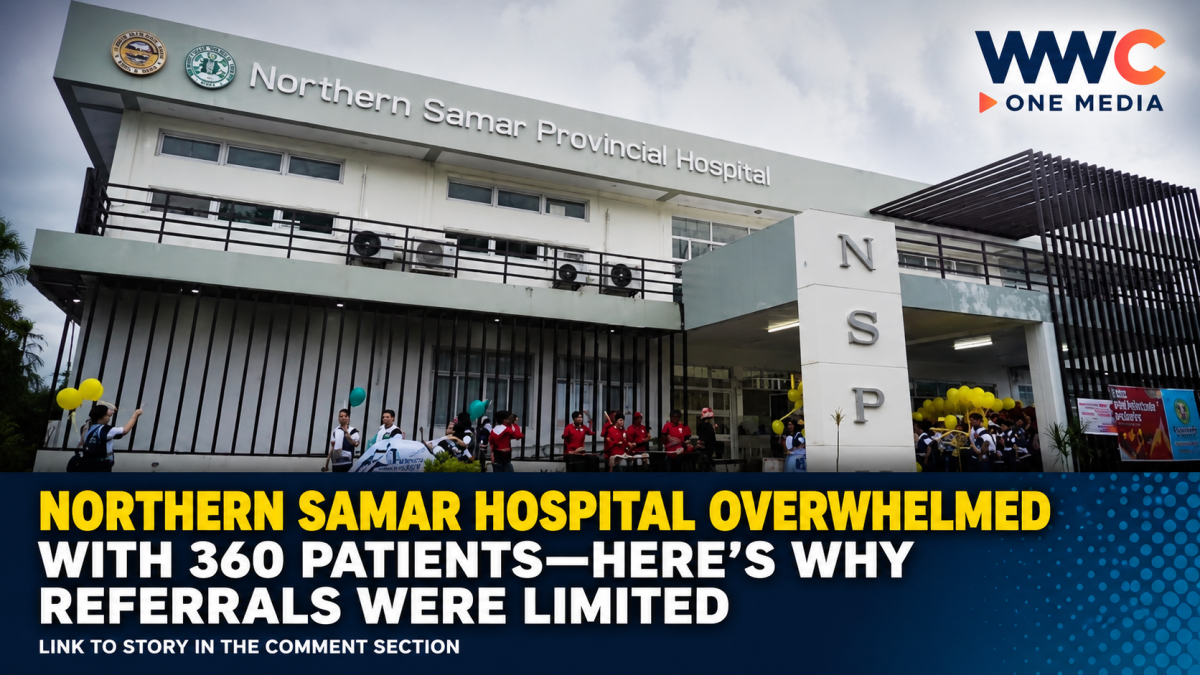
CATARMAN, Northern Samar — Northern Samar’s main government referral hospital was pushed beyond its limits after a sharp increase in patient admissions left it caring for about 360 patients—more than twice its authorized 150-bed capacity.
The Northern Samar Provincial Hospital (NSPH) temporarily restricted new admissions and appealed to other health facilities to refer only patients who genuinely required specialized or higher-level medical care.
Hospital chief Dr. Joseph Estanislao also urged referring facilities to stabilize patients before transferring them to NSPH, as the hospital struggled to accommodate the unusually high number of patients.
The situation was reported in October 2025, when the hospital had reached a critical level of overcrowding. The hospital subsequently returned to normal operations later that month after the patient surge eased.
Hospital forced to stretch beyond capacity
NSPH, located in Catarman, serves as Northern Samar’s major referral facility for patients needing medical services beyond what local health centers and district hospitals can provide.
But during the October 2025 surge, its 150 licensed beds were nowhere near enough.
PNA reported that NSPH was caring for around 360 admitted patients, while hospital officials said its actual operating capacity was about 200 beds. Many patients were being accommodated in available spaces inside the facility as health workers worked to maintain services.
Hospital officials said the medicine and pediatric wards were among those heavily affected by the influx.
The hospital appealed for public understanding, emphasizing that its priority was to make sure patients requiring immediate and higher-level care could still receive treatment.
Why was the hospital so crowded?
Provincial officials pointed to a major problem in the local referral system: patients were frequently bypassing district hospitals and rural health units and going directly to NSPH, even for less serious illnesses.
Northern Samar Provincial Information Officer Arlyn Cui said the provincial hospital was intended primarily as a referral facility, but patients were still going directly there regardless of the severity of their condition.
That practice placed additional pressure on a facility already operating beyond its capacity.
The province has eight district hospitals distributed across Northern Samar, along with municipal health centers that can provide primary and basic emergency services.
Health officials therefore encouraged patients with non-critical conditions to seek treatment closer to their communities whenever appropriate.
Officials turn to district hospitals and health centers
The overcrowding highlighted the importance of Northern Samar’s network of district hospitals and rural health units.
The province’s district hospitals include facilities in Capul, San Antonio, Biri, San Vicente, Gamay, Catubig, Laoang and Allen. Northern Samar also has municipal health centers serving its towns.
The strategy was straightforward: less serious and stable cases could be managed closer to home, while NSPH could concentrate its limited resources on patients requiring more advanced treatment.
Hospital officials also considered transferring less serious cases to nearby facilities to create space for patients with severe conditions such as stroke and pneumonia.
The patient surge was not caused by an outbreak
Despite the dramatic increase in admissions, officials later clarified that the situation was not caused by a disease outbreak.
The surge involved common medical conditions, including diarrhea, measles, respiratory infections, influenza-like illnesses and injuries from vehicular accidents, according to provincial health officials.
That clarification was important because the hospital’s unusually high patient volume initially raised concerns about whether an infectious-disease outbreak might be responsible.
Instead, officials attributed the pressure to the combined increase in ordinary illnesses and injuries, together with patients seeking care directly at the provincial referral hospital.
Normal operations eventually restored
The bed-capacity crisis was temporary.
By October 27, 2025, provincial health officials reported that NSPH had stabilized and could once again accept new admissions.
The hospital had spent more than a week dealing with the extraordinary patient load before the situation improved.
Officials credited coordination among the provincial hospital, district hospitals and rural health units for helping manage the overflow and allowing NSPH to refocus on patients requiring advanced care.
Northern Samar is strengthening primary healthcare
The episode also underscored the need to strengthen healthcare services outside the provincial hospital.
By January 2026, the Philippine Information Agency reported that 19 of Northern Samar’s 24 rural health units had already secured licenses as primary care facilities, representing 79 percent of the province’s RHUs at that time.
The provincial health office said these facilities can provide services including consultations, birthing care, ambulance support, laboratory and radiologic services, and pharmacy access—potentially reducing the need for patients with basic healthcare needs to travel directly to NSPH.
Northern Samar has also been expanding specialized healthcare capacity. In 2025, the provincial government began developing a dialysis center in Allen, with additional centers planned for other parts of the province, in an effort to reduce the need for patients outside Catarman to travel to the capital or neighboring cities for treatment.
A warning about hospital capacity
The NSPH episode reflects a broader challenge facing government hospitals: when patients bypass primary and district-level facilities, referral hospitals can quickly become overwhelmed.
The lesson from Northern Samar is not simply about the number of hospital beds. It is also about how effectively patients are routed through the healthcare system.
For serious and complicated cases, a referral hospital such as NSPH is essential. But when patients with minor or manageable conditions also converge on the same facility, critically ill patients may compete for the same beds, personnel and resources.
The October 2025 crisis eventually eased, but it served as a clear reminder that strengthening community-level healthcare and improving referral coordination are crucial to keeping provincial hospitals from being pushed beyond their limits.
For patients and families, the message from health officials was clear: seek the appropriate level of care, follow the referral system when possible, and reserve limited hospital capacity for those who need it most.

Leave a Reply