
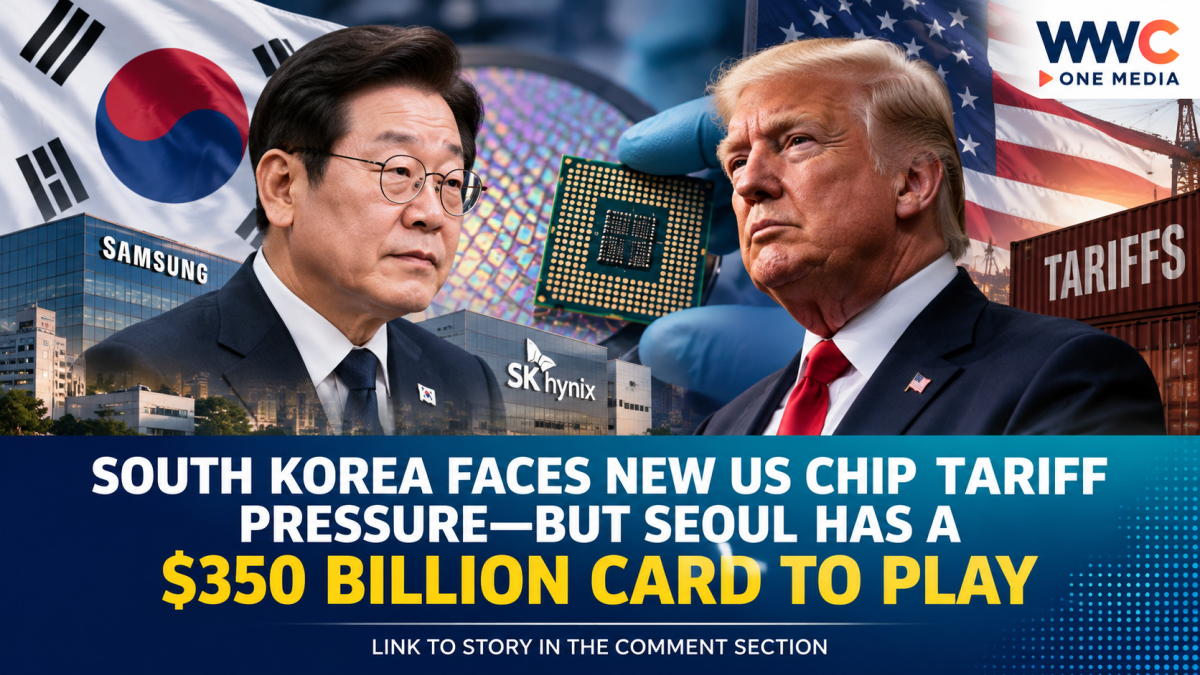
SEOUL — South Korea and the United States are discussing semiconductor investment in the US as Washington prepares a new tariff policy for imported chips, raising fresh uncertainty for major Korean chipmakers Samsung Electronics and SK hynix.
A South Korean presidential official said Friday that semiconductors are among the investment-related issues currently being discussed with Washington. The official acknowledged that separate issues in the broader US-South Korea relationship can affect one another, but said Seoul is working to prevent them from becoming obstacles to the negotiations.
The talks have gained urgency after US Commerce Secretary Howard Lutnick said Washington is preparing a “targeted, thoughtful” tariff policy for semiconductor imports.
Lutnick has indicated that companies producing semiconductors in the United States could receive more favorable treatment, while companies relying on production outside the country could face higher costs when selling into the US market.
Seoul wants Korean chipmakers protected
South Korea is pushing for its semiconductor companies to receive treatment that is no less favorable than that given to competitors.
Industry Minister Kim Jung-kwan said Seoul and Washington are continuing consultations based on an understanding reached during earlier tariff negotiations that South Korean semiconductors should not be disadvantaged compared with competing countries.
Yonhap reported that the November 2025 bilateral fact sheet included a US commitment to provide South Korean semiconductor tariff treatment that would be “no less favorable” than terms offered in a future agreement involving an equal or greater volume of chip trade.
That commitment could become increasingly important if Washington moves ahead with semiconductor tariffs.
The $350 billion question
At the center of the broader relationship is a major South Korean investment commitment.
The two countries agreed last year to a package involving US$350 billion in South Korean investment in US manufacturing. The semiconductor sector is an important part of the discussions surrounding how that investment framework will work in practice.
South Korea is expected to announce its first investment project under the bilateral agreement sometime this month, according to comments reported by Yonhap from Minister Kim.
That creates a potentially crucial link between investment decisions and Washington’s emerging semiconductor tariff policy.
For Seoul, the challenge is to ensure that Korean companies receive meaningful tariff protection without allowing the negotiations to become a one-sided demand for additional US production.
Why Samsung and SK hynix matter
The stakes are particularly high for Samsung Electronics and SK hynix, two of the world’s leading memory-chip manufacturers.
Their products are increasingly important to the global artificial-intelligence boom as technology companies expand data centers and invest heavily in AI infrastructure. Strong demand for memory chips has made semiconductor trade an increasingly strategic issue for both Washington and Seoul.
The tariff question therefore extends beyond traditional consumer electronics.
If semiconductor tariffs are imposed or expanded, the impact could potentially reach companies throughout the technology supply chain, depending on the final rules.
South Korean industry observers are also watching whether Washington ultimately limits tariffs to semiconductor components or expands the policy to products containing advanced chips.
Recent reporting has indicated that the US administration has considered broader measures affecting products such as laptops, gaming consoles and data-center servers, although the final scope and tariff rates remain uncertain.
Washington’s message: build in America
The emerging US strategy is increasingly clear: encourage global semiconductor companies to expand manufacturing inside the United States.
Lutnick has repeatedly framed the policy around domestic production, arguing that companies manufacturing in America would receive tariff relief while those continuing to rely heavily on overseas production could face additional costs.
That approach could accelerate an already significant shift in the global semiconductor industry.
Taiwan Semiconductor Manufacturing Co. has committed substantial investment to US production, while Micron has also announced major US manufacturing plans. Lutnick cited those investments as examples of the administration’s strategy to attract semiconductor production to American soil.
For South Korea, however, moving more production to the US involves major costs and long-term strategic decisions.
Tariff rate still unknown
One of the biggest unanswered questions is how much the United States will ultimately charge on imported semiconductors.
South Korea’s industry minister said Washington had not yet provided Seoul with a timeline for announcing the semiconductor tariffs. That means companies such as Samsung and SK hynix are still operating without clarity on the final tariff structure.
The uncertainty is significant because investment decisions in semiconductor manufacturing typically involve billions of dollars and years of planning.
A tariff structure tied closely to US production could encourage Korean companies to expand American facilities faster. At the same time, it could raise questions about production costs, supply-chain efficiency and how much capacity should remain in South Korea.
More than a trade dispute
The semiconductor negotiations are also taking place alongside other sensitive issues in the US-South Korea relationship.
A South Korean presidential official said negotiations over national-security matters had not been making progress, including Seoul’s plan to build a nuclear-powered submarine that was part of the broader agreement reached last year.
That underscores how complicated the current talks have become.
Trade, investment, technology and security are increasingly interconnected in the US-South Korea relationship.
What happens next?
For now, there is no confirmed new US semiconductor tariff rate for South Korean chips.
The immediate focus will be on three developments: the final design of Washington’s semiconductor tariff policy, whether Seoul secures the treatment it says was promised under the bilateral agreement, and what South Korean companies decide to invest in the United States.
For Samsung and SK hynix, the outcome could influence where future semiconductor capacity is built—and potentially reshape an important part of the global chip supply chain.
The next move from Washington could determine whether the $350 billion investment deal becomes a shield for South Korean chipmakers—or another reason for them to accelerate production in America.

Leave a Reply