
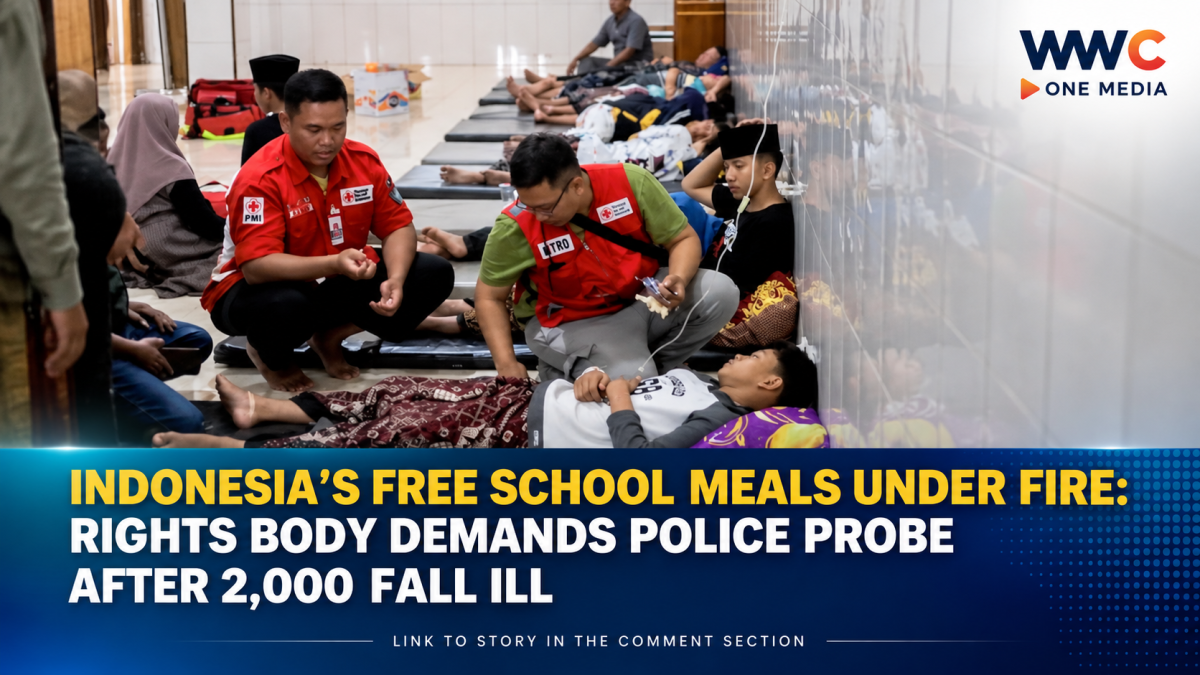
JAKARTA — Indonesia’s ambitious free school meals programme is facing renewed scrutiny after around 2,000 students and teachers fell ill in a series of suspected food-poisoning incidents, prompting the country’s top human rights body to call for a police investigation.
The incidents have intensified concerns over food safety and oversight of President Prabowo Subianto’s flagship Makan Bergizi Gratis (MBG) programme, which was launched to help tackle malnutrition among Indonesian children.
The latest developments were reported by Reuters and Indonesian news agency ANTARA on Friday, September 4.
Rights commission calls for police investigation
Indonesia’s National Human Rights Commission, known as Komnas HAM, urged police to investigate the latest outbreaks and determine whether anyone should be held legally responsible.
The commission also called on the National Nutrition Agency (BGN) to temporarily halt operations at food-preparation kitchens linked to the incidents while authorities conduct evaluations.
Komnas HAM stressed that access to safe food is a human-rights issue—not simply a matter of nutrition.
It said repeated food-safety incidents could undermine the legitimacy of a programme designed to improve the health and nutrition of millions of Indonesians.
About 2,000 people sick in several provinces
The latest cases have been reported across several regions.
More than 1,700 students and teachers were reported sick across Central Java, East Java and West Sumatra in incidents occurring over several days.
A further 170 students and teachers in Tana Toraja, South Sulawesi, reportedly became ill after consuming free meals on September 3, bringing the reported total for the latest wave to around 2,000.
The outbreaks are not being treated as one single incident. Rather, they involve separate cases at different locations, with authorities investigating possible links to the government-supplied meals.
One recent outbreak sickened hundreds
The situation became particularly serious in Sidoarjo, East Java, where hundreds of students and other beneficiaries became ill after consuming MBG meals.
Reuters reported that more than 500 students were hospitalised in the Sidoarjo incident.
The National Nutrition Agency subsequently suspended the suspected food-preparation unit for 30 days and proposed replacing its head.
Officials have also acknowledged problems with food handling.
BGN chief Sudaryono said a preliminary review found negligence at the Sidoarjo food-service unit involving the timing of food preparation and consumption. According to ANTARA, the food was completed early in the morning but was distributed considerably later.
That timing has become a major focus because cooked food can become unsafe when it is stored or transported improperly for too long.
More than 50,000 affected since the programme began, lawmaker says
The latest incidents are part of a much larger food-safety controversy surrounding the programme.
Indonesian lawmaker Charles Honoris said on September 2 that approximately 50,000 people had been affected by food-poisoning cases connected to the programme as of September 1, citing health-department data.
Earlier, an education watchdog cited by CNA reported approximately 37,600 cases as of August 8. The figures come from different dates and sources, so they should not be treated as directly interchangeable or as a definitive official cumulative total.
The recurring incidents have raised questions about whether Indonesia’s rapidly expanding meal-distribution network has adequate food-safety controls.
Authorities say poor storage and late delivery are key concerns
Food-safety officials and government representatives have pointed to issues including improper storage and delays between cooking, delivery and consumption as potential contributors to some outbreaks.
In the Sidoarjo case, BGN acknowledged negligence by the responsible food-service unit, while the agency has said it is reviewing procedures across the programme.
Importantly, the investigations are ongoing. It would therefore be premature to conclude that every reported illness was definitively caused by the government meals.
BGN chief Sudaryono said any determination of criminal responsibility should be left to law-enforcement authorities following investigation.
The problem was already flagged months ago
The latest controversy comes despite earlier warnings from Komnas HAM.
In June, the rights commission said it had identified significant food-safety concerns surrounding MBG operations. At that time, Komnas HAM said information obtained from Indonesia’s Health Ministry showed 449 food-related extraordinary events associated with MBG, affecting more than 38,000 people across 36 provinces and 221 districts/cities as of May 11.
It also reported that only about 57% of operating SPPG food-service units had obtained a hygiene-sanitation eligibility certificate at the time of its assessment.
The commission subsequently recommended stronger food-safety monitoring, better-trained personnel, laboratory testing and clearer emergency procedures.
Government faces growing pressure to fix the system
The latest call for a police probe adds another layer of pressure on the government as it attempts to reform the programme.
The MBG initiative is one of Prabowo’s signature policies and involves providing free nutritious meals to children and other targeted groups across Indonesia.
But its rapid expansion has been accompanied by concerns over food safety, management, funding and accountability. Reuters reported that the programme has a budget of about US$12.94 billion, underscoring the enormous scale of the initiative.
The government has begun taking disciplinary action against some food-service operators. ANTARA reported that by August 26, 249 heads of SPPG units had been dismissed for various violations, including food-poisoning incidents and other disciplinary problems.
What happens next could be crucial
Komnas HAM is now pushing for more than apologies or temporary measures.
It wants authorities to investigate the underlying causes, ensure victims receive medical and other forms of recovery, identify responsibility where appropriate and introduce safeguards to prevent similar incidents from happening again.
It has specifically called for police and Indonesia’s Food and Drug Authority (BPOM) to conduct transparent and fair enforcement in cases where wrongdoing is established.
For a programme created to improve children’s nutrition, the latest outbreaks have created an uncomfortable question for the Indonesian government:
Can the world’s largest school-meal ambitions expand safely if the kitchens and supply chains cannot keep up?
That question is likely to remain at the centre of scrutiny as investigators examine the latest cases and the government moves to overhaul MBG’s food-safety system.
WWC ONE MEDIA J.M.D



Leave a Reply