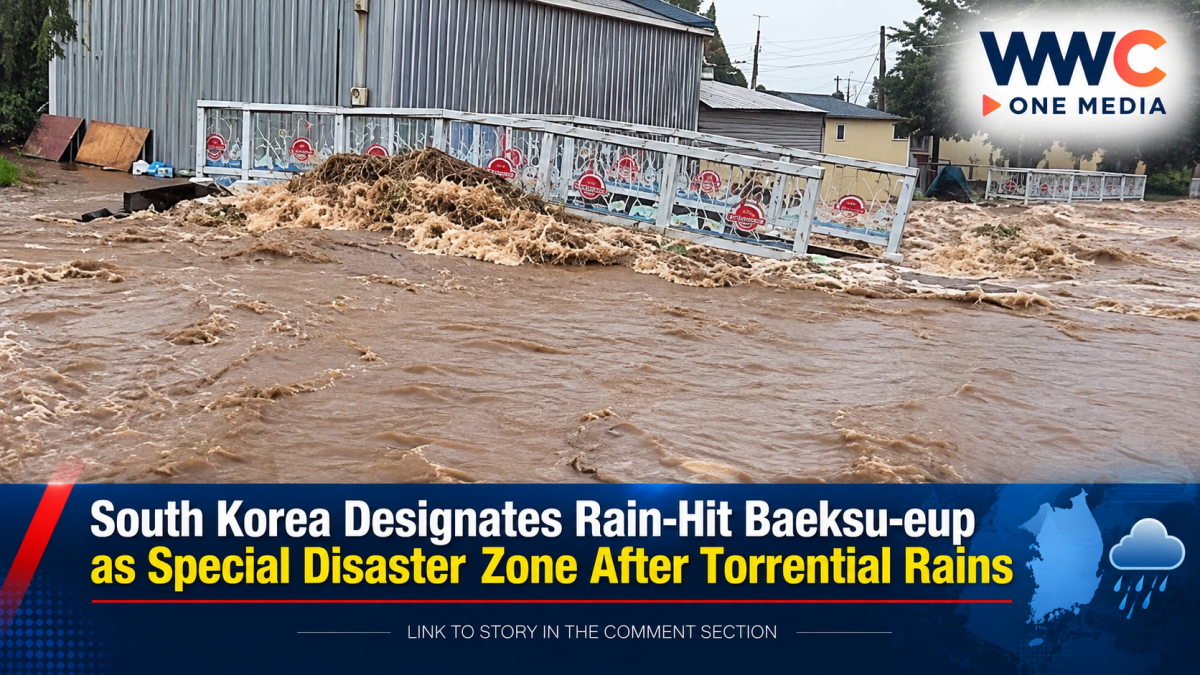
SEOUL — President Lee Jae Myung has designated Baeksu-eup in Yeonggwang County, in South Korea’s southwest, as a special disaster zone following extensive damage from torrential rain, opening the door to additional government assistance for recovery.
The designation was made Thursday night, September 17, after a central government assessment confirmed that the area met the requirements for special-disaster status, according to the presidential office and Yonhap News Agency.
The decision comes after heavy rainfall battered Yeonggwang and surrounding areas from August 28 through September 1, causing flooding and damage to homes, farmland, roads and waterways.
Baeksu-eup Hit by Severe August Rainfall
The rainfall caused significant disruption in Yeonggwang County.
Korean media reported that Yeonggwang recorded exceptionally heavy precipitation during the period. One report said the area received as much as 107.5 millimeters of rain in a single hour, while cumulative rainfall reached 579.5 millimeters during the affected period.
Yonhap also reported that a stream in Baeksu-eup overflowed during the heavy rainfall on August 31, illustrating the conditions that contributed to flooding in the area.
The flooding damaged residential areas and agricultural land, while roads and waterways also sustained damage.
What Special-Disaster Status Means
The designation is more than a symbolic declaration.
Under South Korea’s disaster-response system, a designated special disaster zone can receive additional national funding to help cover recovery costs that would otherwise place a larger burden on local governments.
Affected residents can also receive additional forms of indirect support, including:
- Deferrals of national and local tax payments
- Reductions or relief involving certain public-utility charges
- Disaster-related financial assistance
- Additional government support for recovery and reconstruction
These measures are intended to help both local authorities and affected households deal with the financial consequences of major disasters.
Government Moves Toward Reconstruction
Presidential spokesperson Kang Yu-jung said the government would move quickly to finalize recovery plans and work to help residents return to normal life.
The declaration followed a central joint damage assessment, which examined the scale of destruction and whether the affected area met the legal criteria for special-disaster designation.
The process is important because special-disaster status determines whether additional national-level financial assistance can be provided for restoration work.
Baeksu-eup Is the Latest Area to Receive Special Status
The designation follows other special-disaster declarations in South Korea this year after major weather-related damage.
Earlier in September, President Lee designated Tongyeong City in South Gyeongsang Province as a special disaster zone following heavy rainfall. Parts of Geoje and areas of Tongyeong had previously received similar designations.
The sequence of declarations highlights the government’s continuing response to severe weather events that have affected different parts of the country.
Focus Now Shifts From Damage Assessment to Recovery
With Baeksu-eup now officially designated, attention will shift toward rebuilding damaged infrastructure and assisting affected households.
Local and national authorities will need to coordinate the restoration of roads, waterways and other public facilities while addressing damage to homes and agricultural areas.
For residents whose livelihoods were disrupted by the flooding, the additional government assistance could help reduce some of the financial pressure created by the disaster.
The government has said it will finalize recovery plans as quickly as possible, with the stated goal of helping residents in Baeksu-eup resume normal life.
Why This Matters
The Baeksu-eup designation demonstrates how South Korea’s disaster-response system can escalate from emergency response to nationally supported reconstruction when damage reaches established thresholds.
For the residents of Yeonggwang County, however, the next phase will be measured less by the declaration itself than by how quickly damaged homes, infrastructure and livelihoods can be restored.
As recovery efforts begin, Baeksu-eup becomes another test of how quickly South Korea can translate emergency declarations into practical support for communities hit by increasingly disruptive extreme-weather events.
WWC ONE MEDIA G,A