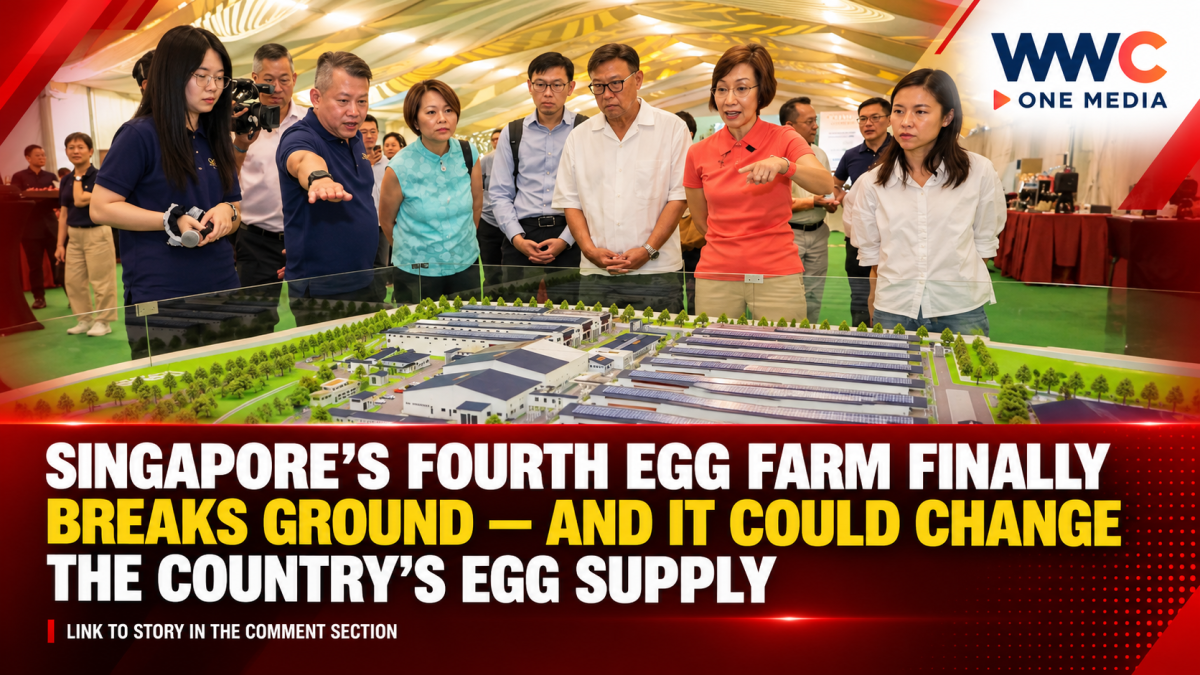
SINGAPORE — After years of delays, Singapore’s long-awaited fourth egg farm has finally broken ground, setting the stage for a major expansion of local egg production and the arrival of Japanese-grade eggs for consumers.
The S$110 million DoMo Farm, developed by ISE Foods Holdings, began construction in Lim Chu Kang on Sept. 29, 2026, with production now targeted for 2028. The project was originally expected to become operational in 2024.
When fully operational, the farm is expected to produce about 380 million eggs annually, with the company planning to eventually increase output beyond 500 million eggs a year.
Why the project was delayed
The four-year delay was linked to the need to redesign the project around stricter biosecurity requirements, while rising construction costs, supply-chain disruptions and economic uncertainty also affected development.
The original 10-hectare site was considered insufficient to meet the required biosecurity measures while maintaining the planned production capacity. The project subsequently secured a larger 15-hectare site, allowing operations to be consolidated into two locations instead of four.
Among the requirements are adequate spacing between egg-laying houses and separate routes for vehicles transporting clean materials such as feed and those carrying manure and other waste.
Japanese-grade eggs are part of the plan
DoMo Farm aims to produce Japanese-grade eggs, including eggs marketed for their deep-orange yolks and suitability for raw consumption under the appropriate safety standards.
The farm is also designed to reduce Singapore’s dependence on imported inputs over time. Its planned integrated system includes egg-laying facilities, a hatchery and breeder operations.
However, the hatchery and breeder facility will come later. During the farm’s initial phase, the hens producing its eggs will be sourced as day-old chicks from Malaysia, similar to Singapore’s existing egg farms.
AI robots will monitor the hens
One of the most eye-catching features of the new farm is its use of artificial intelligence and automation.
Each egg-laying house is planned to accommodate about 150,000 hens, while patrol robots equipped with AI-powered health-monitoring systems, heat sensors and cameras will continuously monitor the birds.
The technology is intended to identify potential health problems earlier and help limit disease spread.
The project will also include an automated egg warehouse, climate-controlled facilities, solar power and a manure-treatment system designed to turn waste into organic fertiliser.
A bigger role in Singapore’s food security
Singapore currently has three egg farms. In 2025, they produced more than 736 million eggs, while national consumption exceeded 2.2 million eggs per day, according to The Straits Times.
DoMo Farm’s planned output could significantly increase the share of eggs supplied locally. The company has said that once production eventually exceeds 500 million eggs annually, local farms could account for more than half of the eggs consumed based on 2025 consumption levels.
The broader goal is not simply to produce more eggs, but to strengthen Singapore’s resilience against disruptions affecting global food supplies.
For a country that imports most of its food, even events far beyond its borders can eventually affect what appears on supermarket shelves. That makes the new farm more than an agricultural project — it is also part of Singapore’s wider effort to strengthen domestic food security.
And after waiting years for construction to begin, the bigger question is now no longer whether Singapore’s fourth egg farm will be built — but how much it could change the country’s egg supply once production finally begins in 2028.
WWC ONE MEDIA G,A