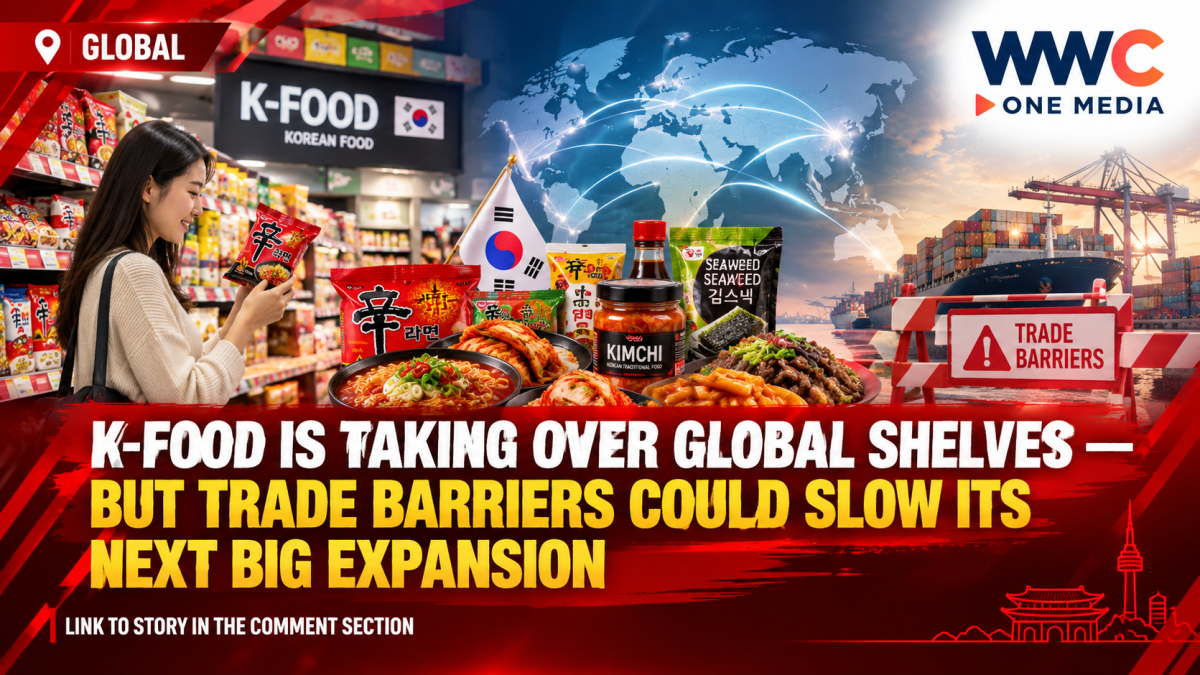
SEOUL — Korean food is winning more attention around the world, but the companies behind the global K-food boom are facing a growing obstacle: trade barriers that can make it harder and more expensive to enter overseas markets.
Park Jin-sun, chairman of the Korea Food Industry Association (KFIA), said Tuesday that Korean food manufacturers continue to encounter tariffs, customs requirements, certification rules and differing food regulations across international markets.
The warning comes as Korean food companies push deeper into global markets, with major exporters including CJ CheilJedang, Daesang, Otoki, Nongshim, Samyang Foods and Lotte Wellfood among KFIA’s more than 190 members.
K-Food’s global rise meets a complicated trade landscape
Park said the challenges extend beyond tariffs.
Companies are also dealing with supply-chain disruptions affecting imported ingredients and materials, while food-safety requirements, production technology standards, government subsidy eligibility and sustainability rules are adding to the complexity of overseas operations.
He also pointed to wider economic pressures, including higher global crude-oil prices, tighter naphtha supplies that can affect packaging operations and a weaker Korean won.
For food manufacturers trying to scale internationally, those pressures can add another layer of uncertainty to an already complicated export environment.
Industry group plans new support center
KFIA is preparing to launch a Food Firm Support Center next month, designed to help food companies deal with practical business problems.
The center will provide consultations by phone and online, as well as through on-site visits. Park said the organization intends to focus on problems companies encounter directly in overseas and domestic operations.
The industry group also plans to take a more active role in addressing trade barriers.
According to Park, some of the obstacles facing exporters can only be resolved through government-to-government discussions, increasing the importance of coordination between the food industry and policymakers.
Middle East crisis adds supply-chain pressure
Supply routes have also become a concern.
Since the onset of the Middle East crisis, Korean food companies and the government have been discussing alternative routes for ingredients, materials and product shipments, according to Park.
That reflects a broader challenge for food manufacturers: expanding internationally while keeping supplies moving through an increasingly complicated global logistics environment.
Africa and India emerge as potential growth markets
Despite the obstacles, KFIA sees significant opportunities outside traditional K-food markets.
Park identified Africa and India as promising destinations for Korean food companies, with Africa in particular described as having substantial export potential over the next decade.
A recent business-to-business event in Egypt involving 16 Korean food companies reportedly attracted stronger local interest than expected, according to Park.
That interest could give Korean food exporters another avenue for expansion as competition and trade challenges intensify in established markets.
The bigger question for K-food
K-food’s international popularity has opened doors for Korean manufacturers, but popularity alone does not guarantee easy access to overseas consumers.
Tariffs, certification requirements, customs procedures, supply-chain disruptions and different food regulations can all determine how efficiently Korean products move from factories to foreign shelves.
With KFIA preparing a new support center and seeking a more active role in addressing trade barriers, the next phase of K-food’s global expansion may depend not only on what Korean companies sell — but how easily they can get those products across borders.
WWC ONE MEDIA G,A